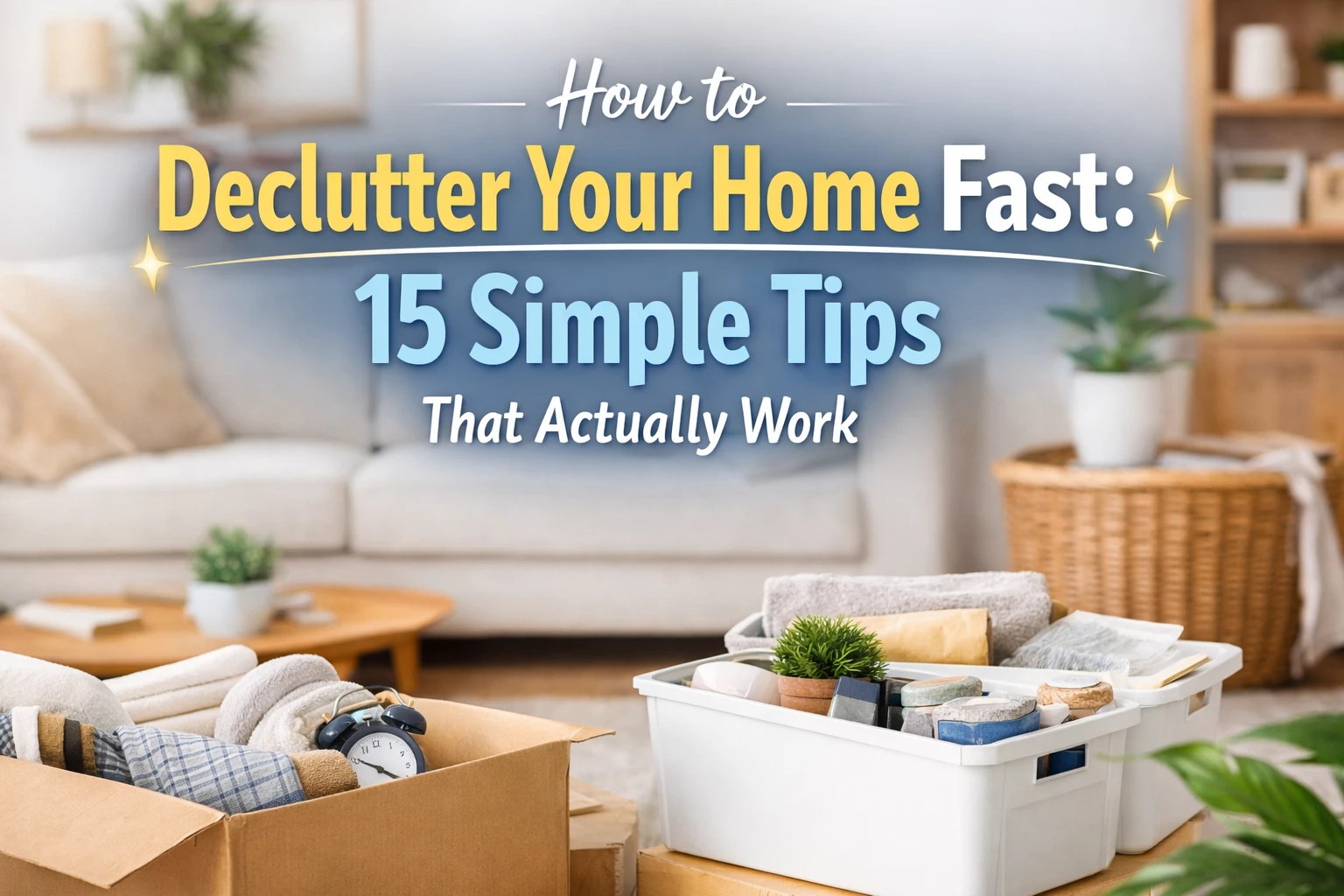
How to Declutter Your Home Fast: 15 Simple Tips That Actually Work

organized home with decluttered living room and storage boxes showing simple ways to declutter your home fast

Table of Contents

🟢 PART 1

How to Declutter Your Home and Reduce Stress: A Complete Step-by-Step Guide 🧺✨


Introduction: Why Your Home Feels Overwhelming (And How to Fix It) 🏡

Have you ever walked into your home and immediately felt… tired?

Not physically—but mentally.

  • You see things everywhere 😩
  • You don’t know where to start 🤯
  • You feel like there’s always something to clean

And even when you try to relax…

👉 Your mind doesn’t feel calm


🧠 That’s not just “mess”

👉 That’s clutter affecting your brain

Clutter is more than just physical stuff.

It creates:

  • Visual noise
  • Mental pressure
  • Constant low-level stress

📊 The Real Impact of Clutter (Most People Ignore This)

Here’s what clutter quietly does to your life:

AreaImpact
🧠 Mental HealthIncreases stress and anxiety
🎯 FocusReduces concentration
🏡 Home FeelingMakes space feel chaotic
💬 RelationshipsCauses tension and frustration
⏳ TimeWastes time looking for things

👉 This is why decluttering is not just cleaning.

👉 It’s a lifestyle upgrade


🌿 Why Decluttering Matters More Than Ever

In today’s world:

  • We own more things than ever
  • We consume constantly
  • We rarely reset our space

Your home should be:

✔ A place to relax
✔ A place to recharge
✔ A place to feel in control


But clutter turns it into:

❌ Another source of stress


👉 If your goal is to create a calm and supportive environment, decluttering is the first step.

You can go deeper into that here:

👉 https://loveahh.com/peaceful-home-environment/ 🌿


💡 The Truth About Decluttering (Most People Get This Wrong)

Let’s clear this up immediately.


❌ Decluttering is NOT:

  • Throwing everything away
  • Becoming a minimalist
  • Making your home “perfect”

✅ Decluttering IS:

  • Keeping what matters
  • Removing what drains you
  • Creating space for your life

👉 It’s about function, not perfection


🧠 Why Most People Fail at Decluttering

If you’ve tried before and failed…

👉 You’re not the problem


⚠️ The real issue is this:

👉 You didn’t have a system


Most people:

  • Clean randomly
  • Organize temporarily
  • Lose motivation quickly

Result?

👉 The clutter comes back


🔁 Why Clutter Always Comes Back

Let’s break it down clearly:

ProblemResult
No systemMess returns
No habitsInconsistency
Too many itemsOverload
Delayed decisionsPiles grow

👉 This is why decluttering must be system-based


🏡 Decluttering Is the Foundation of a Happy Home

A clean home is nice.

👉 But a structured home is life-changing


If you want to build a complete system beyond decluttering:

👉 https://loveahh.com/loving-and-happy-home-guide/ ❤️


🧠 Decluttering = Mental Clarity

When your space is clear:

👉 Your mind becomes clearer too


You’ll notice:

  • Less stress
  • Better focus
  • More calm

This is deeply connected with mindful living.

👉 https://loveahh.com/mindfulness-for-everyday-life/ 🧘


💬 Decluttering Also Improves Relationships

This part is often ignored.

But it matters more than you think.


Clutter creates:

  • Frustration
  • Arguments
  • Stress between people

A clean, organized space helps:

✔ Better communication
✔ Less tension
✔ More connection


👉 Improve that side here:

👉 https://loveahh.com/improve-communication-in-relationships/ 💬

👉 https://loveahh.com/building-emotional-intimacy/ ❤️


🧺 Where You Should Start (Most Important Step)

Here’s where most people go wrong:

👉 They try to do everything


❌ Wrong approach

  • Clean the whole house
  • Organize everything at once

✅ Right approach

👉 Start small


🎯 Your First Decluttering Action

Right now:

👉 Choose ONE area

  • A drawer
  • A table
  • A corner

Set a timer for:

👉 10 minutes ⏱️


That’s it.


🧠 Why Small Wins Matter

Small actions create:

  • Momentum
  • Motivation
  • Confidence

👉 This is how real change happens


🧺 Simple Decluttering Setup (No Overthinking)

You don’t need complicated tools.


📦 Use this simple system:

CategoryAction
KeepYou use it regularly
RemoveYou don’t need it
StoreRare but useful

👉 That’s all you need


🔗 Start with Easy Wins

If you don’t know where to begin:

👉 Start with your closet

It’s one of the easiest places to see results quickly.

👉 https://loveahh.com/how-to-organize-a-closet-2025-in-depth-guide/ 👕


🧠 The Decluttering Mindset Shift

Before moving forward, you need this:


❌ Old mindset

  • “I might need this someday”
  • “I’ll decide later”

✅ New mindset

👉 “Does this support my life right now?”


🔄 Decluttering Is Not a One-Time Task

You don’t “finish” decluttering.

👉 You build a system


And that system keeps your home:

  • Clean
  • Calm
  • Organized

🌱 Connect Decluttering with Daily Life

Decluttering works best when combined with:

  • Daily habits
  • Simple routines
  • Intentional living

👉 Build that here:

👉 https://loveahh.com/living-with-intention/ 🌱

👉 https://loveahh.com/self-care-at-home/ 🛁


📊 Decluttering vs Not Decluttering (Clear Comparison)

Without Decluttering ❌With Decluttering ✅
Constant stressCalm environment
Mess returnsEasy maintenance
Hard to focusClear mind
Time wastedTime saved
FrustrationControl

🧠 What You’ll Learn in This Guide

This is not just another blog post.

👉 This is a complete system


You’ll learn:

  • Types of clutter
  • Step-by-step decluttering method
  • How to organize your home
  • How to maintain it long-term
  • How to reduce stress permanently

🔄 Transition

Now you understand:

  • Why clutter affects your life
  • Why most people fail
  • Why systems matter

🟢 PART 2

Types of Clutter (And Why Your Home Keeps Getting Messy) 🧺🧠

Now that you understand how clutter affects your life, it’s time to go deeper.

Because here’s the truth most people don’t realize:

👉 Clutter is not just “stuff”

It’s a pattern.

And if you don’t understand that pattern, clutter will always come back—no matter how much you clean.


🧠 Why Identifying Clutter Types Changes Everything

Most people approach decluttering like this:

  • “I’ll clean everything today”
  • “I just need to organize better”

But that doesn’t work long-term.

👉 Because different clutter comes from different problems


💡 The Smarter Way to Declutter

Instead of treating clutter as one big issue:

👉 Break it into categories

Once you do that:

  • Decisions become easier
  • You feel less overwhelmed
  • Results last longer

📊 The 5 Types of Clutter (Quick Overview)

Clutter TypeWhat It Looks LikeRoot CauseLong-Term Fix
🧺 Physical ClutterToo many itemsOverconsumptionReduce + organize
❤️ Emotional ClutterSentimental itemsAttachmentLetting go mindset
🧠 Decision Clutter“I’ll decide later”AvoidanceInstant decisions
📱 Digital ClutterNotifications, appsOverloadBoundaries
⏳ Time ClutterNo time, chaosNo structureSimple routines

👉 Let’s break each one down.


🧺 1. Physical Clutter (The Most Obvious Problem)

This is the type everyone sees first.


📦 What It Looks Like
  • Clothes you never wear
  • Items you forgot you own
  • Surfaces covered in random things

🧠 The Real Cause

👉 Owning more than you need

Modern habits encourage:

  • Buying more
  • Keeping everything
  • Avoiding decisions

⚠️ Why It Creates Stress

Physical clutter leads to:

  • Visual overload
  • Mental fatigue
  • Constant distraction

💡 How to Fix It

👉 Reduce first, organize second


🔗 Start Here

👉 https://loveahh.com/how-to-organize-a-closet-2025-in-depth-guide/ 👕


🎯 Quick Action

Pick 5 items you haven’t used in 6 months.

👉 Remove them today


❤️ 2. Emotional Clutter (The Hardest One)

This is where most people get stuck.


🧠 What It Looks Like
  • Old gifts
  • Items from past relationships
  • Things you feel guilty throwing away

⚠️ The Hidden Truth

👉 You’re not keeping the item

👉 You’re holding onto the emotion


🧠 Why It’s So Powerful

Emotional clutter creates:

  • Mental weight
  • Resistance to change
  • Fear of letting go

💡 How to Deal with It
  • Keep what truly matters
  • Let go of guilt
  • Focus on your present life

🔗 Go Deeper

👉 https://loveahh.com/building-emotional-intimacy/ ❤️


🧠 Mindset Shift

Instead of asking:

❌ “What if I need this?”

Ask:

👉 “Does this support who I am today?”


🧠 3. Decision Clutter (The Hidden Energy Drain)

This is one of the biggest reasons clutter keeps coming back.


⚠️ What It Looks Like
  • “I’ll deal with it later”
  • Piles waiting for decisions
  • Half-finished organizing

🧠 Root Cause

👉 Decision fatigue

You make hundreds of decisions daily.

So at home:

👉 You avoid them


⚠️ Result
  • Things pile up
  • Clutter grows silently

💡 Solution

👉 Make faster decisions


📌 Simple Rule

👉 Touch it once → decide

  • Keep
  • Remove
  • Store

🔗 Build Better Systems

👉 https://loveahh.com/living-with-intention/ 🌱


📱 4. Digital Clutter (The Modern Stress Multiplier)

Even if your home is clean…

👉 Your mind can still feel messy


📱 What It Looks Like
  • Endless notifications
  • Too many apps
  • Constant scrolling

🧠 Why It Matters

Digital clutter creates:

  • Mental distraction
  • Lack of focus
  • Constant stimulation

⚠️ Result

👉 You never fully relax


💡 Solution
  • Turn off notifications
  • Create phone-free time
  • Simplify digital space

🔗 Improve Mental Clarity

👉 https://loveahh.com/mindfulness-for-everyday-life/ 🧘


⏳ 5. Time Clutter (The Root Problem)

This is the one most people ignore.

But it controls everything.


🧠 What It Looks Like
  • Always busy
  • No time to clean
  • No structure

⚠️ Result
  • Tasks pile up
  • Stress increases
  • Home becomes chaotic

💡 Solution

👉 Create simple routines


🔗 Start Here

👉 https://loveahh.com/self-care-at-home/ 🛁


🧠 The Real Insight (This Changes Everything)

Most people think:

👉 “I just need to clean more”


But the truth is:

👉 You need to fix the system


📊 How Clutter Types Connect

CauseEffect
No routineTime clutter
Time clutterPhysical clutter
Physical clutterMental stress
StressAvoidance
AvoidanceMore clutter

👉 This creates a loop.


🔁 How to Break the Clutter Cycle

Instead of trying to fix everything:

👉 Focus on ONE type first


🎯 Best Starting Point

👉 Physical clutter

Because:

  • Easy to see
  • Easy to act on
  • Fast results

🚀 Your Simple Decluttering Plan


🧺 Step 1

Pick one small area


⏱️ Step 2

Set a 10-minute timer


🧠 Step 3

Apply the rule:

👉 Keep / Remove / Store


🔁 Step 4

Repeat daily


🔗 Build a Complete Home System

Decluttering is just the beginning.

To create lasting change:

👉 https://loveahh.com/peaceful-home-environment/ 🌿

👉 https://loveahh.com/loving-and-happy-home-guide/ ❤️


🧠 Key Takeaways

  • Not all clutter is the same
  • Emotional clutter is the hardest
  • Decision clutter causes relapse
  • Systems matter more than motivation

🔄 Transition

Now you understand:

  • The 5 types of clutter
  • Why they exist
  • How they affect your home

🟢 PART 3

A Step-by-Step Decluttering System That Actually Works 🧺✨

Now you understand:

  • Why clutter affects your life
  • The different types of clutter
  • Why it keeps coming back

👉 Now it’s time for the most important part:

How to declutter your home step by step (without feeling overwhelmed)


🧠 Why You Need a System (Not Motivation)

Let’s be real.

Motivation doesn’t last.

👉 Systems do


Most people:

  • Clean when they feel like it
  • Stop when they get tired
  • Start again weeks later

👉 That’s why nothing changes


💡 What Makes This System Different

This system is designed to be:

✔ Simple
✔ Repeatable
✔ Sustainable


👉 You don’t need hours

👉 You need structure


🧺 The 5-Step Decluttering System


📊 Overview Table

StepWhat You DoGoal
Step 1Choose a small areaAvoid overwhelm
Step 2Set a time limitStay focused
Step 3Sort itemsMake decisions
Step 4Organize simplyCreate structure
Step 5Maintain dailyPrevent clutter

👉 Let’s break it down.


🟢 Step 1: Start Small (The Most Important Rule) 🎯

This is where most people fail.


❌ Wrong Way
  • Declutter entire house
  • Clean everything at once

✅ Right Way

👉 Start with ONE small area


📍 Examples
  • A drawer
  • A shelf
  • A small corner

🧠 Why This Works

Small tasks:

  • Reduce overwhelm
  • Increase completion
  • Build momentum

🔗 Easy Starting Point

👉 https://loveahh.com/how-to-organize-a-closet-2025-in-depth-guide/ 👕

Closets are perfect because:

  • High impact
  • Easy to see progress

🟢 Step 2: Use the 10-Minute Rule ⏱️

You don’t need hours.

👉 You need consistency


💡 Rule

👉 Set a timer for 10 minutes


🧠 Why It Works
  • Removes pressure
  • Keeps you focused
  • Easy to repeat daily

📊 Comparison
ApproachResult
2-hour cleaningBurnout
10-minute dailyLong-term success

👉 Small effort → Big results


🟢 Step 3: Use the 3-Category Method 🧺

Now you start sorting.


📦 Your 3 Categories
CategoryMeaning
KeepYou use it regularly
RemoveYou don’t need it
StoreRare but useful

👉 That’s it.

No complicated systems.


⚠️ Important Rule

👉 Every item MUST go into one category


🧠 Avoid This Mistake

❌ “I’ll decide later”


👉 That creates clutter again


💡 Better Question

👉 “Does this support my life right now?”


🟢 Step 4: Organize Simply (Don’t Overcomplicate) 📦

Most people make this mistake:

👉 They over-organize


❌ Wrong Way
  • Buying too many storage boxes
  • Creating complex systems

✅ Right Way

👉 Keep it simple


📊 Simple Organization Rules
RuleWhy It Works
Keep similar items togetherEasy access
Use visible storageReduces forgetting
Give everything a “home”Prevents clutter

👉 Organization should make life easier, not harder


🟢 Step 5: Build a Daily Reset Habit 🔄

This is what keeps your home clean forever.


💡 The 10-Minute Reset

Every day:

👉 Spend 10 minutes resetting your space


📍 What to do
  • Put items back
  • Clear surfaces
  • Reset small areas

🧠 Why This Works
  • Prevents buildup
  • Maintains order
  • Reduces stress

🔗 Build Better Habits

👉 https://loveahh.com/self-care-at-home/ 🛁


🧠 The Real Secret: Consistency Over Perfection

You don’t need perfect days.

👉 You need consistent days


📊 Reality Check

PerfectionConsistency
RareDaily
StressfulEasy
UnsustainableLong-term

👉 Choose consistency


🚀 A Realistic 7-Day Declutter Plan

Let’s make this practical.


📅 Example Plan

DayFocus Area
Day 1Closet
Day 2Desk
Day 3Kitchen drawer
Day 4Bathroom
Day 5Living room
Day 6Entry area
Day 7Reset + review

👉 10 minutes each day


🧠 What Happens After 7 Days

You’ll notice:

  • Less stress
  • More space
  • More control

👉 That’s momentum


🔗 Connect to Bigger System

Decluttering is step one.

To build a full lifestyle:

👉 https://loveahh.com/peaceful-home-environment/ 🌿

👉 https://loveahh.com/loving-and-happy-home-guide/ ❤️


⚠️ Common Mistakes (Avoid These)


❌ Mistake 1: Doing Too Much

👉 Leads to burnout


❌ Mistake 2: Keeping “Just in Case” Items

👉 Creates clutter again


❌ Mistake 3: No Maintenance

👉 Mess always returns


🧠 Key Takeaways

  • Start small
  • Use a simple system
  • Decide quickly
  • Stay consistent

🔄 Transition

Now you know:

✔ How to declutter step by step
✔ How to organize
✔ How to maintain


🟢 PART 4

15 Simple Decluttering Habits to Keep Your Home Clean Effortlessly 🧺✨

Now that you have a system in place, the next step is even more important:

👉 Building habits that keep your home clutter-free automatically

Because here’s the truth:

👉 You don’t stay organized by cleaning more
👉 You stay organized by changing your daily behavior


🧠 Why Habits Matter More Than Cleaning

Cleaning is temporary.

👉 Habits are permanent


Without habits:

  • Clutter comes back
  • Mess builds up
  • Stress returns

With the right habits:

✔ Your home stays clean
✔ Your mind stays calm
✔ Your life feels easier


📊 Quick Overview (All 15 Habits)

#HabitImpact
1One In, One OutControls accumulation
210-Minute ResetPrevents buildup
3Touch It OnceReduces decision clutter
4Daily Surface ClearKeeps space clean
5Declutter WeeklyMaintains order
6Keep Only EssentialsReduces overload
7Create “Home” for ItemsPrevents mess
8Limit Storage SpaceForces decisions
9Declutter Before BuyingStops accumulation
10No “Just in Case”Eliminates clutter
11Simplify RoutinesReduces chaos
12Digital Detox TimeClears mental clutter
13Reset Before BedImproves next day
14Weekly ReviewKeeps system working
15Live IntentionallyLong-term control

👉 Let’s break them down.


🟢 1. One In, One Out Rule 📦

Every time you bring something new in:

👉 Remove one item


💡 Why It Works
  • Prevents accumulation
  • Keeps balance

🟢 2. The 10-Minute Daily Reset ⏱️

Every day:

👉 Spend 10 minutes resetting your space


📍 What to do
  • Put things back
  • Clear surfaces
  • Reset small areas

👉 This connects with building routines:

👉 https://loveahh.com/self-care-at-home/ 🛁


🟢 3. Touch It Once Rule 🧠

When you pick something up:

👉 Decide immediately


❌ Avoid
  • Moving things around
  • Delaying decisions

✅ Do
  • Keep
  • Remove
  • Store

🟢 4. Clear Surfaces Daily 🧼

Surfaces create visual stress.


💡 Rule

👉 Keep surfaces mostly empty


📍 Focus Areas
  • Tables
  • Kitchen counters
  • Desks

🟢 5. Weekly Declutter Routine 🔄

Once a week:

👉 Spend 20–30 minutes decluttering


🧠 Why It Works
  • Prevents buildup
  • Keeps system running

🟢 6. Keep Only What You Use 🎯

If you don’t use it:

👉 You probably don’t need it


💡 Ask Yourself

👉 “Have I used this in the last 6 months?”


🟢 7. Give Everything a “Home” 🏡

Every item should have a place.


🧠 Why It Matters
  • Reduces mess
  • Saves time

🔗 Improve Organization

👉 https://loveahh.com/how-to-organize-a-closet-2025-in-depth-guide/ 👕


🟢 8. Limit Storage Space 📦

More storage = more clutter


💡 Strategy

👉 Set limits


Example:

  • One drawer per category
  • One shelf per item type

🟢 9. Declutter Before You Buy 🛒

Before buying anything:

👉 Remove something similar


🧠 This prevents:
  • Overconsumption
  • Future clutter

🟢 10. Eliminate “Just in Case” Thinking 🚫

This is one of the biggest clutter causes.


❌ Thinking

👉 “I might need this someday”


✅ Replace with

👉 “I can replace it if needed”


🟢 11. Simplify Your Daily Routine 🌿

Too many tasks = chaos


💡 Solution

👉 Simplify your day


🔗 Learn More

👉 https://loveahh.com/living-with-intention/ 🌱


🟢 12. Reduce Digital Clutter 📱

Your mind matters too.


💡 Actions
  • Turn off notifications
  • Limit apps
  • Create no-phone time

🔗 Improve Focus

👉 https://loveahh.com/mindfulness-for-everyday-life/ 🧘


🟢 13. Reset Your Home Before Bed 🌙

Before sleeping:

👉 Spend 5–10 minutes resetting


🧠 Benefit
  • Calm mind
  • Better mornings

🟢 14. Weekly Home Check-In 📋

Ask yourself:

  • What’s messy?
  • What needs adjustment?

👉 Small fixes prevent big problems


🟢 15. Live With Intention 🌱

This is the foundation.


💡 Principle

👉 Be intentional with what you own


🔗 Deepen This

👉 https://loveahh.com/loving-and-happy-home-guide/ ❤️


🧠 The Real Secret (This Changes Everything)

Decluttering is not about:

👉 Cleaning your home


👉 It’s about:

Changing how you live every day


📊 Habits vs No Habits

Without Habits ❌With Habits ✅
Mess returnsHome stays clean
Stress buildsCalm environment
Constant effortEasy maintenance
No controlFull control

🔄 Transition

Now you have:

✔ A system
✔ 15 powerful habits


🟢 PART 5

Why Clutter Keeps Coming Back (And How to Stop It for Good) 🔄🧠

You’ve cleaned before.

You’ve organized.

Maybe your home even looked perfect—for a while.


And then…

👉 The clutter came back


🧠 Let’s Be Honest

This is where most people feel frustrated.

They think:

  • “I’m just not organized”
  • “I don’t have discipline”

👉 That’s not true


💡 The Real Reason

👉 Clutter comes back because the system is broken

Not because you are.


🧠 The Core Problem: No Maintenance System

Cleaning is temporary.

👉 Systems are permanent


If your home depends on:

  • Motivation
  • Free time
  • Energy

👉 It will fail


📊 Why Traditional Decluttering Fails

ApproachResult
Clean occasionallyMess returns
Organize randomlyNo consistency
Rely on motivationBurnout
Ignore habitsClutter builds

👉 This is why most people stay stuck


🔁 The Clutter Cycle (Understand This Clearly)

Most homes follow this pattern:


📊 The Clutter Loop

StepWhat Happens
1Things accumulate
2You ignore it
3It becomes overwhelming
4You clean everything
5You get tired
6You stop maintaining
7Clutter returns

👉 And the cycle repeats


⚠️ The Hidden Triggers of Clutter

Let’s break down what actually causes clutter to come back.


🧠 1. You Own Too Much Stuff 📦

This is the biggest reason.


⚠️ Problem
  • Too many items
  • Not enough space
  • Constant overflow

💡 Fix

👉 Reduce first, organize second


🔗 Start Here

👉 https://loveahh.com/how-to-organize-a-closet-2025-in-depth-guide/ 👕


🧠 2. No Daily Reset Habit 🔄

Without maintenance:

👉 Mess builds up quickly


⚠️ Problem
  • Things don’t get put back
  • Small mess becomes big mess

💡 Fix

👉 Daily 10-minute reset


🔗 Build Habit

👉 https://loveahh.com/self-care-at-home/ 🛁


🧠 3. Delayed Decisions (Decision Clutter) 🧠

This one is subtle—but powerful.


⚠️ Problem
  • “I’ll deal with it later”
  • Items pile up

💡 Fix

👉 Decide immediately


📌 Rule

👉 Touch it once


🧠 4. Lack of Structure ⏳

No system = chaos


⚠️ Problem
  • No routine
  • No organization
  • No plan

💡 Fix

👉 Simple daily and weekly routines


🔗 Learn Structure

👉 https://loveahh.com/living-with-intention/ 🌱


🧠 5. Emotional Attachment ❤️

You keep things you don’t need.


⚠️ Problem
  • Guilt
  • Memories
  • Fear of letting go

💡 Fix

👉 Keep meaning, not everything


🔗 Go Deeper

👉 https://loveahh.com/building-emotional-intimacy/ ❤️


🧠 6. No Clear “Home” for Items 🏡

If things don’t have a place:

👉 They create clutter


💡 Fix

👉 Give every item a “home”


🧠 7. Overcomplicated Systems 📦

Too many storage methods = confusion


⚠️ Problem
  • Hard to maintain
  • Takes too much effort

💡 Fix

👉 Keep systems simple


📊 Summary of Clutter Triggers

TriggerResultFix
Too many itemsOverflowReduce
No habitsMess buildsDaily reset
Delayed decisionsPiles growDecide fast
No structureChaosSimple routines
Emotional attachmentCan’t let goMindset shift
No storage systemMess spreadsAssign places
OvercomplicationBurnoutSimplify

🔄 The Real Solution: Build a Sustainable System

You don’t need:

❌ More motivation
❌ More cleaning


👉 You need:

✔ Fewer items
✔ Better habits
✔ Simple systems


🧠 The 3-Layer Declutter System

This is how you make it permanent.


📊 System Breakdown

LayerFocusGoal
Layer 1DeclutterRemove excess
Layer 2OrganizeCreate structure
Layer 3MaintainKeep it clean

👉 Miss one → system fails


🟢 Layer 1: Declutter (Remove the Problem)

👉 Get rid of what you don’t need


🟢 Layer 2: Organize (Create Order)

👉 Make your home functional


🔗 Improve Environment

👉 https://loveahh.com/peaceful-home-environment/ 🌿


🟢 Layer 3: Maintain (Keep It That Way)

👉 Daily habits


🔗 Build System

👉 https://loveahh.com/loving-and-happy-home-guide/ ❤️


🧠 The Key Mindset Shift

Most people think:

👉 “I need to clean more”


👉 But the truth is:

You need to maintain better


📊 Cleaning vs System Thinking

Cleaning Mindset ❌System Mindset ✅
ReactiveProactive
TemporaryLong-term
StressfulEasy
RepetitiveStable

🚀 Your New Approach (Simple Plan)


🧺 Daily

👉 10-minute reset


📅 Weekly

👉 Light declutter


📆 Monthly

👉 Deep reset


🧠 What Happens When You Fix the System

You’ll notice:

  • Less stress
  • More control
  • More time
  • A calmer home

👉 This is where real change happens


🔄 Transition

Now you understand:

✔ Why clutter comes back
✔ What causes it
✔ How to fix it permanently


🟢 PART 6

How Decluttering Improves Your Mental Health and Quality of Life 🧠🌿

At this point, you’ve learned:

  • How to declutter step by step
  • How to build habits
  • How to stop clutter from coming back

But here’s something even more important:

👉 Decluttering doesn’t just change your home

👉 It changes your mind


Most people think clutter is just physical.

But research and real-life experience show something deeper:

👉 Your environment directly affects your mental state


When your space is cluttered, your brain experiences:

  • Constant stimulation
  • Too much visual input
  • Unfinished “tasks” everywhere

👉 This creates mental pressure—even if you don’t notice it


📊 Clutter vs Mental State

EnvironmentMental Effect
Cluttered home ❌Stress, anxiety, distraction
Organized home ✅Calm, clarity, control

👉 This is why decluttering feels so powerful


😩 1. Clutter Increases Stress and Anxiety

Let’s start with the biggest impact.


🧠 What Happens in Your Brain

When your home is messy:

  • Your brain keeps scanning the environment
  • It registers “unfinished tasks”
  • It increases cortisol (stress hormone)

👉 Even if you’re resting, your brain isn’t


⚠️ Result

  • You feel overwhelmed
  • You feel tired without doing much
  • You struggle to relax

💡 Solution

👉 Reduce visual noise


🔗 Create Calm

👉 https://loveahh.com/peaceful-home-environment/ 🌿


🧠 2. Clutter Reduces Focus and Productivity 🎯

Ever tried to work in a messy room?


⚠️ Problem

  • Your attention is divided
  • You get distracted easily
  • You lose focus quickly

🧠 Why This Happens

Your brain processes everything it sees.

👉 More items = more distractions


💡 Result After Decluttering

  • Clear mind
  • Better concentration
  • Higher productivity

🔗 Improve Focus

👉 https://loveahh.com/mindfulness-for-everyday-life/ 🧘


😴 3. Clutter Affects Your Sleep Quality 🌙

This one surprises people.


⚠️ Problem

A cluttered bedroom creates:

  • Mental restlessness
  • Difficulty relaxing
  • Poor sleep quality

🧠 Why

Your brain associates your environment with stress.


💡 Solution

👉 Keep your bedroom simple and calm


📊 Before vs After

Before ❌After ✅
Messy spaceClean space
Racing thoughtsCalm mind
Poor sleepBetter rest


😤 4. Clutter Creates Emotional Pressure ❤️

Clutter is not just physical.

👉 It carries emotional weight


⚠️ Examples

  • Old items from the past
  • Things you feel guilty keeping
  • Objects tied to memories

🧠 Result

  • Emotional heaviness
  • Difficulty moving forward
  • Mental fatigue

💡 Solution

👉 Let go of what no longer serves you


🔗 Emotional Growth

👉 https://loveahh.com/building-emotional-intimacy/ ❤️


💬 5. Clutter Impacts Relationships

This is often overlooked—but very real.


⚠️ Problem

Clutter leads to:

  • Arguments
  • Frustration
  • Blame

🧠 Why

A messy space creates stress—and stress affects how people communicate.


💡 Result After Decluttering

  • More calm interactions
  • Better communication
  • Less tension

🔗 Improve Communication

👉 https://loveahh.com/improve-communication-in-relationships/ 💬


🧠 6. Clutter Creates Decision Fatigue

Every item is a decision.


⚠️ Problem

  • Too many choices
  • Too many “later” decisions
  • Mental exhaustion

🧠 Result

  • Reduced energy
  • Avoidance behavior
  • Procrastination

💡 Solution

👉 Simplify your environment


🌿 7. Decluttering Increases Sense of Control

When your home is organized:

👉 You feel more in control of your life


💡 Why This Matters

Control reduces:

  • Anxiety
  • Stress
  • Overwhelm

📊 Comparison

Cluttered Life ❌Organized Life ✅
ReactiveProactive
ChaoticStructured
StressfulCalm


🧘 8. Decluttering Supports Mindful Living

A clear space helps you:

  • Be present
  • Slow down
  • Enjoy your environment

💡 This leads to:

  • Better emotional balance
  • More awareness
  • Less stress

🔗 Go Deeper

👉 https://loveahh.com/living-with-intention/ 🌱


🛁 9. Decluttering Supports Self-Care

Your environment affects how you treat yourself.


⚠️ Problem

A messy space makes:

  • Self-care harder
  • Relaxation difficult

💡 Solution

👉 Create a clean, supportive environment


🔗 Build Self-Care

👉 https://loveahh.com/self-care-at-home/ 🛁


📊 Summary: How Decluttering Changes Your Life

AreaBefore ❌After ✅
StressHighLow
FocusPoorClear
SleepDisruptedRestful
EmotionsHeavyLight
RelationshipsTenseCalm
ProductivityLowHigh

🧠 The Big Realization

Decluttering is not about:

👉 Cleaning your home


👉 It’s about:

Creating a better life environment


🌱 Small Changes, Big Impact

You don’t need to change everything today.


👉 Start with:

  • One space
  • One habit
  • One decision


🔄 Transition

Now you understand:

✔ How decluttering affects your mental health
✔ Why it improves your life
✔ Why it’s more than just cleaning


🟢 PART 7

15 Common Decluttering Mistakes (And How to Avoid Them) ⚠️🧺

You’ve learned:

  • A complete decluttering system
  • Powerful daily habits
  • How to maintain a clutter-free home

But here’s something important:

👉 Even with the right system, many people still fail


🧠 Why?

👉 Because of hidden mistakes


These mistakes:

  • Slow your progress
  • Create frustration
  • Cause clutter to come back

👉 Let’s fix them.


📊 Quick Overview (All Mistakes)

#MistakeResult
1Doing too much at onceBurnout
2Not having a systemClutter returns
3Keeping “just in case” itemsOverload
4Delaying decisionsPiles grow
5Over-organizingComplexity
6Ignoring habitsNo consistency
7Emotional attachmentCan’t let go
8No daily resetMess builds
9Buying before declutteringMore clutter
10No storage structureChaos
11Trying to be perfectFrustration
12Not involving othersConflict
13Ignoring digital clutterMental stress
14No long-term planTemporary results
15Lack of intentionRepeating cycle

🟢 1. Doing Too Much at Once 😵


❌ Problem
  • Trying to declutter entire house
  • Spending hours cleaning

⚠️ Result

👉 Burnout + giving up


✅ Fix

👉 Start small


🔗 Practical Start

👉 https://loveahh.com/how-to-organize-a-closet-2025-in-depth-guide/ 👕


🟢 2. Not Having a System 🧠


❌ Problem
  • Random cleaning
  • No structure

⚠️ Result

👉 Clutter always comes back


✅ Fix

👉 Follow a step-by-step system (Part 3)


🟢 3. Keeping “Just in Case” Items 📦


❌ Problem

👉 “I might need this someday”


⚠️ Result
  • Overflow
  • Wasted space

✅ Fix

👉 Keep what you actually use


🟢 4. Delaying Decisions ⏳


❌ Problem
  • “I’ll decide later”

⚠️ Result

👉 Piles of clutter


✅ Fix

👉 Touch it once → decide


🟢 5. Over-Organizing 📦


❌ Problem
  • Too many boxes
  • Complicated systems

⚠️ Result

👉 Hard to maintain


✅ Fix

👉 Keep it simple


🔗 Simplify Life

👉 https://loveahh.com/living-with-intention/ 🌱


🟢 6. Ignoring Daily Habits 🔄


❌ Problem
  • No maintenance

⚠️ Result

👉 Mess returns quickly


✅ Fix

👉 Daily 10-minute reset


🔗 Build Routine

👉 https://loveahh.com/self-care-at-home/ 🛁


🟢 7. Emotional Attachment ❤️


❌ Problem
  • Keeping items for memories

⚠️ Result

👉 Emotional clutter


✅ Fix

👉 Keep meaning, not everything


🔗 Emotional Growth

👉 https://loveahh.com/building-emotional-intimacy/ ❤️


🟢 8. No Daily Reset Habit 🧺


❌ Problem
  • Items not returned

⚠️ Result

👉 Small mess becomes big mess


✅ Fix

👉 Reset daily


🟢 9. Buying Before Decluttering 🛒


❌ Problem
  • Adding before removing

⚠️ Result

👉 More clutter


✅ Fix

👉 Declutter first


🟢 10. No Clear Storage System 🏡


❌ Problem
  • Items don’t have a place

⚠️ Result

👉 Mess spreads


✅ Fix

👉 Give everything a “home”


🔗 Improve Space

👉 https://loveahh.com/peaceful-home-environment/ 🌿


🟢 11. Trying to Be Perfect 🎯


❌ Problem
  • Unrealistic expectations

⚠️ Result

👉 Frustration + quitting


✅ Fix

👉 Focus on progress


🟢 12. Not Involving Household Members 👨‍👩‍👧


❌ Problem
  • Only one person organizes

⚠️ Result

👉 Conflict + inconsistency


✅ Fix

👉 Communicate clearly


🔗 Improve Communication

👉 https://loveahh.com/improve-communication-in-relationships/ 💬


🟢 13. Ignoring Digital Clutter 📱


❌ Problem
  • Too many notifications

⚠️ Result

👉 Mental overload


✅ Fix

👉 Simplify digital space


🔗 Improve Focus

👉 https://loveahh.com/mindfulness-for-everyday-life/ 🧘


🟢 14. No Long-Term Plan 📅


❌ Problem
  • One-time declutter

⚠️ Result

👉 Temporary results


✅ Fix

👉 Build habits + routines


🟢 15. Living Without Intention 🌱


❌ Problem
  • Buying without thinking
  • Keeping everything

⚠️ Result

👉 Constant clutter cycle


✅ Fix

👉 Live intentionally


🔗 Deepen This

👉 https://loveahh.com/loving-and-happy-home-guide/ ❤️


🧠 The Real Lesson (Most Important)

Decluttering success is not about:

👉 Working harder


👉 It’s about:

Avoiding the mistakes that keep you stuck


📊 Mistakes vs Smart Approach

Mistake ❌Smart Approach ✅
Do everythingStart small
No systemFollow steps
Keep everythingKeep essentials
Delay decisionsDecide fast
No habitsDaily reset

🧠 Final Insight

Most people don’t fail because they’re lazy.

👉 They fail because they repeat the same patterns


👉 Once you fix the patterns:

Decluttering becomes easy


🔄 Transition

Now you understand:

✔ The biggest decluttering mistakes
✔ How to avoid them
✔ What actually works long-term


🟢 PART 8

Final Thoughts: Build a Clutter-Free Home That Lasts 🏡✨

You made it.

Not just through this guide—but through a complete shift in how you think about your home.


At this point, you understand:

✔ Why clutter happens
✔ How to declutter step by step
✔ How to build habits
✔ How to avoid common mistakes
✔ How clutter affects your mental health


But here’s the most important truth:

👉 A clean home is not the goal


👉 The real goal is:

A home that supports your life


🧠 What a Clutter-Free Home Really Gives You

Decluttering is not about having less.

👉 It’s about making space for what matters


When your home is clear, you create space for:

  • Calm thinking 🧘
  • Better relationships ❤️
  • More focus 🎯
  • Higher energy ⚡
  • A better daily life 🌿

📊 Life Before vs After Decluttering

Before ❌After ✅
Constant messClean & organized
Stress & overwhelmCalm & clarity
No controlStructured life
Low energyMore freedom

👉 This is not just about your home.

👉 It’s about your lifestyle.


🔁 The Long-Term System (Keep It Simple)

If you remember nothing else, remember this:


🧺 Your 3-Step Life System


1. Declutter Regularly

👉 Remove what you don’t need


2. Organize Simply

👉 Make your home easy to use


3. Maintain Daily

👉 Small habits → long-term results


📊 Simple System Table

ActionFrequency
DeclutterWeekly
OrganizeAs needed
ResetDaily (10 min)

👉 That’s all you need


🧠 The Biggest Mindset Shift

Most people think:

👉 “I need more time to clean”


👉 But the truth is:

You need fewer things to manage


Less stuff =

  • Less stress
  • Less cleaning
  • Less decision fatigue

🌱 Start Small (Your First Step Today)

Don’t wait for the perfect time.

👉 Start now


🎯 Simple Action Plan

Pick ONE:

  • Declutter a drawer
  • Clean a small space
  • Remove 5 items

👉 That’s enough to begin


🔗 Continue Your Transformation

Decluttering is just one part of a better home.

To go further, explore:


👉 Create a calm and balanced space:
https://loveahh.com/peaceful-home-environment/ 🌿


👉 Build a happy and supportive home:
https://loveahh.com/loving-and-happy-home-guide/ ❤️


👉 Improve your daily habits and routines:
https://loveahh.com/self-care-at-home/ 🛁


👉 Simplify your lifestyle and mindset:
https://loveahh.com/living-with-intention/ 🌱


👉 Improve focus and mental clarity:
https://loveahh.com/mindfulness-for-everyday-life/ 🧘


👉 Strengthen relationships at home:
https://loveahh.com/improve-communication-in-relationships/ 💬


🚀 Your Next Level (Important)

If you truly want to transform your home:

👉 Don’t just read

👉 Take action


Because reading creates ideas.

👉 Action creates results


🧠 Final Reminder

You don’t need:

❌ A perfect home
❌ A big house
❌ A complete life reset


👉 You need:

✔ Small steps
✔ Simple habits
✔ Consistency


✨ Final Thought

Your home should not drain your energy

👉 It should restore it


And the best part?

👉 You are now fully equipped to create that


❓ What is the fastest way to declutter your home?

The fastest way to declutter your home is to start with a small area and use the 3-category method: keep, remove, or store. Set a 10-minute timer and focus on quick decisions. This approach helps reduce overwhelm and creates immediate progress.


❓ How do I start decluttering when I feel overwhelmed?

Start with one small space, such as a drawer or shelf, instead of the entire house. Use a simple system and focus on completing one task at a time. Small wins build momentum and make decluttering feel manageable.


❓ What should I declutter first?

You should start with high-impact, low-emotional areas like closets, desks, or kitchen drawers. These spaces are easier to manage and give quick visible results, which helps build motivation.

👉 You can begin here:
https://loveahh.com/how-to-organize-a-closet-2025-in-depth-guide/


❓ How often should I declutter my home?

You should declutter lightly every week and do a deeper reset once a month. Daily 10-minute resets help maintain a clutter-free home and prevent mess from building up again.


❓ Why does clutter keep coming back?

Clutter comes back because of a lack of systems, habits, and clear organization. Without daily maintenance and simple routines, items slowly accumulate again.

👉 Learn how to fix this:
https://loveahh.com/loving-and-happy-home-guide/


❓ How do I get rid of clutter permanently?

To get rid of clutter permanently, you need three things: fewer items, simple organization systems, and consistent daily habits. Decluttering once is not enough—maintenance is key.


❓ What are the best decluttering methods?

Some of the most effective decluttering methods include:

  • The 3-category method (keep, remove, store)
  • The 10-minute daily reset
  • The one-in-one-out rule
  • The “touch it once” rule

These methods are simple, practical, and easy to maintain.


❓ How does decluttering affect mental health?

Decluttering reduces stress, improves focus, and creates a sense of control. A clean and organized environment helps your mind feel calmer and more relaxed.

👉 Improve your environment:
https://loveahh.com/peaceful-home-environment/


❓ How do I stay motivated to declutter?

Focus on small, consistent actions instead of big changes. Set a timer for 10 minutes a day and track your progress. Seeing results, even small ones, helps maintain motivation.


❓ What is the 10-minute decluttering rule?

The 10-minute decluttering rule means setting a timer for 10 minutes each day to clean or organize a small area. This method is effective because it is simple, sustainable, and easy to maintain long-term.


❓ How do I declutter my home with a busy schedule?

Use short, focused sessions like the 10-minute rule and prioritize high-impact areas. Build decluttering into your daily routine instead of waiting for free time.


❓ What should I do with items I don’t need?

You can donate, recycle, sell, or discard items depending on their condition. The goal is to remove them from your space so they no longer create clutter.


❓ Is decluttering the same as organizing?

No, decluttering and organizing are different. Decluttering is removing unnecessary items, while organizing is arranging what remains in a functional way. You should always declutter before organizing.


❓ How can I keep my home clutter-free long term?

Maintain your home by:

  • Doing a daily reset
  • Decluttering weekly
  • Avoiding unnecessary purchases
  • Keeping only what you use

Consistency is more important than perfection.


❓ Can decluttering improve my lifestyle?

Yes, decluttering improves your lifestyle by reducing stress, increasing productivity, and creating a more peaceful home environment. It allows you to focus on what truly matters.


🟢 Authoritative Sources & References

📚 Research & Scientific Studies

  1. Stress and Clutter (UCLA Study)
    https://www.ncbi.nlm.nih.gov/pmc/articles/PMC4381863/
    This study shows that cluttered home environments are associated with higher cortisol levels, especially in women, indicating increased stress.

  1. Physical Environment and Mental Health (Princeton Neuroscience Institute)
    https://www.pnas.org/doi/10.1073/pnas.1014420108
    Research shows that visual clutter competes for attention and reduces the brain’s ability to focus and process information effectively.

  1. Clutter and Procrastination Study
    https://journals.sagepub.com/doi/10.1177/0146167211406438
    This study explains how clutter is linked to procrastination, avoidance behaviors, and lower life satisfaction.


🧠 Mental Health & Wellbeing

  1. Stress Management – American Psychological Association
    https://www.apa.org/topics/stress
    Provides expert insights into how environment, habits, and daily behaviors affect stress levels.

  1. Mental Health Benefits of Organized Spaces – Mayo Clinic
    https://www.mayoclinic.org/healthy-lifestyle/adult-health/in-depth/stress/art-20044456
    Explains how reducing stressors (including clutter) improves overall health and emotional wellbeing.


🏡 Home, Environment & Lifestyle

  1. Healthy Home Environment – Centers for Disease Control and Prevention
    https://www.cdc.gov/healthyhomes/
    Highlights how home environments influence physical and mental health.

  1. Mindfulness & Environment – Harvard Health Publishing
    https://www.health.harvard.edu/mind-and-mood/mindfulness-can-improve-your-life
    Explains how mindfulness and a calm environment support mental clarity and emotional balance.


🧘 Behavior & Habit Formation

  1. Habit Formation Research – University College London
    https://www.ucl.ac.uk/news/2009/aug/how-long-does-it-take-form-habit
    Research shows that consistent small actions are more effective than large, irregular efforts—supporting daily decluttering habits.

  1. Decision Fatigue – Stanford University
    https://news.stanford.edu/2010/08/17/decision-fatigue-081710/
    Explains how too many choices reduce decision quality, reinforcing the need to simplify environments.


Recommended Articles:

Welcome – love a happy home

How to Create a Loving and Happy Home: 15 Simple Habits for a Peaceful Life

Happy family embracing in a warm and cozy living room, representing how to create a loving and happy home

Table of Contents

Creating a loving and happy home doesn’t require perfection—just the right habits and mindset.


🟢 PART 1

What Is a Loving and Happy Home? (Quick Answer)🏡

A loving and happy home is a space that supports emotional well-being, strong relationships, and a calm environment. It is built through consistent habits like clear communication, daily routines, decluttering, and meaningful connection.

The 5 key elements of a happy home are:

  1. Emotional safety
  2. Healthy communication
  3. A clean and organized environment
  4. Supportive daily habits
  5. Meaningful connection

Even small changes—like a 10-minute daily reset or better communication—can significantly improve how your home feels.

Introduction: Why Creating a Loving and Happy Home Matters More Than Ever 🏡✨

Home should be the one place where you feel completely at ease.

It’s where you go to rest, recharge, and reconnect—with yourself and with the people you care about. It should feel safe, calm, and supportive.

But for many people, that’s not the reality.

Instead of feeling peaceful, home can feel:

  • Stressful 😣
  • Cluttered 🧺
  • Mentally overwhelming 🧠
  • Emotionally distant 💔

You walk in—and instead of relaxing, your mind starts racing.

You notice the mess.
You feel tension in conversations.
Or maybe everything looks “fine”… but something still feels off.

If that sounds familiar, you’re not alone.


🌍 Why Modern Homes Feel More Stressful Than Ever

In today’s world, creating a happy home has become harder—not easier.

Life is faster. Expectations are higher. And distractions are everywhere.

Many people today are dealing with:

  • Constant digital noise 📱
  • Work-life imbalance ⚖️
  • Mental overload
  • Lack of real connection

Even at home, it’s hard to truly switch off.

According to research from the American Psychological Association, chronic stress and environmental factors play a major role in overall well-being. And your home environment is one of the biggest factors influencing your daily emotional state.

👉 That means your home is not just a place.
👉 It’s a system that either supports you—or drains you.


💡 The Truth Most People Don’t Realize

A loving and happy home doesn’t happen by accident.

It’s not about:

❌ Having a perfectly decorated space
❌ Owning a large or “ideal” house
❌ Following aesthetic trends

Instead, it’s built through:

👉 Daily habits
👉 Intentional choices
👉 Emotional awareness
👉 Simple systems

Your home is shaped by what you do every day.

  • The way you communicate 💬
  • The way you organize your space 🧹
  • The routines you follow 🔁
  • The emotional tone you create ❤️

🔄 Small Changes → Big Impact

Here’s the good news:

You don’t need to change everything overnight.

In fact, trying to do too much at once is one of the biggest reasons people fail.

Instead:

👉 Small changes create real transformation

For example:

  • Clearing one cluttered space can instantly reduce stress
  • Creating a simple daily reset routine can bring order
  • Improving one conversation can strengthen a relationship

If your space feels overwhelming right now, a simple starting point is learning how to create structure in small areas—like your closet.

👉 Start here:
https://loveahh.com/how-to-organize-a-closet-2025-in-depth-guide/

This kind of small, practical improvement creates momentum.


🧠 How Your Environment Affects Your Mind

Your home environment has a direct impact on your mental state.

Research from Princeton University shows that clutter can reduce focus and increase cognitive overload.

That’s why a disorganized home often leads to:

  • Feeling overwhelmed
  • Difficulty concentrating
  • Increased stress

On the other hand, a well-structured space:

  • Promotes calm 😌
  • Improves clarity
  • Makes daily life easier

This is why creating a peaceful home environment is not just about aesthetics—it’s about mental health.

If you want to go deeper into this, explore:
👉 https://loveahh.com/peaceful-home-environment/


❤️ A Happy Home Is Built on More Than Space

Here’s where most people get it wrong:

They focus only on the physical environment.

But a truly happy home is built on two foundations:

1. Your Environment 🏡

2. Your Relationships ❤️

You need both.

Because:

👉 A clean home without connection feels empty
👉 A loving relationship in chaos feels stressful

Balance is everything.


What Is a Loving and Happy Home? 🤔

Before you can create one, you need to clearly understand what it means.

A happy home is not about perfection.

It’s about creating a space where:

  • You feel emotionally safe
  • Your environment supports your life
  • Communication is open and respectful
  • Daily life feels manageable—not overwhelming

Let’s break this down into core elements.


🧩 1. Emotional Safety

This is the foundation of everything.

Without emotional safety, nothing else works.

It means:

  • You feel accepted
  • You can express yourself freely
  • You’re not constantly judged or criticized

When emotional safety is missing:

👉 Even a beautiful home feels uncomfortable

When it’s present:

👉 Even a simple home feels warm and supportive

If you want to strengthen this area, this guide will help:
👉 https://loveahh.com/building-emotional-intimacy/


🏡 2. Physical Comfort

Your space should support your daily life—not fight against it.

A cluttered or disorganized home creates:

  • Friction
  • Stress
  • Extra effort

A simple, organized space creates:

  • Ease
  • Efficiency
  • Calm

You don’t need perfection.

You need functionality.

If you’re just starting, begin small:

👉 https://loveahh.com/how-to-declutter-your-home/


💬 3. Positive Communication

How people communicate defines how a home feels.

Poor communication leads to:

  • Misunderstandings
  • Frustration
  • Emotional distance

Healthy communication builds:

  • Trust
  • Connection
  • Stability

Simple changes like active listening and calm responses can completely shift your home dynamic.

If you want to improve this area:
👉 https://loveahh.com/improve-communication-in-relationships/


🔁 4. Supportive Daily Systems

A happy home is not maintained by motivation.

It is maintained by systems.

Without structure:

  • Tasks pile up
  • Stress increases
  • Everything feels harder

With simple systems:

  • Life flows more smoothly
  • You make fewer decisions
  • You feel more in control

For example:

  • Daily reset routines
  • Weekly cleaning
  • Simple organization systems

If you want to simplify your lifestyle further:
👉 https://loveahh.com/mindfulness-for-everyday-life/


⚠️ Why Most People Struggle to Build a Happy Home

If a happy home is so important, why do so many people struggle?

Because they:

❌ Don’t have a clear system
❌ Try to fix everything at once
❌ Focus on the wrong things

Let’s look at the biggest hidden problems.


🧺 1. Clutter and Disorganization

Clutter is one of the biggest hidden stress triggers.

It silently:

  • Drains your energy
  • Increases mental load
  • Makes daily tasks harder

That’s why decluttering is often the first step.


🔁 2. Lack of Routines

Without routines:

  • Everything becomes a decision
  • Tasks feel overwhelming
  • Life feels chaotic

Simple structure = less stress.


📱 3. Digital Overload

Your home should be a place to disconnect.

But instead, many people:

  • Stay glued to screens
  • Never fully relax
  • Feel mentally drained

Creating small digital boundaries can make a big difference.


💔 4. Emotional Disconnection

Many people live together—but don’t truly connect.

  • Conversations are shallow
  • Time together is limited
  • Emotional needs go unmet

Rebuilding connection starts small—but matters deeply.


🎯 The Core Truth

A happy home is not built through big changes.

It’s built through:

👉 Small, consistent actions

You don’t need:

  • A better house
  • More money
  • A perfect lifestyle

You need:

  • Better habits
  • Clear systems
  • Intentional living

📚 What You’ll Learn in This Guide

This is not just theory.

This is a complete system.

In the next sections, you’ll learn:

  • The core pillars of a happy home
  • Daily habits that actually work
  • How to create a peaceful environment
  • How to declutter and simplify your space
  • How to strengthen relationships
  • How to maintain everything long-term

🌱 Start Small (Most Important Mindset)

Before moving on, remember this:

👉 You don’t need to do everything

Start with:

  • One small habit
  • One small space
  • One small improvement

That’s how real change begins.


How Your Home Environment Shapes Your Daily Life 🏡

Most people underestimate how much their home environment affects their daily experience.

You don’t just live in your home—your home quietly shapes:

  • Your mood
  • Your energy levels
  • Your relationships
  • Your habits

A cluttered, noisy, or disorganized space creates constant background stress.
Even if you don’t notice it consciously, your brain is always processing it.

On the other hand, a calm and intentional space makes everything feel easier:

  • You think more clearly
  • You feel more relaxed
  • You respond more calmly to challenges

This is why creating a peaceful and supportive environment is one of the most powerful things you can do.

If you want a deeper step-by-step approach, you can also explore this guide on creating a peaceful home environment 👉 https://loveahh.com/peaceful-home-environment/


The Connection Between Home and Mental Well-Being 🧠

Your home is not just a physical space—it’s an emotional environment.

When your home feels chaotic:

  • Your stress levels increase
  • Your patience decreases
  • Your mind feels scattered

But when your home feels calm and organized:

  • You feel more in control
  • You experience less anxiety
  • You can actually rest and recharge

This is why practices like self-care at home are so important.
They help you intentionally create moments of calm within your space.

If you haven’t explored this yet, your guide on self-care is a great place to start 👉 https://loveahh.com/self-care-at-home/


Why Small Changes Make a Big Difference ✨

One of the biggest misconceptions is thinking you need a complete transformation.

You don’t.

In fact, trying to change everything at once often leads to:

  • Burnout
  • Overwhelm
  • Giving up

Instead, focus on small, meaningful improvements.

For example:

  • Clearing one drawer
  • Creating one daily habit
  • Improving one relationship interaction

These small actions create momentum.

Over time, they naturally expand into bigger changes.

This approach is very similar to the idea of slow living, where you focus on intentional, manageable improvements instead of rushing everything.

👉 You can explore this concept further here:
https://loveahh.com/slow-living-at-home/


The Role of Habits in Creating a Happy Home 🔁

A happy home is not created by motivation.

It is created by habits.

Think about it:

If your daily habits include:

  • Leaving things out
  • Skipping cleaning
  • Avoiding communication

Your home will slowly become stressful.

But if your habits include:

  • Resetting your space daily
  • Communicating openly
  • Keeping things simple

Your home will naturally feel better.

That’s why building the right habits is more important than trying to “fix everything.”

If you want to go deeper into this, your article on living with intention connects strongly with this idea 👉
https://loveahh.com/living-with-intention/


How Relationships Shape the Feeling of Your Home ❤️

A home is not just about space—it’s about people.

You can have:

  • A perfectly clean home
  • Beautiful design
  • Organized systems

But if the relationships inside feel tense or disconnected, the home won’t feel peaceful.

On the other hand, even a simple home can feel warm and safe when:

  • People communicate openly
  • Appreciation is expressed
  • Emotional support is present

This is why relationship dynamics are a core part of a happy home.

If you want to strengthen this area, these guides will help:

👉 Improve communication in relationships
https://loveahh.com/improve-communication-in-relationships/

👉 Signs of a healthy relationship
https://loveahh.com/signs-of-a-healthy-relationship/

👉 Relationship red flags
https://loveahh.com/relationship-red-flags/

These topics are deeply connected to how your home feels every day.


Creating a Home That Supports Your Life (Not Drains It) ⚖️

Many people unknowingly create homes that work against them.

For example:

  • Too much clutter → more cleaning stress
  • No systems → constant mess
  • No routines → daily chaos

This leads to a cycle where your home becomes another problem to manage.

A well-designed home does the opposite.

It should:

  • Make daily tasks easier
  • Reduce decision fatigue
  • Support your routines
  • Help you relax naturally

This is where simple organization systems become powerful.

Even something as small as improving your storage setup can make a big difference.
If you haven’t already, your closet guide is a great starting point 👉
https://loveahh.com/how-to-organize-a-closet-2025-in-depth-guide/


The Power of Simplicity in a Happy Home 🌿

One of the most underrated principles of a happy home is simplicity.

More stuff does not create more happiness.

In fact:

  • More items = more decisions
  • More clutter = more stress
  • More complexity = less peace

A simple home:

  • Is easier to maintain
  • Feels calmer
  • Supports better habits

This connects strongly with mindful living.

If you want to simplify your lifestyle and create more calm, your guide on mindfulness is highly relevant 👉
https://loveahh.com/mindfulness-for-everyday-life/


What a Happy Home Feels Like (Realistic Expectations) 💡

Let’s set realistic expectations.

A happy home is not:

  • Always clean
  • Always quiet
  • Always perfect

Instead, it feels:

  • Safe
  • Supportive
  • Calm (most of the time)
  • Real and lived-in

There will still be:

  • Messy days
  • Stressful moments
  • Imperfect situations

But the difference is:

👉 The system holds everything together

That’s what we are building in this guide.


A Simple Starting Plan (Take Action Now) 🚀

Before moving to the next section, here’s something important:

Don’t just read—start.

Pick ONE action today:

  • Declutter one small space
  • Have one meaningful conversation
  • Create a 10-minute reset routine

That’s it.

Small action → builds momentum
Momentum → creates change


Transition to Next Section

Now that you understand how your environment, habits, and relationships shape your home, it’s time to break everything down into a clear system.

In the next section, we’ll explore the 5 core pillars of a happy home, which will give you a structured framework to build and maintain a peaceful, loving environment.


🟢 PART 2

The 5 Pillars of a Loving and Happy Home 🏡

Now that you understand what a happy home truly is—and why so many homes feel stressful—the next step is to build a clear structure.

Because here’s the truth:

👉 A happy home is not random. It is built on a system.

That system can be broken down into five essential pillars.

These pillars work together to create a home that feels:

  • Calm
  • Supportive
  • Connected
  • Easy to maintain

When one pillar is missing, the whole system becomes unstable.

But when all five are working together, your home becomes a place that truly supports your life.

Let’s break them down.


🧠 Pillar 1: Emotional Safety

Emotional safety is the foundation of every happy home.

Without it, nothing else works.

It means:

  • You feel safe expressing your thoughts and feelings
  • You are not constantly judged or criticized
  • You feel respected and understood

When emotional safety is present, your home becomes a place where you can truly relax.

When it’s missing:

  • People become guarded
  • Communication breaks down
  • Tension builds over time

How to Build Emotional Safety

Start with small, intentional actions:

  • Listen without interrupting
  • Avoid harsh criticism
  • Validate feelings (even if you disagree)
  • Stay calm during disagreements

These simple behaviors create trust over time.

If you want to go deeper into this, your guide on emotional intimacy in relationships is directly connected to this pillar 👉
https://loveahh.com/building-emotional-intimacy/

Also, understanding unhealthy patterns is just as important:

👉 Relationship red flags
https://loveahh.com/relationship-red-flags/


Why This Pillar Matters ❤️

A home can look perfect—but still feel uncomfortable.

That usually means emotional safety is missing.

👉 This is the invisible layer of a happy home.


🗣️ Pillar 2: Clear and Healthy Communication

Communication is what shapes the emotional atmosphere of your home.

It affects:

  • How conflicts are handled
  • How connected people feel
  • How problems are solved

Poor communication creates:

  • Misunderstandings
  • Frustration
  • Emotional distance

Good communication creates:

  • Trust
  • Clarity
  • Stronger relationships

Simple Communication Habits

You don’t need complicated techniques. Start with:

  • Speak honestly, but calmly
  • Listen actively (not just waiting to respond)
  • Avoid blame-based language
  • Express appreciation regularly

Even one small change—like saying “thank you” more often—can shift the energy of your home.

If this is an area you want to improve, your full guide on communication is a must-read 👉
https://loveahh.com/improve-communication-in-relationships/


The Hidden Power of Communication 💬

Most people think home stress comes from “problems.”

In reality, it comes from:
👉 how those problems are communicated

Fix communication → you fix most tension.


🧹 Pillar 3: A Clean and Organized Environment

Your physical space directly affects your mental state.

A cluttered home creates:

  • Visual overwhelm
  • Stress
  • Lack of focus

A clean and organized home creates:

  • Calm
  • Clarity
  • Efficiency

Where to Start (Keep It Simple)

You don’t need to organize everything at once.

Start small:

  • One closet
  • One drawer
  • One surface

👉 Small wins build momentum.

If you need a practical starting point, this guide will help:
👉 How to organize your closet step-by-step
https://loveahh.com/how-to-organize-a-closet-2025-in-depth-guide/


Decluttering Is the First Step 🧺

Before organizing, you must remove what you don’t need.

Otherwise:

  • You just rearrange clutter
  • The mess comes back

If you want a full system, your decluttering guide is essential 👉
https://loveahh.com/how-to-declutter-your-home/


Why This Pillar Matters

Even small clutter creates mental noise.

👉 A clear space = a clearer mind


🔁 Pillar 4: Supportive Daily Habits

Your home is shaped more by habits than anything else.

Not motivation. Not intention.

👉 Habits.


The Right Habits Make Everything Easier

When you build simple routines, your home runs smoothly:

  • Daily reset (5–10 minutes)
  • Putting things back after use
  • Weekly light cleaning
  • Regular decluttering

Without habits:

  • Mess builds up
  • Stress increases
  • Everything feels harder

Start With Small Systems

Don’t try to build a perfect routine.

Start with one habit:

👉 Example:

  • Reset your space every night for 10 minutes

That alone can transform your home over time.


If you want to build a lifestyle around better habits:

👉 Self-care at home
https://loveahh.com/self-care-at-home/

👉 Living with intention
https://loveahh.com/living-with-intention/

👉 Mindfulness for everyday life
https://loveahh.com/mindfulness-for-everyday-life/


Why This Pillar Matters 🔄

Habits turn effort into automation.

👉 And automation reduces stress.


❤️ Pillar 5: Meaningful Connection

At the end of the day, a home is about people.

You can have:

  • A clean home
  • A beautiful space
  • Perfect organization

But without connection, it won’t feel like home.


What Meaningful Connection Looks Like

  • Spending quality time together
  • Having real conversations
  • Showing appreciation
  • Supporting each other emotionally

Simple Ways to Build Connection

You don’t need big gestures.

Start small:

  • Eat one meal together without phones
  • Ask meaningful questions
  • Spend 10–15 minutes of focused time

These moments build stronger relationships over time.


Strengthening Relationships at Home

If you want to improve relationship quality:

👉 Signs of a healthy relationship
https://loveahh.com/signs-of-a-healthy-relationship/

👉 Improve communication
https://loveahh.com/improve-communication-in-relationships/


Why This Pillar Matters 💞

Connection is what turns a house into a home.

Without it, everything else feels empty.


🧩 How the 5 Pillars Work Together

These pillars are not separate.

They are deeply connected.

For example:

  • No emotional safety → communication breaks
  • No habits → clutter returns
  • No connection → home feels cold

But when all pillars are aligned:

✅ Your space feels calm
✅ Your relationships feel strong
✅ Your daily life feels easier


⚖️ Keep It Balanced (Important)

You don’t need to perfect all five pillars at once.

Start with:
👉 The one that feels weakest right now

Then build gradually.


🔄 Transition to Next Section

Now that you understand the 5 core pillars of a happy home, it’s time to turn this structure into action.

In the next section, we’ll break these pillars down into 15 proven daily habits you can start using immediately to transform your home.


🟢 PART 3

15 Proven Habits for a Loving and Happy Home ❤️🏡

Now that you understand the 5 pillars of a happy home, it’s time to turn them into action.

Because knowing what to do is not enough.

👉 What truly changes your home is what you do every day.

These 15 simple habits are practical, realistic, and powerful.
You don’t need to do all of them at once.

Start small. Stay consistent.
That’s how real change happens.


🧠 Emotional Habits


1. Express Appreciation Daily 🙏

One of the simplest ways to improve your home environment is to express appreciation.

Say:

  • “Thank you”
  • “I appreciate you”
  • “That meant a lot to me”

These small words build emotional warmth over time.

If appreciation feels difficult or unfamiliar, it may be helpful to explore deeper emotional connection patterns 👉
https://loveahh.com/building-emotional-intimacy/


2. Practice Active Listening 👂

Most people listen to respond—not to understand.

Active listening means:

  • Giving full attention
  • Not interrupting
  • Reflecting what the other person says

This creates emotional safety.

If communication is a challenge, improving it can completely change your home dynamic 👉
https://loveahh.com/improve-communication-in-relationships/


3. Create a Judgment-Free Zone 🤝

A loving home allows people to be themselves.

Avoid:

  • Constant criticism
  • Dismissive responses
  • Negative tone

Instead:

  • Be supportive
  • Stay open-minded
  • Encourage honest expression

This strengthens trust and connection.


4. Check In Emotionally 💬

Don’t just talk about tasks—talk about feelings.

Simple questions like:

  • “How are you feeling today?”
  • “Is everything okay?”

These create deeper connection.


🏠 Environment Habits


5. Do a Daily 10-Minute Reset 🧹

This is one of the most powerful habits.

Every day:

  • Tidy up
  • Put things back
  • Clear surfaces

👉 Just 10 minutes.

This prevents clutter from building up.

If your space feels overwhelming, start small with simple systems like this 👉
https://loveahh.com/how-to-organize-a-closet-2025-in-depth-guide/


6. Declutter Regularly 🧺

Clutter creates stress—even if you don’t notice it.

Make decluttering a habit:

  • Weekly small resets
  • Monthly deeper clean

If you’re unsure how to start, this guide will help 👉
https://loveahh.com/how-to-declutter-your-home/


7. Keep Surfaces Clear ✨

Visual clutter = mental clutter.

Focus on:

  • Tables
  • Counters
  • Desks

Clear surfaces create an instant sense of calm.


8. Let in Natural Light ☀️

Light affects your mood more than you think.

  • Open curtains
  • Keep windows clean
  • Rearrange furniture if needed

A brighter space feels more peaceful.


❤️ Relationship Habits


9. Spend Quality Time Together ⏳

Time together doesn’t have to be long.

Even:

  • 15 minutes of focused time
  • No phones
  • Real conversation

This strengthens relationships.


10. Create Small Daily Rituals 🔁

Rituals create stability and connection.

Examples:

  • Morning coffee together
  • Evening walk
  • Weekly movie night

These moments become anchors in your home.


11. Reduce Phone Distractions 📵

Phones often disconnect people—even when they are physically together.

Try:

  • No-phone meals
  • Device-free time

This instantly improves presence.


12. Resolve Conflicts Calmly ⚖️

Conflict is normal—but how you handle it matters.

Avoid:

  • Shouting
  • Blaming
  • Avoidance

Instead:

  • Stay calm
  • Listen first
  • Focus on solutions

Understanding relationship patterns is key 👉
https://loveahh.com/signs-of-a-healthy-relationship/


🔁 Daily Lifestyle Habits


13. Build a Simple Daily Routine 📅

Structure reduces stress.

Start with:

  • Morning routine
  • Evening wind-down

Simple routines create stability.

If you want to live more intentionally, this guide connects well 👉
https://loveahh.com/living-with-intention/


14. Practice Mindfulness at Home 🧘

Being present changes how your home feels.

  • Slow down
  • Notice your environment
  • Be aware of your emotions

This creates calm and clarity.

👉 Explore more here:
https://loveahh.com/mindfulness-for-everyday-life/


15. Make Time for Self-Care 🛁

You cannot create a peaceful home if you are constantly stressed.

Take care of yourself:

  • Rest
  • Relax
  • Recharge

Even small moments matter.

👉 Practical ideas here:
https://loveahh.com/self-care-at-home/


💡 How to Start (Important)

Don’t try to apply all 15 habits at once.

👉 Choose 1–2 habits

Focus on consistency:

  • Do them daily
  • Keep them simple

That’s how habits stick.


🔗 Connect This With Your Overall Home System

These habits are not random.

They connect directly to the 5 pillars:

  • Emotional habits → Emotional safety
  • Environment habits → Organized space
  • Relationship habits → Connection
  • Lifestyle habits → Daily systems

👉 This is how everything works together.


🔄 Transition to Next Section

Now that you have practical habits you can start using right away, the next step is to go deeper into one of the most important areas:

👉 Creating a peaceful home environment

In the next section, we’ll break down exactly how to design your space to feel calm, simple, and stress-free.


🟢 PART 4

How to Create a Peaceful Home Environment 🏡✨

Creating a loving and happy home is not just about habits and relationships.

Your physical environment plays a powerful role in how your home feels every single day.

A peaceful home environment can:

  • Reduce stress 😌
  • Improve focus 🧠
  • Support better sleep 💤
  • Create a sense of calm and control

The good news?

👉 You don’t need a complete home makeover.

Small, intentional changes can completely transform how your space feels.


🌿 1. Start With Decluttering (The Foundation)

Before anything else, you need to remove what doesn’t belong.

Clutter creates:

  • Visual stress
  • Mental overload
  • A constant feeling of “unfinished tasks”

That’s why decluttering is always the first step.


How to Start (Without Overwhelm)

Keep it simple:

  • Start with one small area
  • Set a timer (10–20 minutes)
  • Remove what you don’t use

👉 Progress matters more than perfection.

If you want a full step-by-step system, follow this guide 👉
https://loveahh.com/how-to-declutter-your-home/


🧹 2. Create a Clean and Clear Base

Once clutter is reduced, your next goal is to maintain a clean foundation.

You don’t need a perfect home.

You need a functional baseline:

  • Clear surfaces
  • Organized essentials
  • Clean floors

This creates instant calm.


Simple Cleaning Strategy

Instead of deep cleaning all the time:

👉 Focus on maintenance

  • Daily 10-minute reset
  • Weekly light cleaning
  • Monthly deeper reset

This connects directly with the habits you learned earlier.


☀️ 3. Use Light to Change the Mood

Lighting has a huge impact on how a space feels.

Dark spaces often feel:

  • Heavy
  • Tiring
  • Less inviting

Bright spaces feel:

  • Open
  • Calm
  • Energizing

Simple Ways to Improve Lighting
  • Open curtains during the day
  • Use warm lighting at night
  • Avoid harsh artificial light

Even small adjustments can shift the atmosphere immediately.


🔇 4. Reduce Noise and Create Quiet Zones

Noise is one of the most overlooked stress factors at home.

Constant background noise:

  • Increases tension
  • Reduces focus
  • Makes it harder to relax

Create Calm Through Sound

Try:

  • Turning off unnecessary TV or music
  • Creating quiet periods
  • Using soft background sounds if needed

👉 Silence (or controlled sound) creates peace.


🌱 5. Add Natural and Personal Elements

A peaceful home should feel alive—but not overwhelming.

Adding natural and meaningful elements can create emotional comfort:

  • Plants 🌱
  • Photos 📸
  • Artwork 🎨
  • Personal items

These make your home feel:
👉 Warm, personal, and grounding


🧩 6. Create Functional Zones

A peaceful home is organized not just by items—but by purpose.

Divide your space into zones:

  • Rest (bedroom)
  • Work (desk area)
  • Relaxation (living area)

Why This Works

Your brain responds to structure.

When spaces are clear:

  • You focus better
  • You relax easier
  • You feel more in control

📦 7. Simplify Your Storage Systems

Complicated storage systems don’t work long-term.

Keep it simple:

  • Easy-to-access storage
  • Minimal categories
  • Clear organization

If organizing feels difficult, start with something manageable like your closet 👉
https://loveahh.com/how-to-organize-a-closet-2025-in-depth-guide/


🌬️ 8. Keep Your Space Breathable (Avoid Overcrowding)

One of the biggest mistakes people make is filling every space.

More items ≠ better home

In fact:

  • Too much furniture → crowded feeling
  • Too many decorations → visual stress

Aim for “Open Space”

Leave room:

  • Between furniture
  • On surfaces
  • In storage

👉 Space itself creates calm


📵 9. Reduce Digital Clutter

A peaceful home is not just physical—it’s digital.

Too many devices and notifications create:

  • Constant distraction
  • Mental fatigue
  • Lack of presence

Simple Digital Boundaries
  • No phones during meals
  • Device-free time at night
  • Limit background screens

This improves both:
👉 Focus AND relationships


🧘 10. Create Calm Ritual Spaces

Design one small area just for calm.

It could be:

  • A reading corner 📚
  • A meditation space 🧘
  • A quiet chair by a window ☀️

This becomes your “reset space.”


Why This Matters

Having a dedicated calm space helps you:

  • Slow down
  • Recharge
  • Step away from stress

If you want to deepen this, your mindfulness guide is very helpful 👉
https://loveahh.com/mindfulness-for-everyday-life/


💡 How This Connects to Your Daily Life

A peaceful home environment doesn’t exist on its own.

It supports everything else:

  • Your habits
  • Your mood
  • Your relationships

For example:

👉 A clutter-free space makes daily routines easier
👉 A quiet home improves communication
👉 A simple environment reduces stress

This is how your home becomes:
👉 A support system, not a burden


🔗 Deepen Your Peaceful Home System

If you want to go deeper into building a calm and stress-free home, you can explore this full guide 👉
https://loveahh.com/peaceful-home-environment/

This article expands on many of the ideas here with even more practical tips.


⚠️ Common Mistake to Avoid

Many people try to fix their home by:

❌ Buying more storage
❌ Rearranging things endlessly
❌ Trying to be perfect

But the real solution is simpler:

👉 Remove → Simplify → Maintain


🔄 Transition to Next Section

Now that you understand how to create a peaceful physical environment, the next step is to simplify your home even further.

In the next section, we’ll focus on:

👉 Decluttering and simplifying your home

This is where long-term transformation really begins.


🟢 PART 5

Decluttering and Simplifying Your Home 🧺✨

If there is one step that can instantly improve your home, it is this:

👉 Decluttering.

Before you organize, decorate, or optimize anything—
you need to remove what no longer serves you.

Because here’s the truth:

A cluttered home creates:

  • Stress 😣
  • Distraction 🧠
  • Frustration 😤

A simplified home creates:

  • Calm 😌
  • Clarity ✨
  • Ease 🏡

And the best part?

👉 You don’t need to do everything at once.


🌿 Why Decluttering Is So Powerful

Decluttering is not just about getting rid of things.

It changes how your home functions—and how you feel inside it.

When you reduce clutter:

  • Your space becomes easier to manage
  • Your mind feels less overwhelmed
  • Your daily routines become smoother

This is why decluttering is the foundation of both:
👉 a peaceful home
👉 a happy life

If you want a full step-by-step breakdown, follow this guide 👉
https://loveahh.com/how-to-declutter-your-home/


🧠 The Right Mindset (This Changes Everything)

Most people struggle with decluttering because they focus on the wrong question:

❌ “Should I throw this away?”

Instead, ask:

👉 “Does this add value to my life right now?”

This shift makes decisions much easier.


Let Go of These Common Blocks

  • “I might need it someday”
  • “It was expensive”
  • “I feel guilty throwing it away”

Holding onto everything keeps your home stuck in the past.

Letting go creates space for the present.


🚀 Step-by-Step: How to Declutter Your Home


Step 1: Start Small (Avoid Overwhelm)

Don’t try to declutter your entire home in one day.

Start with:

  • One drawer
  • One shelf
  • One corner

👉 Small wins build momentum.


Step 2: Sort Into Simple Categories

Use 3 basic categories:

  • Keep
  • Donate
  • Remove

Keep the system simple—complicated systems slow you down.


Step 3: Make Quick Decisions

Avoid overthinking.

If you hesitate too long:
👉 you’ll keep everything

Trust your first instinct.


Step 4: Remove Items Immediately

Don’t leave “donate piles” sitting around.

👉 Take action:

  • Put items in a bag
  • Move them out of your home

This creates instant progress.


Step 5: Organize What Remains

Only after decluttering should you organize.

Otherwise:
👉 you are just rearranging clutter

If you need help with this step, start with something practical like your closet 👉
https://loveahh.com/how-to-organize-a-closet-2025-in-depth-guide/


🧹 How to Simplify Your Home Long-Term

Decluttering once is not enough.

👉 You need a system to keep things simple.


🔁 1. Follow the “One In, One Out” Rule

Every time you bring something new in:

👉 Remove one item

This prevents clutter from building up again.


🧺 2. Schedule Regular Mini Declutters

  • Weekly: small resets
  • Monthly: deeper review

Consistency is key.


🧠 3. Reduce Decision Fatigue

The more items you have:
👉 the more decisions you make daily

Simplifying your space reduces mental load.


🏡 4. Keep Only What You Use and Love

Ask yourself:

  • Do I use this regularly?
  • Do I truly enjoy it?

If not:
👉 it may not belong in your space


⚠️ Common Decluttering Mistakes

Avoid these mistakes:


❌ Organizing Before Decluttering

This is the most common mistake.

👉 Declutter first
👉 Then organize


❌ Buying Too Many Storage Products

Storage doesn’t fix clutter.

👉 It hides it

Focus on reducing items first.


❌ Trying to Be Perfect

You don’t need a minimalist, empty home.

You need:
👉 a functional, comfortable space


❌ Doing Too Much at Once

This leads to:

  • Burnout
  • Frustration
  • Giving up

Go step by step.


🌿 The Connection Between Simplicity and Peace

A simplified home creates more than just space.

It creates:

  • Mental clarity 🧠
  • Emotional calm 😌
  • Better focus 🎯

This connects strongly with mindful living.

If you want to go deeper into simplifying your lifestyle, this guide will help 👉
https://loveahh.com/mindfulness-for-everyday-life/


❤️ Decluttering Improves Relationships Too

This is something many people don’t expect.

A less cluttered home:

  • Reduces tension
  • Makes shared spaces easier to use
  • Creates a calmer atmosphere

Which leads to:
👉 better communication
👉 fewer conflicts

If you want to strengthen your relationship environment, these guides connect directly:

👉 https://loveahh.com/improve-communication-in-relationships/
👉 https://loveahh.com/signs-of-a-healthy-relationship/


💡 Simple Decluttering Plan (Start Today)

If you don’t know where to begin, follow this:

👉 Day 1: Clear one drawer
👉 Day 2: Declutter one surface
👉 Day 3: Organize one small space

That’s it.

Small steps → big results


🔗 Connect Decluttering to Your Happy Home System

Decluttering is not a separate task.

It supports everything:

  • Makes habits easier
  • Improves your environment
  • Reduces stress
  • Supports relationships

👉 This is how your home becomes easier to live in.


🔄 Transition to Next Section

Now that you’ve simplified your space, the next step is to focus on the people inside it.

Because a truly happy home is not just clean and organized—it’s emotionally connected.

In the next section, we’ll explore:

👉 How to build a happy family environment


🟢 PART 6

Building a Happy Family Environment ❤️🏡

A clean and organized home is important.

But it’s not enough.

Because at its core, a home is not just about space—it’s about people.

You can have:

  • A beautifully organized home
  • A peaceful environment
  • Perfect systems

But if the relationships inside feel distant, tense, or disconnected…

👉 It won’t feel like a happy home.

On the other hand:

Even a simple home can feel warm, safe, and joyful when the relationships are strong.

That’s why building a happy family environment is essential.


❤️ 1. Create a Culture of Appreciation

One of the simplest but most powerful habits in a happy home is appreciation.

Most people focus on what’s missing.

But happy families focus on what’s working.


Simple Ways to Practice Appreciation

  • Say “thank you” for small things 🙏
  • Acknowledge effort (not just results)
  • Express gratitude regularly

These small actions create a positive emotional atmosphere.

Over time, appreciation builds:
👉 trust
👉 connection
👉 emotional warmth

If you want to deepen this, your guide on emotional connection can help 👉
https://loveahh.com/building-emotional-intimacy/


🗣️ 2. Improve Communication (The Game Changer)

Most family problems are not caused by the situation itself.

👉 They are caused by how people communicate.

Poor communication leads to:

  • Misunderstandings
  • Frustration
  • Emotional distance

Healthy communication creates:

  • Clarity
  • Trust
  • Stronger relationships

Key Communication Habits

  • Listen without interrupting 👂
  • Speak calmly (not reactively)
  • Avoid blame language
  • Be honest but respectful

Even small improvements can transform your home environment.

If this is an area you want to improve, your full guide is here 👉
https://loveahh.com/improve-communication-in-relationships/


💞 3. Build Emotional Safety

Emotional safety is what makes a home feel truly safe.

It means:

  • You can express yourself freely
  • You won’t be judged or attacked
  • Your feelings are respected

Without emotional safety:
👉 people shut down

With it:
👉 people open up


How to Build Emotional Safety

  • Validate feelings (even if you disagree)
  • Avoid harsh criticism
  • Stay calm during conflict
  • Be supportive instead of reactive

Understanding both healthy and unhealthy patterns is important:

👉 https://loveahh.com/signs-of-a-healthy-relationship/
👉 https://loveahh.com/relationship-red-flags/


⏳ 4. Spend Quality Time Together

Time together is not just about being in the same space.

It’s about being present.


What Quality Time Really Means

  • No phones 📵
  • No distractions
  • Full attention

Even:
👉 10–15 minutes a day

Can strengthen relationships significantly.


Simple Ideas

  • Eat one meal together
  • Take a walk
  • Have a real conversation

Consistency matters more than duration.


🔁 5. Create Family Rituals

Rituals create stability and connection.

They give your home:
👉 structure
👉 meaning
👉 shared experience


Examples of Simple Rituals

  • Weekly movie night 🎬
  • Sunday reset together 🧹
  • Morning coffee or tea ☕

These small traditions become emotional anchors.


📵 6. Reduce Digital Distractions

One of the biggest modern challenges in family life is digital distraction.

Even when people are physically together:
👉 they are mentally elsewhere


Simple Boundaries

  • No phones during meals
  • Device-free evenings (even short ones)
  • Limit background TV

This instantly improves:
👉 presence
👉 connection


⚖️ 7. Handle Conflict in a Healthy Way

Conflict is normal in every home.

The goal is not to avoid conflict—but to handle it better.


Avoid These Patterns

  • Shouting
  • Blaming
  • Avoiding problems

Replace With

  • Calm discussions
  • Listening first
  • Finding solutions together

Healthy conflict builds stronger relationships.


🧠 8. Understand Emotional Needs

Every person has emotional needs:

  • To feel heard
  • To feel valued
  • To feel supported

When these needs are ignored:
👉 disconnection grows


Simple Practice

Ask:

  • “How are you really feeling?”
  • “What do you need right now?”

This builds deeper understanding.


🌿 9. Create a Supportive Atmosphere

A happy home feels:

  • Safe
  • Encouraging
  • Positive

Not perfect—but supportive.


How to Do This

  • Encourage each other
  • Celebrate small wins 🎉
  • Stay positive (but realistic)

This creates emotional stability.


💡 10. Accept Imperfection

No family is perfect.

No home is perfect.

Trying to make everything perfect creates:

  • Stress
  • Pressure
  • Disappointment

Instead

Focus on:
👉 progress
👉 understanding
👉 flexibility

That’s what real happiness looks like.


🔗 How Family Environment Connects to Everything

Your family environment influences:

  • Your stress levels
  • Your daily mood
  • Your overall happiness

For example:

👉 Better communication → less tension
👉 Stronger connection → more emotional support
👉 Clear habits → smoother daily life

This connects directly to your entire home system.


🔗 Deepen Your Relationship Foundation

If you want to strengthen your family and relationship dynamics further, explore:

👉 https://loveahh.com/improve-communication-in-relationships/
👉 https://loveahh.com/building-emotional-intimacy/
👉 https://loveahh.com/signs-of-a-healthy-relationship/

These will help you build a stronger emotional foundation at home.


🔄 Transition to Next Section

Now that you’ve built a strong foundation for your home environment and relationships, it’s time to avoid the biggest pitfalls.

In the next section, we’ll look at:

👉 Common mistakes that prevent a happy home

These are the hidden issues that quietly block progress—even when you’re doing many things right.


🟢 PART 7

Common Mistakes That Prevent a Happy Home ⚠️🏡

Even when people try to improve their home, many still feel stuck.

Not because they are doing nothing…

👉 But because they are doing the wrong things.

These mistakes are common—and often invisible.

Fixing them can instantly improve how your home feels.


❌ 1. Trying to Fix Everything at Once

This is one of the biggest mistakes.

You feel motivated… so you try to:

  • Declutter the entire house
  • Build new habits
  • Improve relationships

All at the same time.


Why This Fails

  • It creates overwhelm 😣
  • You lose consistency
  • You give up quickly

What to Do Instead

👉 Focus on ONE area at a time

  • One habit
  • One space
  • One relationship improvement

Small wins create real progress.

If you need a simple starting point, begin with decluttering 👉
https://loveahh.com/how-to-declutter-your-home/


❌ 2. Focusing Only on the Physical Space

Many people think:

👉 “If my home is clean, I’ll feel better.”

But that’s only part of the picture.

You can have:

  • A clean home
  • Organized space

And still feel:

  • Stress
  • Disconnection
  • Tension

The Missing Piece

👉 Emotional environment

  • Communication
  • Connection
  • Emotional safety

If this area needs work, start here 👉
https://loveahh.com/improve-communication-in-relationships/


❌ 3. Ignoring Small Daily Habits

People often look for big solutions.

But your home is shaped by:
👉 small daily actions


The Problem

  • Skipping small resets
  • Leaving things for later
  • Inconsistent routines

This leads to:
👉 slow buildup of stress and clutter


The Fix

👉 Build simple habits

  • 10-minute daily reset
  • Put things back immediately
  • Stay consistent

If you need structure, revisit daily habit ideas 👉
https://loveahh.com/living-with-intention/


❌ 4. Holding Onto Too Much Stuff

This is one of the most common hidden problems.

People keep things because:

  • “I might need it someday”
  • “It was expensive”
  • “I feel guilty”

The Reality

👉 Clutter = mental load

It silently:

  • Increases stress
  • Reduces clarity
  • Makes your home harder to manage

The Solution

👉 Simplify

Keep:

  • What you use
  • What you value

Let go of the rest.

If you need help, follow this guide 👉
https://loveahh.com/how-to-declutter-your-home/


❌ 5. Poor Communication Habits

Many homes feel stressful not because of problems—

👉 But because of how people talk to each other.


Common Issues

  • Interrupting
  • Blaming
  • Avoiding conversations

These create:
👉 tension and emotional distance


What to Improve

  • Listen actively 👂
  • Speak calmly 🧘
  • Be honest but respectful

If this is a challenge, this guide will help 👉
https://loveahh.com/improve-communication-in-relationships/


❌ 6. Letting Digital Distractions Take Over 📱

Phones and screens have quietly changed home life.

Even when people are together:
👉 they are not present


The Impact

  • Less connection
  • More distraction
  • Lower quality time

The Fix

👉 Create simple boundaries

  • No phones during meals
  • Device-free time daily

This small change can transform your home atmosphere.


❌ 7. Expecting a Perfect Home

This is a major mindset problem.

People expect:

  • A perfectly clean home
  • Perfect relationships
  • No stress

Why This Is Harmful

👉 It creates pressure and disappointment

No home is perfect.


A Better Approach

Focus on:

  • Progress
  • Balance
  • Flexibility

A happy home is:
👉 lived-in, not perfect


❌ 8. Not Creating Systems

Without systems, everything depends on motivation.

And motivation doesn’t last.


What Happens Without Systems

  • Mess returns
  • Stress builds
  • Tasks feel harder

What to Do

👉 Create simple systems

  • Daily reset routine
  • Weekly cleaning
  • Decluttering habit

If you want to simplify your lifestyle overall 👉
https://loveahh.com/mindfulness-for-everyday-life/


❌ 9. Neglecting Emotional Connection

This is one of the most overlooked mistakes.

People focus on:

  • Tasks
  • Responsibilities
  • Daily routines

But forget:
👉 connection


The Result

  • Emotional distance
  • Less warmth
  • A “cold” home feeling

The Fix

👉 Make time for connection

  • Talk
  • Listen
  • Be present

If you want to strengthen this, explore 👉
https://loveahh.com/building-emotional-intimacy/


❌ 10. Inconsistency

This is the silent problem behind everything.

You may:

  • Start strong
  • Make changes
  • Then stop

Why This Happens

  • Too many changes at once
  • No clear system
  • Unrealistic expectations

The Solution

👉 Keep it simple and consistent

  • 1–2 habits
  • Small actions
  • Repeat daily

Consistency beats intensity.


💡 The Key Insight

Most people don’t fail because they don’t try.

👉 They fail because they try the wrong way.

Avoiding these mistakes can:

  • Reduce stress immediately 😌
  • Improve relationships ❤️
  • Make your home easier to manage 🏡

🔗 Connect This Back to Your Home System

Every mistake you just saw connects back to the core system:

  • Clutter → fixed by decluttering
  • Poor communication → fixed by better habits
  • Disconnection → fixed by intentional time

👉 This is how everything works together.


🔄 Transition to Final Section

Now that you know what works—and what to avoid—it’s time to bring everything together.

In the final section, we’ll create a simple, clear plan:

👉 How to build and maintain a loving and happy home long-term

This is where everything becomes practical and sustainable.


🟢 PART 8

How to Build and Maintain a Loving and Happy Home Long-Term ❤️🏡

By now, you’ve learned:

  • What a happy home really means
  • The 5 core pillars
  • 15 powerful daily habits
  • How to create a peaceful environment
  • How to declutter and simplify
  • How to build strong relationships
  • What mistakes to avoid

Now comes the most important part:

👉 How to make it last.

Because creating a happy home is not a one-time effort.

👉 It’s a lifestyle.


🔁 1. Focus on Consistency, Not Perfection

This is the most important principle.

You don’t need:

  • A perfect home
  • Perfect habits
  • Perfect relationships

What you need is:

👉 Consistency


What Consistency Looks Like

  • A quick daily reset 🧹
  • Regular communication 💬
  • Small moments of connection ❤️
  • Ongoing decluttering 🧺

Even small actions, repeated daily, create long-term change.

If you ever feel overwhelmed, return to simple habits 👉
https://loveahh.com/living-with-intention/


🧩 2. Keep Your System Simple

Complicated systems don’t last.

Simple systems do.


Your Basic Home System

👉 Daily:

  • 10-minute reset
  • Put things back
  • Small connection moments

👉 Weekly:

  • Light cleaning
  • Check clutter

👉 Monthly:

  • Deeper reset
  • Review what’s working

Why This Works

Simple systems:

  • Reduce decision fatigue 🧠
  • Are easy to maintain
  • Fit into real life

If your home feels chaotic, simplifying is key 👉
https://loveahh.com/how-to-declutter-your-home/


🏡 3. Build Habits That Support Your Life

Your home should work for you—not against you.

That happens through habits.


Focus on These Core Habits

  • Reset your space daily
  • Keep surfaces clear
  • Communicate openly
  • Make time for connection

These habits connect directly to everything you’ve learned.

If you want to deepen daily habits 👉
https://loveahh.com/self-care-at-home/


❤️ 4. Keep Strengthening Relationships

A happy home is built on strong relationships.

This is not something you “finish.”

👉 It’s something you maintain.


Keep Doing the Basics

  • Listen actively 👂
  • Express appreciation 🙏
  • Spend quality time ⏳
  • Handle conflict calmly ⚖️

These small actions prevent big problems.

If you want to strengthen this area further:

👉 https://loveahh.com/improve-communication-in-relationships/
👉 https://loveahh.com/building-emotional-intimacy/


🌿 5. Regularly Reset Your Environment

Even the best home systems need maintenance.

Over time:

  • Clutter returns
  • Habits slip
  • Energy shifts

Simple Reset Strategy

👉 Weekly:

  • Quick tidy-up
  • Clear surfaces

👉 Monthly:

  • Declutter one area

👉 Seasonally:

  • Deep reset

If you need guidance 👉
https://loveahh.com/how-to-organize-a-closet-2025-in-depth-guide/


🧠 6. Stay Mindful of Your Space

A happy home is not just physical—it’s intentional.

Pay attention to:

  • How your space feels
  • How you feel inside it
  • What needs adjustment

Practice Awareness

  • Notice stress triggers
  • Adjust your environment
  • Simplify when needed

This connects strongly with mindful living 👉
https://loveahh.com/mindfulness-for-everyday-life/


⚖️ 7. Adjust as Life Changes

Your home is not static.

Your life changes:

  • New routines
  • New responsibilities
  • New priorities

What This Means

👉 Your home system should evolve

  • Update routines
  • Simplify when needed
  • Let go of what no longer fits

Flexibility is key to long-term success.


🚀 8. Your Simple Action Plan (Start Today)

If everything feels like a lot, simplify it:

👉 Start here:

  1. Declutter one small space 🧺
  2. Do a 10-minute reset tonight 🧹
  3. Have one meaningful conversation ❤️

That’s it.


Why This Works

Small actions:
👉 build momentum
👉 create consistency
👉 lead to real change


💡 Final Truth

A loving and happy home is not about:

❌ Perfection
❌ Control
❌ Having everything figured out

It’s about:

👉 Intention
👉 Consistency
👉 Connection


❤️ Your Home Is Your Foundation

At the end of the day:

Your home is where you:

  • Rest
  • Recharge
  • Connect
  • Live your daily life

When your home feels right:

👉 Everything else becomes easier.


🔗 Continue Your Journey

If you want to keep improving your home and life, explore these guides:

👉 https://loveahh.com/how-to-declutter-your-home/
👉 https://loveahh.com/self-care-at-home/
👉 https://loveahh.com/improve-communication-in-relationships/
👉 https://loveahh.com/mindfulness-for-everyday-life/

Each one will help you go deeper into building a better home and life.


🎯 Final Encouragement

Don’t wait for the “perfect time.”

Start small. Start today.

Because the feeling you want from your home…

👉 Is created by what you do next.


Frequently Asked Questions (FAQ) ❓

What makes a home feel happy?

A home feels happy when it provides emotional safety, comfort, and strong relationships. Simple habits like open communication, regular cleaning, and spending quality time together can greatly improve the atmosphere.


How can I make my home more peaceful?

You can make your home more peaceful by decluttering, reducing noise, improving lighting, and creating simple daily routines. Even small changes can reduce stress and create a calmer environment.


How do you create a loving home environment?

A loving home environment is built through emotional connection, appreciation, and communication. Spending quality time together and expressing gratitude regularly are key factors.


How do I start improving my home?

Start small:

  • Declutter one space
  • Create a simple daily habit
  • Improve one relationship interaction

Consistency is more important than doing everything at once.


Why does my home feel stressful?

A home often feels stressful due to clutter, lack of routines, poor communication, or too many distractions. Fixing these areas step by step can significantly improve how your home feels.

🏆 Authoritative Sources & References 📚


🧠 Research on Environment and Mental Well-Being


❤️ Relationships & Emotional Well-Being


🌿 Mindfulness and Mental Health


🏡 Home Environment & Lifestyle


Recommended Articles:

Welcome – love a happy home

What Actually Makes a Home Feel Happy?

WhatMakesAHappyHomeA1

🌿 What Actually Makes a Home Feel Happy?

A happy home isn’t defined by perfection, luxury furniture, or Instagram-worthy interiors. Instead, it grows quietly from everyday moments — shared routines, emotional safety, and the small choices we make each day. 🏡✨

In this article, we’ll explore what truly makes a home feel happy, grounded in simple, realistic lessons from daily life. These ideas are not about doing more — they’re about living with more intention, warmth, and presence.

Whether you live alone, with family, or with loved ones, happiness at home is something you can gently cultivate.


💛 What Does a “Happy Home” Really Mean?

A happy home is not a place without stress — it’s a place where stress feels manageable.

At its core, a happy home offers:

  • Emotional safety
  • A sense of belonging
  • Predictable comfort
  • Space to rest and reset
  • Room for individuality and connection

Research in environmental psychology shows that our living environments strongly influence mood, behavior, and emotional well-being. When home supports us emotionally, we recover faster from stress and feel more resilient overall. 🧠🌱


🕯️ Lesson 1: Consistency Creates Emotional Safety

Happiness thrives on predictability.

Simple, repeatable routines — morning light, evening tea, quiet moments before bed — help the nervous system feel safe. When your home has rhythms, your body learns: I’m okay here.

Examples:

  • Waking up and opening the same window each morning ☀️
  • Lighting a candle after dinner 🕯️
  • A nightly “reset” where clutter is gently put away

These small habits anchor us emotionally, especially during uncertain times.


🧘 Lesson 2: Calm Is More Important Than Aesthetics

A home does not need to be perfectly styled to feel good.

In fact, visual overload — too much clutter, noise, or competing decor — can subtly increase anxiety. A happy home prioritizes calm over appearance.

Try this:

  • Leave open space on shelves
  • Reduce background noise
  • Choose soft, neutral colors that feel restful
  • Let one room be intentionally “simple”

Peaceful homes don’t impress — they support. 🌿


🛋️ Lesson 3: Comfort Is Personal, Not Universal

There is no single formula for comfort.

For some, it’s warm lighting and quiet evenings.
For others, it’s music playing while cooking or colorful art on the walls.

A happy home reflects who you are, not who you think you should be.

Ask yourself:

  • What makes me relax instantly?
  • What helps me feel like myself?
  • What feels heavy or unnecessary?

Then adjust your home accordingly — without guilt.


🤍 Lesson 4: Emotional Atmosphere Matters More Than Objects

You can feel tension the moment you walk into a room.

Homes absorb emotions. Stress, kindness, patience, and warmth all leave traces in how a space feels.

Ways to soften emotional atmosphere:

  • Speak gently at home when possible
  • Allow silence without filling it
  • Resolve conflicts calmly or pause them intentionally
  • Create “soft landing” moments after long days

A happy home is emotionally breathable. 🌬️


🌞 Lesson 5: Natural Elements Quietly Boost Happiness

Nature soothes us — even indoors.

Simple ways to bring nature home:

  • Open windows daily for fresh air
  • Add plants or dried flowers 🌱
  • Use natural materials (wood, linen, cotton)
  • Let sunlight touch your space whenever possible

Studies show that natural light and greenery improve mood, reduce stress, and support better sleep.


🍽️ Lesson 6: Shared Moments Build Lasting Warmth

Happiness grows in ordinary shared moments.

Not big events — but:

  • Eating together without phones 🍲
  • Casual conversations in the kitchen
  • Checking in with “How are you really?”
  • Laughing over small mistakes

A happy home values presence over productivity.


🕊️ Lesson 7: A Happy Home Allows Imperfection

Homes are lived in — not staged.

Mess happens. Bad days happen. Silence happens.

A truly happy home allows:

  • Rest without guilt
  • Emotions without judgment
  • Change without pressure

When home feels forgiving, happiness follows naturally.


🌱 How to Gently Build a Happier Home (No Overhaul Needed)

You don’t need to start over. Try one small shift:

  • Change lighting in one room
  • Introduce one calming routine
  • Remove one item that feels heavy
  • Add one comforting ritual

Small changes, repeated daily, reshape how home feels over time.


❓ Frequently Asked Questions (FAQ)

What makes a home truly happy?

A happy home offers emotional safety, comfort, and consistency. It supports well-being through routines, calm spaces, and meaningful connections.

Can a small home still feel happy?

Absolutely. Happiness is not about size — it’s about atmosphere, intention, and how the space supports your daily life.

How do daily habits affect happiness at home?

Daily habits create rhythm and predictability, which help reduce stress and increase emotional stability.

Does decluttering really improve happiness?

Yes. Reduced clutter often leads to lower stress levels and improved focus, making a home feel lighter and calmer.

How long does it take to feel a difference?

Often immediately. Even small changes — like lighting or routines — can shift how a home feels within days.


📚 Authoritative Sources & References


🌼 Final Thoughts

A happy home isn’t built in a weekend.

It’s shaped slowly — through kindness, intention, and everyday choices. When your home feels supportive, life feels lighter.

You don’t need more things.
You need more presence, gentleness, and care — and those are always within reach. 🤍


Recommended Articles:

Welcome – love a happy home

Creating Comfort at Home Through Thoughtful Daily Routines

CreatingComfortAtHomeA3

🏡 Creating Comfort at Home Through Thoughtful Daily Routines

A truly comfortable home isn’t defined by how it looks — but by how it feels when you live in it, day after day.

Many people search for comfort by changing furniture, buying décor, or following home trends. While these can help, they often miss the deeper truth:
👉 Comfort is built through daily experiences, not design alone.

A home feels comforting when it supports your emotions, respects your energy, and provides a sense of safety and belonging. In this article, we’ll explore how thoughtful daily routines can transform your home into a calm, nurturing, and emotionally supportive space 🌿


🧠 The Psychology Behind Comfort at Home

From a psychological perspective, comfort is closely tied to predictability and emotional safety.

Research in environmental psychology shows that:

  • Predictable routines lower cortisol (stress hormone)
  • Familiar rhythms create a sense of control
  • Consistent environments support emotional regulation
  • Homes associated with calm routines feel safer over time

🏠 When daily routines happen in the same environment, the brain begins to associate home with rest, balance, and relief.


☀️ Morning Routines That Set a Supportive Tone

The emotional tone of your home often begins in the morning.

Simple but powerful morning routines include:

  • Opening curtains to let in natural light
  • Opening windows for fresh air
  • Making the bed gently (progress, not perfection)
  • Avoiding immediate screen use
  • Standing or sitting quietly in the same spot each morning

🌅 These habits signal to your nervous system that the day is beginning calmly — not urgently.


💡 How Lighting Routines Influence Emotional Comfort

Light plays a major role in how a space feels emotionally.

Thoughtful lighting habits:

  • Bright, natural light during the morning and early afternoon
  • Gradually softer lighting in the evening
  • Turning off harsh overhead lights after sunset
  • Using lamps, candles, or warm bulbs

🕯️ Over time, your body learns to relax naturally in your home as lighting changes.


🧺 Small Reset Habits That Reduce Mental Clutter

Clutter doesn’t just affect space — it affects the mind.

Instead of deep cleaning, focus on daily micro-resets:

  • 5–10 minutes in the evening
  • Clearing one surface at a time
  • Returning items to their place
  • Preparing one small thing for tomorrow

🧺 These habits prevent overwhelm and help your home feel lighter and calmer.


🌿 Bringing Nature Into Everyday Home Life

Humans are biologically wired to feel calmer around nature.

Daily nature-based routines can include:

  • Opening windows whenever weather allows
  • Caring for a plant (even one is enough)
  • Sitting near a window during breaks
  • Choosing natural materials like wood, linen, or cotton

🌿 Studies show even minimal exposure to natural elements improves mood and reduces stress.


🪑 Creating Intentional Pause Moments at Home

Comfort is not only about movement — it’s also about stillness.

Pause routines might include:

  • Drinking tea or coffee without distractions
  • Reading a few pages of a book
  • Gentle stretching or breathing
  • Sitting quietly for a few minutes

🪑 These moments transform your home from a functional space into a restorative one.


🔊 Sound and Silence: An Overlooked Comfort Factor

Sound deeply affects emotional wellbeing.

Supportive sound routines include:

  • Lowering background noise
  • Playing calming music at certain times
  • Allowing natural sounds (wind, rain, birds) inside
  • Embracing silence when possible

🎶 A calmer sound environment helps the home feel emotionally safe.


🌙 Evening Routines That Help the Home “Wind Down”

A comfortable home knows how to close the day gently.

Evening routines that support comfort:

  • Dimming lights gradually
  • Preparing small things for tomorrow
  • Turning off screens at a consistent time
  • Reflecting on the day with gratitude

🌙 Emotional closure allows deeper rest and better sleep.


🧠 Adapting Routines to Your Real Life

Comfort is personal. There is no universal routine.

Ask yourself:

Do my routines support my energy, lifestyle, and emotional needs right now?

✨ The most effective routines are flexible, realistic, and kind.


🌱 Why Small Routines Matter More Than Big Changes

You don’t need a new home to feel comfortable.

Comfort grows from:

  • Small actions
  • Repetition
  • Emotional awareness

💛 Over time, these routines teach your home how to support you.


🌼 Comfort Is a Relationship, Not a Destination

A comforting home evolves with you.

Some days it offers energy.
Some days it offers rest.
Some days it offers quiet support.

🌼 When daily routines align with your life, your home becomes a place that truly holds you.


❓ Frequently Asked Questions (FAQ)

❓ Can daily routines really change how a home feels?

Yes. Studies show routines reduce anxiety and increase emotional stability, which directly affects spatial perception.


❓ What is the easiest routine to start with?

Opening curtains and letting in natural light each morning is simple and effective.


❓ Do routines need to be strict?

No. Gentle, flexible routines are far more sustainable and emotionally supportive.


❓ How long does it take to feel a difference?

Many people notice improvements within days, especially when routines reduce stress.


❓ Are these routines suitable for families or shared homes?

Absolutely. They can be adapted to any household structure.


📚 Authoritative Sources & References


Recommended Articles:

Welcome – love a happy home

How to Reset the Energy of Your Home in One Weekend

SmallChangesCanTransformA1

🌿 How to Reset the Energy of Your Home in One Weekend

A home doesn’t change because everything is new. It changes because the way you live in it becomes gentler.

You don’t need a bigger house, a full makeover, or perfect decor to feel better at home. In reality, the emotional atmosphere of a home is shaped by small, often overlooked details — light, flow, sound, habits, and intention.

This article explores how small, manageable changes can completely transform the feeling of your home, making it calmer, warmer, and more emotionally supportive.


🧠 How Your Home Affects Your Emotions (Even When You Don’t Notice)

Your brain is constantly reacting to your surroundings.

Research in environmental psychology shows that:

  • Clutter increases cognitive load and stress
  • Poor lighting can lower mood and energy
  • Calm, predictable spaces promote emotional safety

That’s why small changes matter. They work with your nervous system, not against it.

✨ A peaceful home is less about appearance — and more about how it feels to live inside it.


☀️ 1. Let Light Guide the Mood of Your Home

Light is one of the fastest ways to change how a space feels.

Simple adjustments:

  • Open curtains fully each morning
  • Replace harsh white bulbs with warm-toned lighting
  • Add one soft lamp instead of using overhead lights
  • Use candles or string lights in the evening

🕯️ Warm, layered lighting tells your body it’s safe to relax.


🌿 2. Add One Element That Feels Alive

You don’t need to redesign your home to feel more connected.

Just one natural element can soften a space:

  • A small houseplant or fresh flowers
  • Natural materials like wood or stone
  • Linen, cotton, or wool textures
  • Fresh air from open windows

Nature slows the mind and grounds emotions.


🧺 3. Fix One Thing That Annoys You Every Day

Instead of trying to “organize everything,” ask:

What small thing in this room causes daily frustration?

Common examples:

  • Shoes piled near the door
  • No place to put keys or bags
  • Overcrowded surfaces
  • Messy charging cables

Removing one daily irritation can instantly improve how a space feels.


🪑 4. Change the Flow, Not the Furniture

You don’t need new furniture — you need better movement.

Try:

  • Creating clear walking paths
  • Moving furniture away from doorways
  • Turning seating toward each other
  • Removing one unnecessary item per room

🧩 When a room flows well, it feels calmer and more welcoming.


🧠 5. Create One Space With No Expectations

Every home needs at least one place where you don’t have to do anything.

This could be:

  • A chair by a window
  • A corner with a blanket
  • A quiet reading or reflection spot

Rules:
❌ No work
❌ No screens (if possible)
✅ Only rest

This small boundary deeply affects emotional comfort.


🔊 6. Soften the Sound of Your Home

Sound shapes mood more than visuals.

Small changes include:

  • Lowering constant background noise
  • Playing gentle music during the day
  • Letting in natural outdoor sounds
  • Adding soft fabrics to reduce echo

🎶 A calmer sound environment reduces stress without effort.


🕯️ 7. Introduce Gentle Daily Rituals

Homes feel safer when they have rhythm.

Simple rituals:

  • Morning light with coffee or tea
  • Opening windows each morning
  • Lighting a candle in the evening
  • Five minutes of tidying before bed

Rituals anchor emotions and make a home feel intentional.


🖼️ 8. Let Go of What No Longer Reflects You

A home can feel heavy when it holds:

  • Old versions of yourself
  • Objects kept out of guilt
  • Decor chosen for others, not you

Ask:

Does this still support who I am today?

Letting go creates space — emotionally and physically.


🌱 Small Changes, Big Emotional Shifts

A calm, loving home isn’t built in a weekend.
It’s built through small choices repeated with care.

✨ When your home supports your emotional needs, daily life feels lighter — even during difficult seasons.


❓ Frequently Asked Questions (FAQ)

❓ Can small changes really change how a home feels?

Yes. Studies show that minor environmental adjustments can significantly impact mood, stress, and overall wellbeing.


❓ What’s the easiest change to start with?

Light. Improving natural or warm lighting often creates the fastest emotional shift.


❓ Do I need to spend money?

No. Rearranging furniture, removing clutter, and changing habits are often more effective than buying new items.


❓ How quickly will I feel a difference?

Many people notice a difference immediately — especially after reducing daily friction or adding calming routines.


❓ Are these ideas renter-friendly?

Absolutely. All suggestions are flexible, low-cost, and suitable for rented spaces.


📚 Authoritative Sources & References


Recommended Articles:

Welcome – love a happy home

Simple Living Ideas for a Cozy and Joyful Home

SimpleLivingIdeasA1

Table of Contents

SimpleLivingIdeasA2

🌿 Simple Living Ideas for a Cozy and Joyful Home

A Complete Pillar Guide to Calm, Comfort, and Everyday Happiness


Introduction: Why Simple Living Creates a Happier Home ✨

In a world filled with constant noise, pressure, and distraction, many people are rediscovering the quiet power of simple living. A cozy and joyful home is not created by owning more things or following perfect design trends. Instead, it grows from intentional choices, gentle routines, emotional safety, and meaningful connection.

Simple living is not about deprivation. It is about clarity.
It helps you remove what drains your energy so you can focus on what truly supports your wellbeing.

This pillar guide explores practical, emotional, and psychological approaches to creating a home that feels calm, loving, and deeply comforting—every single day 🏡💛


What Is Simple Living at Home? 🌱

Simple living at home means:

  • Choosing quality over quantity
  • Designing spaces that support rest and connection
  • Building habits that reduce stress and emotional overload
  • Creating an environment where everyone feels safe, seen, and supported

It is not minimalism for the sake of aesthetics.
It is emotional simplicity, not just visual simplicity.


🧠 The Psychology Behind a Cozy and Joyful Home

Research in environmental psychology shows that our surroundings strongly influence:

  • Stress levels
  • Emotional regulation
  • Relationship quality
  • Overall life satisfaction

Homes that feel cluttered, noisy, or chaotic often increase anxiety.
Homes that feel orderly, warm, and predictable promote calm and emotional security.

Simple living works because it aligns your environment with your nervous system.


🧹 Decluttering for Emotional Wellbeing

Decluttering is not about perfection.
It is about making space for peace.

Why clutter affects your emotions

  • Visual clutter increases cognitive load
  • Excess items create subconscious decision fatigue
  • Mess often triggers guilt or overwhelm

Gentle decluttering principles

  • Start with one small area
  • Keep items that serve a practical or emotional purpose
  • Release guilt attached to unused things

🧡 A peaceful home is not empty—it is intentional.

👉 Related guide: Decluttering for Emotional Wellbeing (cluster article)


🛋️ Creating Cozy Spaces Without Overdecorating

Cozy does not mean crowded.

Elements of cozy simplicity

  • Soft lighting instead of harsh brightness
  • Natural textures (wood, cotton, linen)
  • A limited, calming color palette
  • One or two comfort-focused zones

Cozy homes invite you to slow down, not impress others.


🌿 Bringing Nature Indoors for Calm and Joy

Nature has a restorative effect on the human brain.

Simple ways to add nature

  • Houseplants or fresh flowers 🌿
  • Natural light whenever possible
  • Earth tones and organic materials
  • Open windows for fresh air

Even small connections to nature improve mood and focus.


🕯️ Daily Habits That Support a Joyful Home

Homes feel happy because of what happens inside them daily.

Simple habits that matter

  • Morning light and fresh air
  • Shared meals without screens 🍽️
  • Evening wind-down routines
  • Tidying as a form of care, not punishment

Joy grows from consistency, not intensity.

👉 Related guide: Daily Habits That Make a Home Feel Happier and More Loving


❤️ Emotional Safety: The Heart of a Loving Home

A joyful home is emotionally safe.

Emotional safety looks like:

  • Calm communication
  • Respect for boundaries
  • Space for feelings without judgment
  • Predictable routines

Children and adults thrive when home feels like a refuge, not a performance.


👨‍👩‍👧 Simple Living for Families

Simple living is especially powerful for families.

Family-focused simplicity

  • Fewer toys, more shared experiences
  • Clear rhythms for mornings and evenings
  • Family traditions over constant activities
  • Homes that prioritize connection over schedules

A simpler home supports stronger relationships.


🧘 Mindful Routines That Reduce Stress

Mindfulness does not require silence or perfection.

Mindful home practices

  • Pausing before transitions
  • Creating tech-free moments
  • Noticing comfort and gratitude
  • Letting go of urgency

Your home can teach your body how to relax.


🏡 Designing a Home That Feels Safe and Calm

Safety is emotional, not just physical.

Calm-supportive design

  • Clear walkways
  • Defined zones for rest and activity
  • Soft sounds and minimal noise
  • Warm, predictable lighting

A calm home tells your nervous system:
“You are okay here.”

👉 Related guide: How to Create a Peaceful Home Environment That Feels Calm and Safe


🌼 Slow Living Inside the Home

Slow living is a mindset.

Slow living at home means:

  • Doing fewer things with more presence
  • Leaving white space in your day
  • Allowing rest without guilt
  • Valuing being over doing

A slow home creates room for joy to appear naturally.


✨ Simple Joys That Make a Big Difference

Joy often lives in small moments:

  • A tidy kitchen in the morning
  • A warm drink in a quiet room ☕
  • Laughter at the dinner table
  • A familiar routine at night

Simple living helps you notice and protect these moments.


❓ FAQ: Simple Living & Cozy Homes

Is simple living the same as minimalism?

No. Simple living focuses on emotional ease and intention, not strict rules or aesthetics.

Can a family home still be simple?

Yes. Simple living supports families by reducing overwhelm and strengthening connection.

Do I need to get rid of most of my belongings?

No. Keep what supports your life and wellbeing. Release what drains you.

How long does it take to feel the benefits?

Many people feel calmer within days. Deeper change comes with consistent habits.


📚 Authoritative Sources & References

Journal of Environmental Psychology
https://www.sciencedirect.com/journal/journal-of-environmental-psychology

American Psychological Association – Clutter and Mental Health
https://www.apa.org/monitor/nov01/clutter

Harvard Health Publishing – Reducing Stress Through Simple Habits
https://www.health.harvard.edu/mind-and-mood/simple-steps-to-reduce-stress

Verywell Mind – Creating a Calm and Comfortable Home
https://www.verywellmind.com/how-to-create-a-calm-home-5202042

Healthline – Mindful Living Spaces
https://www.healthline.com/health/mind-body/mindful-home

Frontiers in Built Environment – Indoor Environmental Quality & Wellbeing
https://www.frontiersin.org/journals/built-environment


🌱 Final Thoughts: A Home That Supports Your Life

A cozy and joyful home is not built overnight.
It is shaped slowly—through kindness, intention, and care.

Simple living reminds us that peace is not something we buy.
It is something we create—one choice, one habit, one moment at a time 💛


Pillar Page – Part 2: Deepening Calm, Comfort, and Emotional Simplicity


🧹 Decluttering as an Ongoing Emotional Practice

Decluttering is often misunderstood as a one-time task.
In simple living, decluttering is a continuous emotional practice, not a seasonal cleanup.

A cozy and joyful home is not defined by how little you own, but by how supported you feel by what remains.

Why decluttering feels emotionally difficult

Many items carry:

  • Unfinished intentions
  • Guilt from past purchases
  • Emotional attachment to old versions of ourselves
  • Fear of needing something later

Simple living reframes decluttering as self-respect, not loss.

When you release objects that no longer serve your life, you send a quiet message to yourself:

“My present wellbeing matters more than my past decisions.”


A sustainable decluttering mindset 🕊️

Instead of asking:

“Do I really need this?”

Ask:

  • Does this item make my daily life easier?
  • Does it support who I am now?
  • Does it create calm or noise?

This mindset prevents rebound clutter and emotional burnout.


Micro-decluttering for busy homes

You don’t need a weekend overhaul.

Try:

  • One drawer per week
  • One category per month
  • One surface per day

Consistency beats intensity.

A home becomes lighter not through dramatic change, but through gentle maintenance.


❤️ Emotional Safety for Adults: The Overlooked Foundation

When people talk about emotional safety at home, they often focus on children.
But adults need emotional safety just as much.

A joyful home allows adults to:

  • Rest without guilt
  • Express emotion without fear
  • Be imperfect without judgment
  • Disconnect without apology

Simple living supports this by reducing:

  • Visual overload
  • Constant decision-making
  • Performance pressure

Signs your home feels emotionally safe

  • Silence feels comfortable, not awkward
  • Mistakes are handled calmly
  • Boundaries are respected
  • Routines feel supportive, not rigid

If your home feels emotionally safe, joy has room to grow.


👨‍👩‍👧 Simple Living as a Relationship Practice

Simple living is not only about objects and habits—it deeply shapes relationships.

How simplicity strengthens connection

  • Fewer distractions → more presence
  • Clear routines → fewer conflicts
  • Calm environments → kinder communication
  • Shared rhythms → deeper trust

Homes filled with noise and urgency often create emotional distance.
Simple homes invite people back toward one another.


Simple living for couples 💛

Small changes that matter:

  • Shared morning or evening rituals
  • Tech-free meals
  • Predictable rest time
  • Calm spaces for conversation

A loving home grows when people feel seen and unhurried.


🕯️ Building Daily Habits That Sustain Joy

Joy does not come from occasional moments of perfection.
It comes from repeatable habits that support emotional balance.

Sustainable habits for a joyful home

Morning:

  • Natural light as early as possible
  • Gentle movement or quiet moments
  • Avoid immediate digital overload

Daytime:

  • Tidy-as-you-go mindset
  • Open windows or fresh air
  • Intentional pauses between tasks

Evening:

  • Soft lighting
  • Familiar routines
  • Predictable wind-down signals

These habits create emotional predictability, which the nervous system loves.


🧘 The Role of Mindfulness in Simple Living

Mindfulness inside the home does not require meditation cushions or silence.

It looks like:

  • Not rushing transitions
  • Being aware of sensory comfort
  • Allowing moments of stillness
  • Letting go of “productive guilt”

A mindful home teaches your body how to relax without effort.


🏡 Cozy vs Minimalist: Understanding the Difference

Many people confuse cozy homes with minimalist homes.

Minimalism focuses on:

  • Reducing possessions
  • Visual simplicity
  • Aesthetic restraint

Cozy simple living focuses on:

  • Emotional warmth
  • Sensory comfort
  • Psychological safety

A home can be minimal but cold.
A home can be cozy without being cluttered.

The goal is not less—it is enough.


Trends change. Nervous systems don’t.

Simple living design principles:

  • Soft textures over hard surfaces
  • Warm tones over stark contrast
  • Personal meaning over visual perfection
  • Function before aesthetics

Design should support how you live, not how your home looks online.


🏡 Simple Living for Different Life Stages

For young adults

  • Flexible routines
  • Calm sleep environments
  • Low-maintenance systems

For families

  • Clear rhythms
  • Shared responsibilities
  • Zones for play and rest

For empty nesters or retirees

  • Comfort-focused spaces
  • Meaningful rituals
  • Gentle daily structure

Simple living adapts—it does not restrict.


🌼 Why Simple Living Supports Long-Term Happiness

Happiness is not constant excitement.
It is emotional stability, safety, and meaning.

Simple living supports happiness by:

  • Reducing chronic stress
  • Supporting emotional regulation
  • Strengthening relationships
  • Creating space for gratitude

A joyful home is one where life feels manageable and kind.


Pillar Page – Part 3: Science, Family Dynamics, and Lasting Joy


🧠 The Science Behind Simple Living and Emotional Calm

Simple living is not just a lifestyle preference—it is biologically supportive.

Modern neuroscience and psychology show that our brains are highly sensitive to environmental input. Noise, clutter, visual complexity, and constant stimulation all increase cognitive load, which leads to fatigue and stress.

A simplified home environment helps by:

  • Reducing sensory overload
  • Lowering cortisol (stress hormone) levels
  • Supporting nervous system regulation
  • Improving emotional resilience

When your surroundings are calm, your brain does not need to stay in “alert mode.”
This is why a peaceful home feels physically soothing, not just emotionally pleasant.


How the nervous system responds to a simple home 🧘

Homes that feel cozy and predictable support the parasympathetic nervous system, which is responsible for:

  • Rest and recovery
  • Emotional regulation
  • Connection and bonding
  • Improved sleep quality

Simple living works because it aligns your environment with how the human nervous system is designed to function.


🏡 The Role of Routine in Emotional Security

Routines are often misunderstood as boring or restrictive.
In reality, routines create freedom.

Predictable rhythms help:

  • Reduce decision fatigue
  • Increase emotional safety
  • Improve cooperation in families
  • Lower daily stress levels

A joyful home usually has:

  • Gentle morning structure
  • Clear transition points
  • Familiar evening rituals
  • Consistent rest patterns

Routine is not rigidity—it is support.


👨‍👩‍👧 Family Dynamics in a Simple Living Home

Simple living has a powerful effect on family relationships.

Why families thrive in simpler homes

  • Fewer distractions → more shared attention
  • Clear systems → fewer arguments
  • Calm spaces → gentler communication
  • Slower pace → stronger emotional bonds

Children especially benefit from environments that feel predictable and emotionally safe.


Simple living and emotional regulation in children 🧸

Research shows that children regulate emotions better when:

  • Their environment is orderly but not rigid
  • Routines are consistent
  • Sensory input is manageable
  • Emotional responses are modeled calmly

A simple home teaches children that:

“Life is not something to rush through—it is something to experience safely.”


❤️ How Simple Living Strengthens Love and Connection

Love grows in environments where people feel:

  • Unhurried
  • Accepted
  • Emotionally safe
  • Supported rather than judged

Simple living removes many of the silent stressors that erode connection:

  • Overpacked schedules
  • Constant digital stimulation
  • Visual and mental clutter
  • Performance pressure

When life slows down, presence increases.


Everyday moments that build love 💛

  • Sitting together without multitasking
  • Eating meals without screens
  • Listening without rushing to fix
  • Sharing quiet moments

A loving home is built in ordinary moments, not dramatic gestures.


🌿 Simple Living During Stressful Seasons of Life

Simple living is especially valuable during:

  • Burnout
  • Life transitions
  • Parenting challenges
  • Grief or emotional overload

During difficult seasons, simplicity becomes protective.

How to simplify during hard times

  • Lower expectations
  • Reduce commitments
  • Focus on rest and nourishment
  • Maintain only essential routines

A cozy home becomes a buffer between you and the outside world.


🕯️ Creating Meaning Through Small Rituals

Rituals turn daily life into something meaningful.

Simple rituals might include:

  • Morning tea or coffee in silence ☕
  • Evening candle lighting
  • Weekly family meals
  • Seasonal home resets

Rituals do not need to be elaborate.
They simply need to be intentional and repeated.


🧘 Simple Living and Mental Health

Simple living does not replace therapy or medical support, but it strongly supports mental health.

Benefits often include:

  • Reduced anxiety
  • Improved mood stability
  • Better sleep
  • Increased sense of control

A supportive home environment makes it easier to heal, reflect, and grow.


🌼 Long-Term Joy: Why Simple Living Lasts

Trends fade. Systems endure.

Simple living lasts because it:

  • Adapts to different life stages
  • Requires less energy to maintain
  • Supports emotional wellbeing
  • Aligns with human needs

Joy created through simplicity is quiet, stable, and sustainable.


❓ Extended FAQ: Simple Living & Cozy Homes

What if I like having many belongings?

Simple living is not about numbers. It’s about whether your belongings support or drain you.

Can a home be cozy even if it’s small?

Yes. Small homes often feel cozier because they encourage intentional use of space.

Is simple living expensive?

No. It often reduces spending by prioritizing intention over accumulation.

How long does it take to see results?

Many people feel calmer within days. Deeper emotional benefits appear over weeks and months.

Can simple living work with a busy schedule?

Yes. In fact, it works best for busy people because it reduces friction and decision fatigue.


📚 Expanded Authoritative Sources & References

Journal of Environmental Psychology
https://www.sciencedirect.com/journal/journal-of-environmental-psychology

American Psychological Association – Stress and Environment
https://www.apa.org/topics/stress

Harvard Health Publishing – Stress Reduction and Daily Habits
https://www.health.harvard.edu/mind-and-mood/simple-steps-to-reduce-stress

Verywell Mind – Creating a Calm Home Environment
https://www.verywellmind.com/how-to-create-a-calm-home-5202042

Healthline – Mindful Living Spaces and Mental Health
https://www.healthline.com/health/mind-body/mindful-home

Frontiers in Psychology – Environmental Effects on Wellbeing
https://www.frontiersin.org/journals/psychology

Frontiers in Built Environment – Indoor Environmental Quality
https://www.frontiersin.org/journals/built-environment


🌱 Final Pillar Conclusion: A Home That Supports Your Life

A cozy and joyful home is not about perfection.
It is about alignment—between your space, your habits, and your emotional needs.

Simple living reminds us that:

  • Peace is practical
  • Joy is built slowly
  • Comfort is a form of care
  • Home is where healing happens

When your home supports your nervous system, your relationships, and your daily rhythms, life begins to feel lighter—without trying harder 💛


Recommended Articles:

Welcome – love a happy home

7 Daily Habits That Quietly Create a Happier Home

DailyHabitsForAHappierHomeA1
DailyHabitsForAHappierHomeA2
DailyHabitsForAHappierHomeA3


🌿 7 Daily Habits That Quietly Create a Happier Home

A happy home isn’t built overnight.

It’s not about expensive furniture or picture-perfect decor.
It’s about the small, repeated habits that shape how people feel inside a space.

When daily routines create emotional safety, warmth, and connection, a house slowly becomes something much more powerful — a loving home. ❤️

In this guide, you’ll discover science-backed daily habits that make a home feel happier, calmer, and more emotionally secure — without needing a big renovation or lifestyle overhaul.


🏡 Why Daily Habits Matter More Than Design

Research consistently shows that emotional atmosphere impacts well-being more than aesthetics.

According to the American Psychological Association (APA), chronic stress is often influenced by daily environmental cues — including clutter, noise, and relational tension.

A loving home is less about perfection…
And more about predictable warmth and safety.

If you haven’t yet, you may also want to read:
👉 How to Create a Peaceful Home Environment That Feels Calm and Safe
👉 Why Emotional Safety in Relationships Matters at Home

These foundational principles shape everything that follows.


🌅 1. Start the Morning Gently (Instead of Reactively)

How the day begins sets the emotional tone for the home.

Instead of:

  • Checking phones immediately
  • Raising voices to rush
  • Starting in chaos

Try:

  • Soft lighting ☀️
  • Opening windows for fresh air
  • Calm background music
  • A short shared breakfast ritual

Small predictable routines reduce stress responses. According to research from the National Institute of Mental Health (NIMH), stable routines improve mood regulation and decrease anxiety.

A calm morning = calmer interactions all day.


🕯 2. Keep One “Comfort Corner” in the Home

Every home benefits from a single space dedicated to calm.

This could be:

  • A reading chair with a warm lamp
  • A small meditation area
  • A cozy sofa corner with soft blankets
  • A tea table near a window

Harvard T.H. Chan School of Public Health notes that indoor environmental factors — including lighting and air quality — significantly affect emotional well-being.

A comfort corner becomes a psychological reset space.

It signals:
“This home is safe.”


🧹 3. Do a 10-Minute Evening Reset

Clutter increases cortisol levels.

In a well-known study by Saxbe & Repetti (2010), researchers found that cluttered homes were associated with higher stress hormone patterns.

You don’t need to deep clean daily.

Just:

  • Clear surfaces
  • Wash dishes
  • Fold visible laundry
  • Reset shared spaces

10 minutes.

Consistency matters more than intensity.


💬 4. Practice Emotional Check-Ins

A loving home is emotionally expressive.

Try one simple daily question:

  • “How are you feeling today?”
  • “Was anything stressful?”
  • “What made you smile?”

According to Polyvagal Theory (Dr. Stephen Porges), feelings of safety in relationships regulate our nervous system.

When people feel heard, their bodies relax.

That’s what turns a house into a refuge.


🌿 5. Reduce Background Noise and Digital Chaos

Constant noise keeps the nervous system slightly activated.

Daily habits to reduce this:

  • Turn off TV when not watching
  • Set phone-free dinner times
  • Lower notification sounds
  • Use warm lighting at night

The home should feel different from the outside world.

Calmer.
Softer.
Slower.


🍽 6. Eat Together (Even Briefly)

Shared meals increase connection.

Even 15–20 minutes without devices improves emotional bonding.

You don’t need gourmet dinners.

You need presence.

That habit alone increases warmth dramatically.


🕊 7. End the Day with Appreciation

Before bed, try one of these:

  • Say one thing you’re grateful for
  • Acknowledge someone’s effort
  • Share one positive moment

This rewires focus toward safety and belonging.

A loving home is built through small affirmations.

Repeated daily.


🌸 Small Habits Create Emotional Safety

The truth:

Big gestures are rare.
Tiny habits are daily.

And daily habits create emotional climate.

Over time, these micro-actions:

  • Reduce tension
  • Increase trust
  • Build emotional safety
  • Improve mental well-being

A peaceful home is not built by perfection.

It’s built by repetition.


❓ FAQ – Daily Habits for a Happier Home

Q1: How long does it take to make a home feel more loving?

Consistency matters more than speed.
Within 2–4 weeks of stable routines, most families notice a calmer atmosphere.


Q2: Do these habits work for people living alone?

Yes. Emotional safety applies to individuals too.

Creating calm routines reduces anxiety and increases self-regulation, even if you live alone.


Q3: What if family members resist new routines?

Start small.

Change your own behavior first.
Emotional tone spreads quietly.


Q4: Is clutter really linked to stress?

Yes. Multiple psychological studies, including work by Saxbe & Repetti, show correlations between clutter and elevated cortisol patterns.


Q5: What is the most important daily habit?

Emotional warmth.

If people feel safe, heard, and respected — the home will feel loving, even if it isn’t perfect.


📚 Authoritative Sources & References

American Psychological Association (APA) – Stress Research
https://www.apa.org/topics/stress

National Institute of Mental Health (NIMH) – Mental Health & Mood Research
https://www.nimh.nih.gov/health/topics

Harvard T.H. Chan School of Public Health – Indoor Environmental Health
https://www.hsph.harvard.edu/environmental-health/

Porges, S. (Polyvagal Theory) – Neuroscience of Safety
Polyvagal Institute
https://www.polyvagalinstitute.org

Saxbe, D. & Repetti, R. (2010).
No Place Like Home: Home Tour Method & Cortisol Patterns
Personality and Social Psychology Bulletin
https://journals.sagepub.com/doi/10.1177/0146167210376834


💛 Final Thoughts

You don’t need:

  • A larger house
  • Expensive decor
  • Perfect parenting

You need:

Small daily habits
Calm emotional tone
Intentional warmth

That’s what makes a home feel happier.

And the beautiful part?

You can start tonight. 🌿


Recommended Articles:

Welcome – love a happy home

15 Simple Ways to Create a Peaceful Home Environment (Reduce Stress & Feel Calm Daily)

PeacefulHomeEnvironment

Table of Contents

🟢 PART 1

Introduction: Why Creating a Peaceful Home Environment Matters More Than Ever 🏡✨

Your home should be the one place where you can truly relax.

A place where your mind slows down.
Where your body feels at ease.
Where you can finally breathe.

But for many people today, home doesn’t feel peaceful at all.

Instead, it feels:

  • Stressful 😣
  • Cluttered 🧺
  • Noisy 🔊
  • Mentally exhausting 🧠

You walk in after a long day, hoping to unwind…

But instead of feeling calm, you feel overwhelmed.

There are things to clean.
Things to organize.
Messages to check.
Conversations that feel tense or unfinished.

And even when everything looks “okay” on the outside…

Something still feels off on the inside.

If you’ve ever felt this way, you’re not alone.


🌍 Why So Many Homes Feel Stressful Today

In the past, home was often seen as a place of rest.

Today, it has become something else entirely.

For many people, home is now:

  • An office 💻
  • A workspace
  • A place filled with screens 📱
  • A space that never fully “turns off”

Instead of escaping stress, we bring stress home with us.

And over time, this creates a subtle but constant pressure.


The Hidden Sources of Stress at Home

Most people think stress comes from work or responsibilities.

But in reality, your home environment plays a massive role in how you feel every day.

Some of the biggest hidden stress triggers include:


🧺 1. Clutter and Visual Noise

Clutter doesn’t just affect your space—it affects your mind.

When your environment is filled with too many items:

  • Your brain processes more information
  • Your attention gets scattered
  • You feel mentally drained

Even small amounts of clutter can create a constant sense of “unfinished work.”

That’s why one of the fastest ways to create a peaceful home environment is to simplify your space.

If you’re not sure where to begin, start with a small, manageable area like your closet:

👉 https://loveahh.com/how-to-organize-a-closet-2025-in-depth-guide/


📱 2. Digital Overload

Your home is no longer a place to disconnect.

Instead, it’s filled with:

  • Notifications
  • Social media
  • Endless scrolling

Even when you’re sitting on your couch, your mind is still “busy.”

This makes it difficult to truly relax.

Creating a peaceful home often starts with reducing digital noise—even slightly.


🔊 3. Constant Background Noise

Noise is one of the most overlooked stress factors.

  • TV running in the background
  • Music playing all the time
  • Notifications pinging constantly

Your brain never gets a break.

Over time, this leads to fatigue—even if you don’t notice it immediately.


💬 4. Emotional Tension

A home doesn’t need to be loud to feel stressful.

Sometimes, the stress is emotional.

  • Unresolved conversations
  • Lack of communication
  • Feeling disconnected

These create a subtle tension that affects how your home feels.

Improving how people communicate can dramatically change the emotional atmosphere.

If this is something you want to improve, this guide will help:

👉 https://loveahh.com/improve-communication-in-relationships/


🔁 5. Lack of Structure

When your home has no structure:

  • Tasks pile up
  • Mess builds up
  • Stress increases

Without simple systems, everything feels harder than it should.

This is why routines—even small ones—can make such a big difference.


💡 What a Peaceful Home Really Means

When people think of a peaceful home, they often imagine:

  • A perfectly clean house
  • Minimalist design
  • Silence all the time

But that’s not the full picture.

A peaceful home is not about perfection.

👉 It’s about how your home makes you feel.


🧠 A Real Definition of a Peaceful Home Environment

A peaceful home environment is a space that:

  • Reduces stress 😌
  • Supports your daily life
  • Feels calm and manageable
  • Encourages rest and connection

It is a place where:

👉 Your environment works for you—not against you


🧩 The 3 Core Layers of a Peaceful Home

To truly understand it, you need to look at three layers:


🏡 1. Physical Environment

This includes:

  • Cleanliness
  • Organization
  • Layout
  • Lighting

A cluttered space creates stress.
A simple space creates calm.

If you’re starting here, decluttering is the first step:

👉 https://loveahh.com/how-to-declutter-your-home/


❤️ 2. Emotional Environment

This is about:

  • How people interact
  • How safe you feel
  • The tone of communication

Even a beautiful home can feel stressful if the emotional environment is tense.

If you want to improve this, building emotional connection is key:

👉 https://loveahh.com/building-emotional-intimacy/


🔁 3. Daily Systems and Habits

Your home is shaped by what you do every day.

Without systems:

  • Things become chaotic
  • Stress builds up

With simple habits:

  • Life feels smoother
  • Your home feels more stable

If you want to build a more intentional lifestyle:

👉 https://loveahh.com/mindfulness-for-everyday-life/


⚠️ Why Most People Fail to Create a Peaceful Home

Most people don’t fail because they don’t care.

They fail because they try the wrong way.


❌ Mistake 1: Trying to Fix Everything at Once

This leads to:

  • Overwhelm
  • Burnout
  • Giving up

❌ Mistake 2: Focusing Only on Cleaning

Cleaning helps—but it’s not enough.

You also need:

  • Systems
  • Habits
  • Emotional awareness

❌ Mistake 3: Ignoring Daily Habits

Your home is not shaped by big changes.

👉 It’s shaped by small daily actions


🔄 The Truth About Creating a Calm Home

Here’s what actually works:

👉 Small, consistent improvements

You don’t need:

  • A full home makeover
  • Expensive furniture
  • A perfect system

You need:

  • Simplicity
  • Consistency
  • Intention

🌱 Small Changes That Make a Big Difference

For example:

  • Clearing one surface can reduce stress instantly
  • Turning off background noise can create calm
  • Having one real conversation can improve connection

These small shifts change how your home feels.


🔗 How This Connects to a Happy Home

A peaceful home is part of something bigger.

👉 It’s the foundation of a loving and happy home

If you want to go deeper into building a complete system for your home and life, start here:

👉 https://loveahh.com/loving-and-happy-home-guide/


📚 What You’ll Learn in This Guide

This guide is not just ideas—it’s a complete system.

In the next sections, you’ll learn:

  • What truly makes a home peaceful
  • Why your home may feel stressful right now
  • 15 simple ways to create a calm environment
  • Daily habits that support a peaceful life
  • How to maintain it long-term

🌿 Start Small (Most Important Step)

Before you continue, remember this:

👉 You don’t need to change everything

Start with:

  • One small space
  • One small habit
  • One small improvement

That’s how real transformation begins.


🔄 Transition

Now that you understand why a peaceful home environment matters—and what may be causing stress in your space—

👉 It’s time to go deeper.

In the next section, we’ll break down:

👉 What a Peaceful Home Environment Really Looks Like

So you can clearly see what you’re working toward.


🟢 PART 2

What Is a Peaceful Home Environment? 🏡😌

Before you can create a peaceful home, you need to clearly understand what it actually means.

Because here’s the truth:

👉 Most people are chasing the wrong idea of “peace.”

They think a peaceful home means:

  • Absolute silence 🤫
  • A perfectly clean and minimal space
  • No stress, no conflict, no mess

But that version of peace is unrealistic—and often unsustainable.


💡 A Better Definition of a Peaceful Home

A peaceful home environment is not about perfection.

It is about balance, support, and emotional ease.

👉 A real peaceful home is a space where:

  • You can relax without effort
  • Your mind feels less busy
  • Your environment supports your daily life
  • You feel emotionally safe and comfortable

It’s not about removing all problems.

👉 It’s about reducing unnecessary stress.


🧠 Why “Feeling” Matters More Than “Appearance”

Many people focus on how their home looks.

But what truly matters is how it feels.

You can have:

  • A beautifully decorated home
  • A trendy, minimalist space

And still feel:

  • Anxious
  • Overwhelmed
  • Disconnected

On the other hand:

👉 A simple, imperfect home can feel deeply calming—if it supports your needs.


🧩 The 4 Core Elements of a Peaceful Home Environment

To understand this deeply, we can break a peaceful home into four key elements:


🏡 1. A Calm and Functional Physical Space

Your environment is the first layer of peace.

When your space is cluttered or disorganized, your brain stays active.

You may not notice it immediately—but it affects:

  • Focus
  • Mood
  • Energy levels

A peaceful physical environment should be:

  • Simple
  • Functional
  • Easy to maintain

✨ What This Looks Like in Real Life
  • Clear surfaces (not empty—just intentional)
  • Organized storage
  • Easy access to daily items
  • No constant visual chaos

This doesn’t mean minimalism.

👉 It means your space works for you.


🔗 Start With Small Wins

If your home feels overwhelming, don’t try to fix everything.

Start small:

👉 https://loveahh.com/how-to-declutter-your-home/

Or even simpler:

👉 https://loveahh.com/how-to-organize-a-closet-2025-in-depth-guide/

These small actions can instantly create a sense of control.


❤️ 2. Emotional Safety and Comfort

A peaceful home is not just physical—it’s emotional.

This is where many people struggle.

Because even in a clean home, tension can exist.


💬 What Emotional Peace Means
  • You feel safe expressing yourself
  • You are not constantly judged
  • Conflicts don’t feel overwhelming
  • You can relax around the people in your home

When emotional safety is missing:

👉 Your home never truly feels calm


🔗 Strengthening Emotional Connection

Building emotional safety takes intention.

If you want to improve this area, start here:

👉 https://loveahh.com/building-emotional-intimacy/

And for daily interaction improvement:

👉 https://loveahh.com/improve-communication-in-relationships/


🧠 Small Shifts That Matter
  • Listening without interrupting
  • Expressing appreciation
  • Staying calm during disagreements

These are small actions—but they shape the entire atmosphere of your home.


🔁 3. Supportive Daily Systems

Here’s something most people overlook:

👉 Peace is not created by motivation
👉 It is created by systems


⚠️ Without Systems:
  • Mess builds up
  • Tasks pile up
  • Stress increases

✅ With Simple Systems:
  • You make fewer decisions
  • Your home stays manageable
  • You feel more in control

🔄 Examples of Simple Systems
  • 10-minute daily reset
  • Weekly cleaning rhythm
  • Defined spaces for items

These systems reduce friction.

And less friction = more peace.


🔗 Build a More Intentional Life

If you want to create structure in your daily life:

👉 https://loveahh.com/living-with-intention/

And to simplify mental load:

👉 https://loveahh.com/mindfulness-for-everyday-life/


🌿 4. A Calm Sensory Environment

Peace is not just visual or emotional—it’s sensory.

Your home affects:

  • What you hear 👂
  • What you see 👀
  • What you feel ✨

🔊 Noise

Too much background noise keeps your brain alert.

A peaceful home includes:

  • Quiet moments
  • Reduced unnecessary sound

💡 Lighting

Harsh lighting creates tension.

Soft lighting creates calm.


🌱 Natural Elements

Nature has a grounding effect.

Adding elements like:

  • Plants
  • Natural textures
  • Sunlight

Can instantly make your space feel more peaceful.


🧠 The Difference Between a Calm Home and a Perfect Home

This is important:

👉 A calm home is not a perfect home

A perfect home is:

  • Unrealistic
  • Stressful to maintain
  • Based on external expectations

A calm home is:

  • Flexible
  • Personal
  • Supportive

⚖️ Peace Comes From Balance, Not Control

Many people try to control everything:

  • Every object
  • Every routine
  • Every interaction

This creates more stress—not less.


💡 Real Peace Looks Like:

  • Some mess—but manageable
  • Some noise—but balanced
  • Some conflict—but handled calmly

👉 Peace is not the absence of life
👉 It is the ability to handle life without overwhelm


🔗 How This Connects to a Happy Home

A peaceful home is not the final goal.

It is part of something bigger:

👉 A loving and happy home

If you want to build the full system, start here:

👉 https://loveahh.com/loving-and-happy-home-guide/


🧭 What Most People Get Wrong

Let’s be honest:

Most people don’t struggle because they don’t try.

They struggle because they focus on:

❌ Cleaning instead of systems
❌ Appearance instead of feeling
❌ Big changes instead of small habits


🌱 The Shift That Changes Everything

Instead of asking:

👉 “How do I make my home perfect?”

Ask:

👉 “How do I make my home feel better?”

That one shift changes everything.


📌 Key Takeaways

A peaceful home environment is built on:

  • A functional space 🏡
  • Emotional safety ❤️
  • Daily systems 🔁
  • Sensory calm 🌿

🔄 Transition

Now that you understand what a peaceful home really is—

👉 The next step is just as important:

👉 Why your home might feel stressful right now

Because before you can fix the problem…

👉 You need to clearly see what’s causing it.


🟢 PART 3

Why Your Home Feels Stressful (And What’s Really Causing It) 😣🏡

If your home doesn’t feel peaceful right now, there’s always a reason.

But here’s the tricky part:

👉 Most of the causes are not obvious.

You don’t wake up and think,
“My home is stressful because of poor systems or emotional tension.”

Instead, you just feel:

  • Overwhelmed
  • Tired
  • Irritated for no clear reason

And over time, this becomes your “normal.”


🧠 The Hidden Nature of Home Stress

Home stress is rarely caused by one big problem.

👉 It’s usually the result of small issues stacking up over time.

  • A little clutter here
  • A little tension there
  • A lack of structure
  • Constant distractions

Individually, these don’t seem serious.

But together?

👉 They create a constant low-level stress that drains your energy every day.


⚠️ Why This Matters More Than You Think

When your home feels stressful:

  • You don’t fully relax
  • Your mind stays active
  • Your energy never fully resets

And that affects everything:

  • Your mood
  • Your productivity
  • Your relationships

That’s why creating a peaceful home environment is not a luxury.

👉 It’s a necessity for your well-being.


🔍 10 Hidden Reasons Your Home Feels Stressful

Let’s break this down clearly.

These are the most common (and often overlooked) causes.


🧺 1. Clutter Is Quietly Overwhelming You

Clutter is one of the biggest hidden stress triggers.

Even if you think you’ve “gotten used to it,” your brain hasn’t.

Every item in your space competes for your attention.


🧠 What Clutter Does to Your Mind
  • Increases mental load
  • Reduces focus
  • Creates a sense of unfinished work

You don’t just see clutter.

👉 You feel it.


🚀 What to Do Instead

Don’t try to declutter everything at once.

Start small:

👉 https://loveahh.com/how-to-declutter-your-home/

Or even easier:

👉 https://loveahh.com/how-to-organize-a-closet-2025-in-depth-guide/

Small wins reduce stress immediately.


🔁 2. You Don’t Have Simple Daily Systems

Without systems, everything becomes harder.

You rely on:

  • Memory
  • Motivation
  • Energy

And those run out quickly.


⚠️ Signs You Lack Systems
  • Things pile up easily
  • Cleaning feels overwhelming
  • You don’t know where to start

💡 The Truth

👉 A peaceful home is not maintained by effort
👉 It is maintained by systems


🔗 Build Structure Here

👉 https://loveahh.com/living-with-intention/


📱 3. Digital Distractions Are Stealing Your Calm

Your home should help you disconnect.

But instead, it keeps you mentally “on.”


📵 What’s Happening
  • Constant notifications
  • Endless scrolling
  • No mental downtime

Even when you’re resting, your brain isn’t.


🧠 The Result
  • You feel tired—but not relaxed
  • Your mind stays busy
  • You struggle to feel calm

🔗 Create Mental Space

👉 https://loveahh.com/mindfulness-for-everyday-life/


💬 4. Poor Communication Creates Tension

A home can look peaceful—but feel heavy.

That’s often due to communication issues.


⚠️ Signs of This
  • Unspoken frustrations
  • Short or reactive conversations
  • Avoiding important topics

💡 Why It Matters

Communication shapes the emotional environment.

Bad communication = constant tension
Good communication = emotional safety


🔗 Improve It Here

👉 https://loveahh.com/improve-communication-in-relationships/


💔 5. Emotional Disconnection

This is deeper than communication.

It’s about connection.


😔 What It Looks Like
  • Living together—but feeling distant
  • Spending time together—but not truly connecting
  • Feeling unseen or unheard

🧠 Why This Feels Stressful

Humans need emotional connection to feel safe.

Without it:

👉 Your home feels incomplete


🔗 Rebuild Connection

👉 https://loveahh.com/building-emotional-intimacy/


🔊 6. Constant Noise and Stimulation

Your brain needs quiet.

But many homes are filled with constant stimulation.


🔊 Examples
  • TV always on
  • Music in the background
  • Phone notifications

🧠 What This Does
  • Keeps your brain alert
  • Prevents deep relaxation
  • Increases fatigue

💡 Small Fix

👉 Create moments of intentional silence

Even 10–15 minutes can reset your mind.


💡 7. Your Space Doesn’t Support Your Life

Sometimes the problem isn’t clutter.

It’s that your space doesn’t match your needs.


⚠️ Signs
  • You can’t find things easily
  • Your layout feels inconvenient
  • Daily tasks feel harder than they should

💡 The Fix

👉 Optimize for function—not appearance


🔗 Start Here

👉 https://loveahh.com/how-to-organize-a-closet-2025-in-depth-guide/


🔄 8. Lack of Routine Creates Chaos

Without routines:

  • Everything feels random
  • Nothing feels under control

🧠 Why This Matters

Your brain likes predictability.

Routines reduce:

  • Decision fatigue
  • Stress
  • Mental load

💡 Example
  • Morning reset
  • Evening tidy
  • Weekly clean

Simple—but powerful.


📊 9. Too Many Things Competing for Attention

Modern homes are overloaded.

Too many:

  • Objects
  • Screens
  • Inputs

🧠 The Result
  • Mental fatigue
  • Lack of focus
  • Constant distraction

💡 The Solution

👉 Simplify what you see daily


🎯 10. You’re Trying to Be Perfect

This is the most overlooked cause.


❌ The Problem
  • Trying to keep everything perfect
  • Feeling like you’re “failing”
  • Comparing your home to others

💡 The Truth

👉 A peaceful home is not perfect
👉 It is realistic and flexible


🧠 The Pattern Behind All These Problems

If you look closely, all these issues come down to:

👉 Lack of clarity
👉 Lack of systems
👉 Lack of intention


🔄 The Good News

All of these problems are fixable.

And you don’t need to fix them all at once.


🌱 The Right Way to Start

Instead of asking:

👉 “How do I fix everything?”

Ask:

👉 “What is the ONE thing making my home feel stressful right now?”

Start there.


🔗 Build the Full System

If you want a complete roadmap for transforming your home:

👉 https://loveahh.com/loving-and-happy-home-guide/


📌 Key Takeaways

Your home feels stressful because of:

  • Clutter 🧺
  • Lack of systems 🔁
  • Digital overload 📱
  • Poor communication 💬
  • Emotional disconnection 💔

🔄 Transition

Now that you clearly understand what’s causing the stress in your home—

👉 It’s time to fix it.

In the next section, we’ll break down:

👉 15 Simple Ways to Create a Peaceful Home Environment

These are practical, realistic steps you can start using immediately.


很好,这一部分是整篇文章的流量核心引擎(决定能不能排名)

👉 这一段做好,你这篇文章才真正具备:

  • 排名能力
  • 点击能力(CTR)
  • 用户停留能力

我直接帮你写成:可发布 + 强SEO + 高转化 + 内链完整版本👇


🟢 PART 4

15 Simple Ways to Create a Peaceful Home Environment 🏡✨

Now that you understand what’s making your home feel stressful…

👉 It’s time to fix it.

The good news?

You don’t need a full makeover.
You don’t need expensive upgrades.

👉 You just need simple, consistent changes.

These 15 practical strategies will help you create a peaceful home environment—step by step.


1. Declutter Your Space 🧺

Clutter is one of the fastest ways to increase stress.

Even small messes create mental noise.

👉 Start small:

  • One drawer
  • One shelf
  • One corner

If you need a simple system:

👉 https://loveahh.com/how-to-declutter-your-home/


2. Create a Daily Reset Routine 🔁

A peaceful home is maintained daily—not occasionally.

Try:

  • 10-minute evening reset
  • Quick tidy before bed

This prevents chaos from building up.


3. Improve Communication at Home 💬

Tension often comes from how people talk—not what they say.

Simple habits:

  • Listen fully
  • Speak calmly
  • Avoid reacting instantly

👉 Learn more:
https://loveahh.com/improve-communication-in-relationships/


4. Build Emotional Safety ❤️

Your home should feel safe—not stressful.

Create an environment where:

  • People feel heard
  • Feelings are respected

👉 Start here:
https://loveahh.com/building-emotional-intimacy/


5. Reduce Background Noise 🔇

Constant noise keeps your brain alert.

Try:

  • Turning off unnecessary TV
  • Creating quiet time

Even a few quiet moments can reset your mind.


6. Use Soft and Natural Lighting ☀️

Lighting changes everything.

  • Harsh light = stress
  • Soft light = calm

Use:

  • Warm bulbs
  • Natural sunlight
  • Lamps instead of overhead lights

7. Add Natural Elements 🌱

Nature creates calm instantly.

Add:

  • Plants
  • Wood textures
  • Natural light

These make your space feel grounded and peaceful.


8. Create a Calm Corner 🧘

You don’t need a whole peaceful house.

Start with:

👉 One calm space

It can be:

  • A chair
  • A small corner
  • A reading spot

This becomes your reset zone.


9. Limit Digital Distractions 📵

Your home should not feel like your phone.

Try:

  • No-phone zones
  • Screen-free time

👉 For deeper practice:
https://loveahh.com/mindfulness-for-everyday-life/


10. Simplify Your Space 🏡

Too many items = too much stimulation.

Ask:

👉 “Do I really need this?”

Less clutter = more calm.


11. Organize Functional Spaces 🗂️

Disorganization creates friction.

Focus on:

  • Closet
  • Kitchen
  • Daily-use areas

👉 Start here:
https://loveahh.com/how-to-organize-a-closet-2025-in-depth-guide/


12. Establish Simple Routines 🔄

Routines reduce stress.

Examples:

  • Morning reset
  • Weekly cleaning
  • Night routine

They create stability.


13. Practice Daily Self-Care 🛁

Your home should support your well-being.

Simple self-care:

  • Quiet time
  • Relaxation
  • Personal space

👉 Learn more:
https://loveahh.com/self-care-at-home/


14. Spend Intentional Time Together ❤️

A peaceful home is not just quiet—it’s connected.

Try:

  • Talking without distractions
  • Sharing small moments

Connection reduces emotional stress.


15. Let Go of Perfection 🎯

This is the most important step.

👉 Stop trying to create a perfect home

Instead:

👉 Create a real, livable, peaceful space


🔗 Build the Full System

These 15 steps are powerful.

But they work best together.

If you want the complete structure:

👉 https://loveahh.com/loving-and-happy-home-guide/


📌 Key Takeaway

You don’t need to do all 15 at once.

Start with:

👉 ONE small change

That’s how peaceful homes are built.


🔄 Transition

Now that you know exactly what to do

👉 The next question is:

👉 How do you turn these into daily habits?

Because knowing is not enough.

👉 Consistency is what creates lasting peace.


🟢 PART 5

Daily Habits for a Calm and Peaceful Home 🌿🔁

Creating a peaceful home is not about doing something once.

👉 It’s about what you do every day.

You can declutter your home once.
You can clean everything perfectly.

But without daily habits…

👉 The stress will come back.


🧠 Why Habits Matter More Than Motivation

Most people rely on motivation.

They think:

  • “I’ll clean when I feel like it”
  • “I’ll organize when I have time”

But the truth is:

👉 Motivation is unreliable

Some days you have energy.
Some days you don’t.


💡 What Actually Works

👉 Systems + habits

When something becomes a habit:

  • You don’t think about it
  • You don’t resist it
  • You just do it

That’s how peaceful homes stay peaceful.


🔄 The Goal: Reduce Friction in Daily Life

A calm home is not about doing more.

👉 It’s about making things easier

Daily habits should:

  • Save energy
  • Reduce decision-making
  • Prevent problems before they grow

🌅 1. Start Your Day with a Simple Reset

How your day starts affects how your home feels.


☀️ Simple Morning Habits

  • Open windows for fresh air
  • Make your bed
  • Clear one small surface

These small actions create:

👉 A sense of order and control


🧠 Why This Works

Your brain loves “quick wins.”

Starting your day with a reset reduces stress immediately.


🌙 2. Do a 10-Minute Evening Reset

This is one of the most powerful habits.


🔁 What to Do

  • Put things back in place
  • Wipe surfaces
  • Prepare for the next day

💡 Why It Matters

Instead of waking up to chaos…

👉 You wake up to calm


🧺 3. Keep Clutter Under Control Daily

Decluttering is not a one-time task.

It’s a daily habit.


✨ Simple Rule

👉 “Don’t let things pile up”

  • Put items back immediately
  • Clear small messes quickly

🔗 If You Need a System

👉 https://loveahh.com/how-to-declutter-your-home/


📵 4. Create Daily “No-Phone” Time

Your mind needs quiet.


📱 Try This

  • No phone during meals
  • 30 minutes before bed
  • Morning without scrolling

🧠 Result

  • Less mental noise
  • More presence
  • More calm

🔗 Go Deeper

👉 https://loveahh.com/mindfulness-for-everyday-life/


💬 5. Practice Better Communication Daily

Peace at home is built through conversations.


💡 Small Daily Actions

  • Ask how someone feels
  • Listen without interrupting
  • Speak calmly

🧠 Why This Matters

Small communication habits prevent:

👉 Big emotional problems


🔗 Improve Here

👉 https://loveahh.com/improve-communication-in-relationships/


❤️ 6. Show Appreciation Every Day

This is one of the simplest but most powerful habits.


✨ Examples

  • Say “thank you”
  • Acknowledge effort
  • Give small compliments

🧠 Impact

Creates:

  • Warmth
  • Connection
  • Emotional safety

🔗 Strengthen Connection

👉 https://loveahh.com/building-emotional-intimacy/


🧘 7. Take 5–10 Minutes of Quiet Time

Your home needs stillness.

So do you.


🌿 Ideas

  • Sit quietly
  • Breathe
  • Reflect

💡 Result

  • Reduced stress
  • Mental clarity
  • Emotional reset

🗂️ 8. Keep Daily-Use Spaces Organized

Focus on areas you use most:

  • Kitchen
  • Bedroom
  • Closet

🧠 Why This Works

Less friction = less stress


🔗 Start Here

👉 https://loveahh.com/how-to-organize-a-closet-2025-in-depth-guide/


🔄 9. Follow Simple Routines

Routines create stability.


📌 Examples

  • Morning reset
  • Evening tidy
  • Weekly clean

🧠 Benefit

  • Fewer decisions
  • Less chaos
  • More control

🔗 Build Intentional Living

👉 https://loveahh.com/living-with-intention/


🛁 10. Make Time for Self-Care

A peaceful home starts with you.


💡 Simple Self-Care

  • Rest
  • Relaxation
  • Personal time

🧠 Why It Matters

If you’re stressed…

👉 Your home will feel stressful


🔗 Learn More

👉 https://loveahh.com/self-care-at-home/


🌱 11. Keep Your Environment Simple

Avoid overloading your space.


💡 Ask Yourself

👉 “Do I need this?”


🧠 Result

  • Less clutter
  • Less distraction
  • More calm

🔊 12. Be Intentional with Noise

Don’t fill every moment with sound.


🔇 Try

  • Turning off background noise
  • Creating quiet moments

🧠 Effect

Your brain finally rests.


❤️ 13. Create Small Connection Moments

Connection doesn’t need to be big.


✨ Examples

  • Short conversations
  • Sharing a meal
  • Sitting together

💡 Result

  • Stronger relationships
  • More emotional calm

🎯 14. Let Go of “All or Nothing”

You don’t need to do everything perfectly.


❌ Wrong Thinking

  • “If I can’t do it all, I won’t do anything”

✅ Better Approach

👉 Do something small


🔁 15. Repeat, Not Restart

Most people “restart” all the time.


💡 Instead

👉 Keep going—even imperfectly

Consistency beats perfection.


🔗 Build the Full System

All these habits work together.

If you want the full structure:

👉 https://loveahh.com/loving-and-happy-home-guide/


📌 Key Takeaways

A peaceful home is built through:

  • Small daily habits 🔁
  • Simple systems 🧠
  • Consistency over time

🔄 Transition

Now you know how to build daily habits.

But there’s still one thing that can destroy progress:

👉 Common mistakes that keep your home stressful

Let’s fix those next.


🟢 PART 6

Common Mistakes That Keep Your Home Stressful ❌🏡

By now, you know what creates a peaceful home.

You understand:

  • The causes of stress
  • The habits that help
  • The systems that work

But here’s something important:

👉 Even if you do everything “right,”
you can still feel stuck.

Why?

Because of hidden mistakes.

These are patterns that quietly undo your progress.

And most people don’t even realize they’re making them.


🧠 Why Mistakes Matter More Than You Think

Creating a peaceful home is not just about adding good habits.

👉 It’s also about removing what doesn’t work

If you don’t fix these mistakes:

  • Stress keeps coming back
  • Progress feels slow
  • Motivation drops

🔍 10 Common Mistakes That Destroy a Peaceful Home

Let’s break them down clearly.


❌ 1. Trying to Fix Everything at Once

This is the most common mistake.


⚠️ What Happens

You decide:

  • “I’ll clean the whole house”
  • “I’ll change everything today”

And then:

  • You get overwhelmed
  • You lose energy
  • You give up

💡 The Fix

👉 Start small

  • One space
  • One habit
  • One improvement

🔗 Start Here

👉 https://loveahh.com/how-to-declutter-your-home/


❌ 2. Focusing Only on Cleaning

Cleaning helps—but it’s not enough.


🧠 The Problem

You clean…

But the mess comes back.

Why?

👉 Because there’s no system


💡 The Fix
  • Create routines
  • Build simple systems

🔗 Build Structure

👉 https://loveahh.com/living-with-intention/


❌ 3. Ignoring Emotional Environment

Many people focus only on space.

But ignore:

  • Communication
  • Connection
  • Emotional safety

⚠️ Result

A clean home that still feels stressful.


💡 The Fix

👉 Improve emotional connection


🔗 Learn Here

👉 https://loveahh.com/building-emotional-intimacy/

👉 https://loveahh.com/improve-communication-in-relationships/


❌ 4. Being Too Hard on Yourself

This is a hidden but powerful mistake.


🧠 What It Looks Like
  • Feeling like you’re failing
  • Comparing your home to others
  • Expecting perfection

💡 The Truth

👉 A peaceful home is not perfect


✅ Better Approach
  • Accept progress
  • Focus on improvement—not perfection

❌ 5. Not Having Daily Habits

Without habits:

  • Everything resets
  • Progress disappears

⚠️ Result

You feel like you’re starting over again and again.


💡 The Fix

👉 Build simple daily habits


🔗 Learn Here

👉 https://loveahh.com/self-care-at-home/


❌ 6. Letting Clutter Build Up Again

Even after decluttering…

Clutter returns if habits don’t change.


🧠 Why This Happens
  • No maintenance system
  • Delayed decisions
  • “I’ll do it later” thinking

💡 The Fix

👉 Deal with things immediately


🔗 Reset Your Space

👉 https://loveahh.com/how-to-organize-a-closet-2025-in-depth-guide/


❌ 7. Constant Digital Distraction

This is one of the biggest modern problems.


📱 What Happens
  • You’re always connected
  • Your mind never rests

🧠 Result
  • Mental fatigue
  • Lack of calm
  • Reduced presence

💡 The Fix

👉 Set boundaries


🔗 Practice Mindfulness

👉 https://loveahh.com/mindfulness-for-everyday-life/


❌ 8. Overcomplicating Everything

Many people try to:

  • Create perfect systems
  • Follow complicated routines

⚠️ Result
  • Too hard to maintain
  • Easy to quit

💡 The Fix

👉 Keep it simple

Simple systems last longer.


❌ 9. Ignoring Small Problems

Small problems grow over time.


⚠️ Examples
  • Small mess → big clutter
  • Small tension → big conflict

💡 The Fix

👉 Address things early


🔗 Improve Communication

👉 https://loveahh.com/improve-communication-in-relationships/


❌ 10. Expecting Instant Results

This is a mindset problem.


⚠️ What Happens
  • You don’t see results immediately
  • You lose motivation

💡 The Truth

👉 A peaceful home is built over time


✅ Better Approach
  • Focus on consistency
  • Trust the process

🧠 The Pattern Behind These Mistakes

If you look closely, most mistakes come from:

👉 Trying to do too much
👉 Thinking short-term
👉 Ignoring systems


🔄 The Shift That Changes Everything

Instead of asking:

👉 “How do I fix everything fast?”

Ask:

👉 “What small change can I sustain daily?”


🔗 Build the Full System

If you want a complete roadmap:

👉 https://loveahh.com/loving-and-happy-home-guide/


📌 Key Takeaways

Avoid these mistakes:

  • Doing too much at once ❌
  • Ignoring habits ❌
  • Focusing only on cleaning ❌
  • Expecting perfection ❌

🔄 Transition

Now you know:

  • What works ✅
  • What doesn’t ❌

The final step is:

👉 How to maintain a peaceful home long-term

Because creating peace is one thing…

👉 Keeping it is another.


🟢 PART 7

How to Maintain a Peaceful Home Long-Term 🔄🏡

Creating a peaceful home is one thing.

👉 Maintaining it is something else entirely.

Many people start strong.

They:

  • Declutter
  • Clean
  • Build new habits

For a few days—or even weeks—everything feels better.

But then slowly…

  • Clutter comes back
  • Routines break
  • Stress returns

And suddenly, it feels like you’re back where you started.


🧠 Why Peace Doesn’t Last (For Most People)

This is not because you failed.

👉 It’s because you didn’t have a system for maintenance.

Most people focus on:

  • Big changes
  • Short-term motivation

But they ignore:

👉 Long-term sustainability


💡 The Truth About Maintaining a Peaceful Home

A calm home is not maintained by effort.

👉 It is maintained by systems + consistency

You don’t need to do more.

👉 You need to make things easier to maintain


🔁 The 3-Layer System for Long-Term Peace

To make your home stay peaceful, you need structure.

We break it into three layers:


🟢 Layer 1: Daily Maintenance (Keep It Under Control)

This is your foundation.


🔄 Daily Non-Negotiables
  • 10-minute reset
  • Put items back immediately
  • Keep key areas clear

🧠 Why It Works

Daily resets prevent:

👉 Small problems from becoming big ones


🔗 Build Daily Habits

👉 https://loveahh.com/self-care-at-home/


🔵 Layer 2: Weekly Reset (Restore Order)

Daily habits maintain.

Weekly resets restore.


📅 Weekly Actions
  • Clean main areas
  • Reset clutter hotspots
  • Review your space

💡 Why Weekly Matters

Without it:

👉 Things slowly drift out of control


🔗 Simplify Your Life

👉 https://loveahh.com/living-with-intention/


🟣 Layer 3: Monthly Simplification (Prevent Overload)

This is the most overlooked layer.


🧺 Monthly Tasks
  • Remove unused items
  • Reorganize problem areas
  • Adjust your systems

🧠 Why This Is Critical

Life changes.

Your home must adapt.


🔗 Declutter Again

👉 https://loveahh.com/how-to-declutter-your-home/


🔄 The “Reset, Not Restart” Mindset

This is a powerful shift.


❌ Most People:

  • Fall off track
  • Feel like they failed
  • Start over

✅ Better Approach:

👉 Reset quickly

  • Miss a day? Reset
  • Mess builds? Reset

💡 Why This Works

Consistency doesn’t mean perfection.

👉 It means returning quickly


🧠 Reduce Friction in Your Environment

If something is hard to maintain…

👉 You won’t maintain it


⚠️ Examples of High Friction

  • Complicated storage systems
  • Too many steps to clean
  • Items without a clear place

💡 Solution

👉 Make things easier

  • Simplify storage
  • Reduce items
  • Make routines quick

🔗 Organize Smartly

👉 https://loveahh.com/how-to-organize-a-closet-2025-in-depth-guide/


🧺 Control Clutter Before It Grows

Clutter doesn’t appear suddenly.

It builds slowly.


💡 Rule:

👉 “Deal with it now”

  • Put it back
  • Decide immediately
  • Don’t delay

🧠 Why This Works

You stop clutter at the source.


💬 Maintain Emotional Peace

Physical space matters.

But emotional environment matters just as much.


❤️ Daily Emotional Maintenance

  • Check in with people
  • Communicate openly
  • Address tension early

🧠 Why This Matters

Unresolved emotions = hidden stress


🔗 Strengthen Connection

👉 https://loveahh.com/building-emotional-intimacy/

👉 https://loveahh.com/improve-communication-in-relationships/


📵 Protect Your Mental Space

Your home cannot feel peaceful if your mind isn’t.


📱 Set Boundaries

  • Limit notifications
  • Create phone-free zones
  • Schedule offline time

🧠 Result

  • More calm
  • Less distraction
  • Better focus

🔗 Practice Mindfulness

👉 https://loveahh.com/mindfulness-for-everyday-life/


🔁 Build Habits That Fit Your Life

Don’t copy someone else’s system.


💡 Instead

👉 Create habits that match your lifestyle

  • Your schedule
  • Your energy
  • Your needs

🧠 Why This Works

If it fits your life:

👉 You’ll stick with it


🌱 Accept That Life Changes

Your home will never stay the same.


⚠️ Reality

  • New responsibilities
  • New routines
  • New challenges

💡 The Key

👉 Adapt your systems


🎯 Focus on Progress, Not Perfection

Perfection creates pressure.

Progress creates peace.


💡 Reminder

  • Your home doesn’t need to be perfect
  • It needs to be functional and supportive

🔗 Connect Everything Together

If you want a complete system:

👉 https://loveahh.com/loving-and-happy-home-guide/


📌 Key Takeaways

To maintain a peaceful home:

  • Use daily resets 🔁
  • Do weekly cleanups 🧺
  • Simplify monthly 🌱
  • Reduce friction 🧠
  • Stay consistent 🎯

🔄 Transition

Now you know:

  • How to create a peaceful home ✅
  • How to maintain it long-term ✅

There’s just one final step:

👉 Bringing everything together into a simple, actionable plan


🟢 PART 8

Final Thoughts: A Peaceful Home Starts with Small Changes 🌿🏡

Creating a peaceful home environment is not about doing everything perfectly.

It’s not about having:

  • A spotless house
  • A perfectly organized system
  • A stress-free life

Because the truth is:

👉 Life will always have some level of chaos

There will be:

  • Messy days
  • Busy schedules
  • Emotional ups and downs

And that’s completely normal.


💡 What Truly Matters

A peaceful home is not about eliminating all problems.

👉 It’s about how you respond to them

It’s about creating a space that:

  • Supports you
  • Calms your mind
  • Helps you reset

🧠 Let’s Bring Everything Together

Throughout this guide, you’ve learned:

🧺 How to reduce physical stress

  • Decluttering your space
  • Simplifying your environment
  • Organizing daily-use areas

👉 Start here if you need it:
https://loveahh.com/how-to-declutter-your-home/


💬 How to improve emotional atmosphere

  • Better communication
  • Stronger connection
  • Emotional safety

👉 Improve relationships here:
https://loveahh.com/improve-communication-in-relationships/

👉 Build deeper connection:
https://loveahh.com/building-emotional-intimacy/


🔁 How to build daily systems

  • Simple routines
  • Daily resets
  • Consistent habits

👉 Learn intentional living:
https://loveahh.com/living-with-intention/


📵 How to protect your mental space

  • Reducing digital distractions
  • Practicing mindfulness
  • Creating quiet moments

👉 Start here:
https://loveahh.com/mindfulness-for-everyday-life/


🧘 How to maintain long-term peace

  • Daily, weekly, monthly systems
  • Progress over perfection
  • Reset instead of restart

👉 Support your well-being:
https://loveahh.com/self-care-at-home/


🔗 The Bigger Picture: Building a Truly Happy Home

A peaceful home is powerful.

But it’s just one part of something bigger.

👉 A loving and happy home

If you want to build a complete system that brings together:

  • Emotional well-being
  • Relationships
  • Daily habits
  • Living environment

Start here:

👉 https://loveahh.com/loving-and-happy-home-guide/


🌱 Your Next Step (Keep It Simple)

At this point, you might feel inspired.

But here’s the most important advice:

👉 Don’t try to do everything


🎯 Instead, do this:

Pick ONE small action today:

  • Clear one surface
  • Create a 10-minute reset
  • Turn off background noise
  • Have one meaningful conversation

That’s it.


🔄 Why Small Steps Work

Big changes feel exciting.

But small actions are what last.

👉 Small actions → daily habits → lasting peace


🧠 A Simple Reminder

You don’t need:

  • A perfect home
  • A perfect system
  • A perfect routine

You just need:

👉 A home that feels better than yesterday


✨ Final Thought

Your home should not be another source of stress.

It should be:

  • A place to recharge
  • A place to feel safe
  • A place to feel calm

And that doesn’t happen by accident.

👉 It happens through small, intentional choices—every single day


🌿 Start Today

Not tomorrow.
Not when everything is perfect.

👉 Start small. Start now.

Because the peaceful home you want…

👉 Is built one simple step at a time.


🟢 FAQ: Peaceful Home Environment (High Ranking Version) ❓🏡


❓ What is a peaceful home environment?

A peaceful home environment is a space that helps you feel calm, relaxed, and supported in your daily life. It combines a clean and organized physical space, a positive emotional atmosphere, and simple daily routines that reduce stress and create stability.

If you want to build a complete system for your home, you can explore this guide:
👉 https://loveahh.com/loving-and-happy-home-guide/


❓ How can I create a peaceful home environment?

You can create a peaceful home environment by focusing on small, consistent changes, such as:

  • Decluttering your space
  • Creating simple daily routines
  • Reducing digital distractions
  • Improving communication at home
  • Adding calming elements like soft lighting and plants

Start with one small step and build from there.

👉 Learn how to declutter effectively:
https://loveahh.com/how-to-declutter-your-home/


❓ Why does my home feel stressful?

Your home may feel stressful due to hidden factors like clutter, lack of routines, digital overload, or emotional tension. These small issues build up over time and create constant mental pressure.

Improving organization and communication can significantly reduce this stress.

👉 Improve your communication here:
https://loveahh.com/improve-communication-in-relationships/


❓ What makes a home feel calm and relaxing?

A calm home usually includes:

  • A simple and organized space
  • Quiet or controlled noise levels
  • Comfortable lighting
  • Positive and supportive relationships
  • Clear daily routines

These elements work together to create a relaxing environment.


❓ How do I keep my home peaceful long-term?

To maintain a peaceful home, you need consistent habits and simple systems:

  • Daily reset routines
  • Weekly cleaning and organizing
  • Monthly decluttering
  • Ongoing communication and emotional care

Consistency matters more than perfection.

👉 Build daily habits here:
https://loveahh.com/self-care-at-home/


❓ Does decluttering really reduce stress?

Yes, decluttering can significantly reduce stress.

A cluttered environment increases mental load and makes it harder to focus and relax. By simplifying your space, you reduce visual distractions and create a calmer atmosphere.

👉 Start small with this guide:
https://loveahh.com/how-to-organize-a-closet-2025-in-depth-guide/


❓ How can I create a calm home on a budget?

You don’t need money to create a peaceful home.

Simple changes can make a big difference:

  • Declutter what you already have
  • Use natural light
  • Reduce noise
  • Rearrange your space for better flow
  • Create daily routines

Peace comes from simplicity—not spending.


❓ How do I create a peaceful home with a busy schedule?

Focus on small, realistic habits:

  • 10-minute daily reset
  • Keeping key areas organized
  • Limiting distractions
  • Building simple routines

Even with a busy life, consistency in small actions can create a big impact.

👉 Learn intentional living here:
https://loveahh.com/living-with-intention/


❓ Can a peaceful home improve mental health?

Yes, a peaceful home environment can improve mental health.

A calm and organized space helps reduce stress, improves focus, and supports emotional well-being. It also creates a safe place where you can relax and recharge.

👉 Explore mindfulness practices:
https://loveahh.com/mindfulness-for-everyday-life/


❓ What are the first steps to creating a peaceful home?

Start with the basics:

  1. Declutter one small area
  2. Create a simple daily reset habit
  3. Reduce noise or distractions
  4. Improve one interaction or conversation

Small steps lead to lasting change.


🟢 Authoritative Sources & References 📚

Below are trusted sources and research studies that support the ideas and strategies discussed in this guide on creating a peaceful home environment.


🧠 Mental Health & Stress Reduction

  • American Psychological Association (APA)
    https://www.apa.org/topics/stress
    👉 Explains how chronic stress affects mental and physical health, and why creating a calm environment is essential.


🏡 Environment, Clutter & Well-Being


  • UCLA Center on Everyday Lives of Families (CELF)
    https://www.celf.ucla.edu
    👉 Studies how home environments and clutter impact stress levels and family well-being.


💬 Relationships & Emotional Environment

  • Gottman Institute
    https://www.gottman.com
    👉 Research-backed insights on communication, emotional connection, and healthy relationships.

  • Harvard Study of Adult Development
    https://adultdevelopmentstudy.org
    👉 One of the longest-running studies showing that strong relationships are key to happiness and well-being.

🌿 Mindfulness & Calm Living

  • Mindful.org
    https://www.mindful.org
    👉 Practical resources on mindfulness, stress reduction, and intentional living.


🧘 Habits, Behavior & Daily Routines

  • James Clear – Atomic Habits (Research & Behavior Insights)
    https://jamesclear.com
    👉 Explains how small habits and systems create long-term change.


Recommended Articles:

Welcome – love a happy home