
This is my little online home where we celebrate life's real magic - the warm connections, simple self-care rituals, and those quiet moments that stay with you.
What I do here:
• Craft stories and tips to brighten your everyday
• Build a space where everyone feels welcome
• Make each visit worth your while - whether you need quick advice or food for thought
My superpowers? Turning ordinary moments into something special through words that actually mean something.
Off-screen, I'm probably:
☕ Curled up with a book that changes my perspective
🎨 Trying some new creative hobby
🌿 Noticing the small wonders we usually rush past
So glad you're here - let's make something meaningful together!
Table of Contents
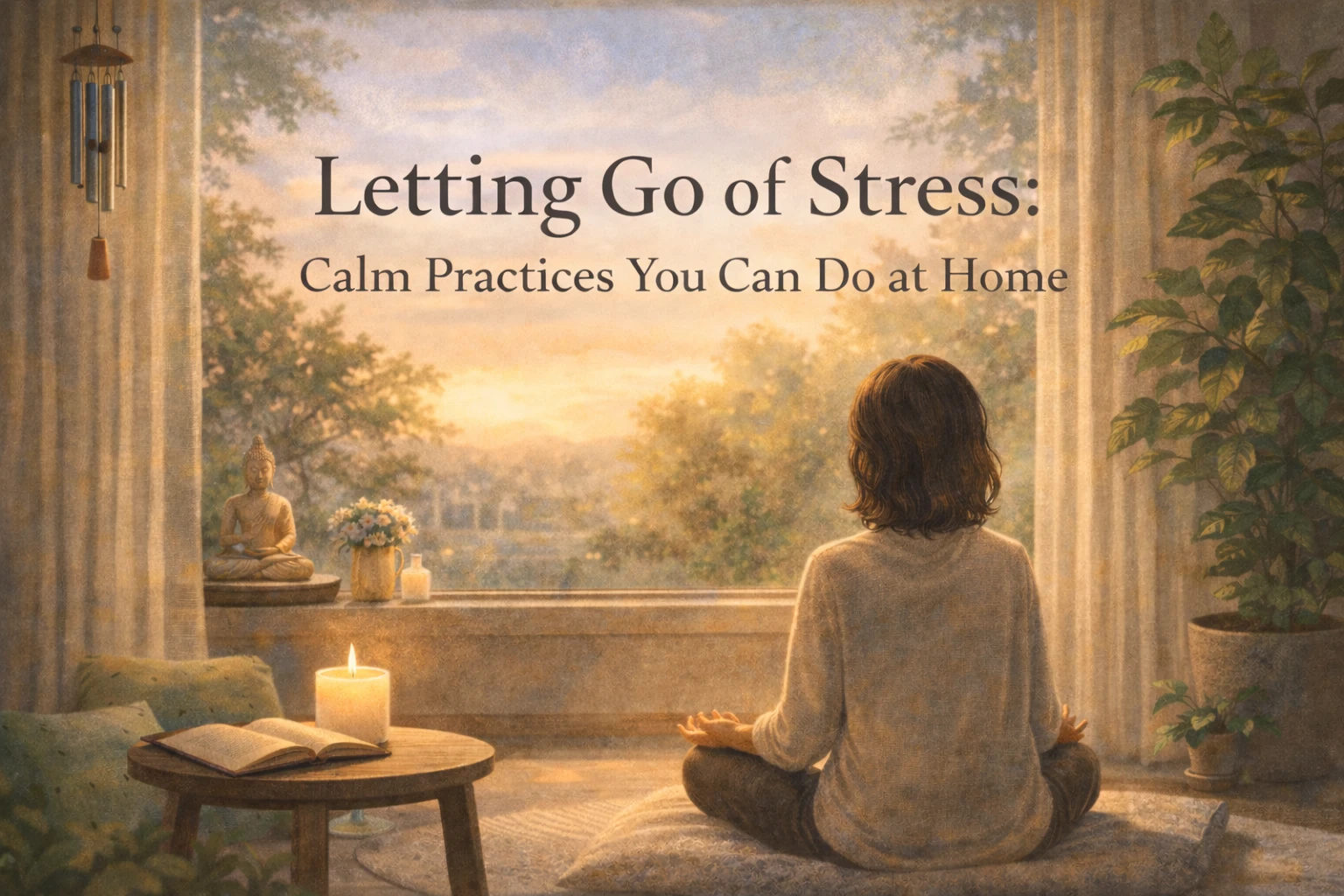
Letting Go of Stress: 8 Calm, Evidence-Informed Practices You Can Do at Home

Last Updated: September 15, 2026
By David Yang
Quick Answer: How Can You Let Go of Stress at Home?
Letting go of stress does not mean eliminating every difficult feeling or making your life permanently calm. It means creating regular opportunities to reduce unnecessary stimulation, recover from daily demands, and respond to stress in healthier ways.
At home, useful strategies can include slow breathing, short periods of movement, reducing evening stimulation, creating transitions between work and rest, practicing mindfulness, getting enough sleep, using supportive self-talk, and staying connected with people you trust. These approaches may support stress management, but their effects vary from person to person.
If stress is persistent, severe, or interfering with sleep, work, relationships, or everyday functioning, self-care alone may not be enough. In that situation, professional support can be an important next step.
Introduction: You Do Not Have to Carry Every Stressor at Full Volume
Some stress comes from obvious places.
A demanding job.
Financial pressure.
Family responsibilities.
Relationship problems.
Health concerns.
Major life changes.
But stress can also accumulate through dozens of smaller experiences.
Constant notifications.
Too little sleep.
Never taking a real break.
Moving from one task directly into another.
Trying to answer every message immediately.
Thinking about tomorrow while still dealing with today.
None of these experiences necessarily feels overwhelming by itself.
Together, however, they can leave you feeling as if you are never quite finished.
That is why letting go of stress is not about finding one magical relaxation technique.
It is about learning how to create small periods of recovery inside an ordinary life.
And sometimes the most useful place to begin is not by changing everything.
It is by asking:
What can I make a little easier, quieter, or more manageable right now?
What Does “Letting Go of Stress” Actually Mean?
Stress is a normal response to challenges and demands.
According to the National Center for Complementary and Integrative Health (NCCIH), stress can produce physical and emotional changes, including increased heart rate, faster breathing, muscle tension, and other changes associated with the body’s stress response. Occasional stress is a normal part of life, while long-term stress can contribute to or worsen a range of health problems. NCCIH: Stress
So the goal is not to become a person who never experiences stress.
That would not be realistic.
A healthier goal is to develop ways of responding to stress, recovering from it, and reducing avoidable sources of overload.
Think of stress management as having several parts:
- Notice: Recognize when stress is building.
- Reduce: Remove unnecessary sources of stimulation or pressure when possible.
- Recover: Give yourself opportunities for sleep, movement, relaxation, and connection.
- Respond: Deal with the actual problem instead of only trying to feel calmer.
- Seek support: Get professional or interpersonal help when stress becomes too difficult to manage alone.
This is a more useful definition of “letting go.”
Stress Relief Is Not the Same as Avoiding Your Problems
This distinction is important.
A breathing exercise can help you feel calmer.
A walk can give you space to think.
A quiet evening can help you recover.
But none of those things automatically fixes a toxic relationship, an impossible workload, financial problems, grief, chronic illness, or another serious source of stress.
Sometimes the healthiest response to stress is not another relaxation technique.
It may be:
- Having an honest conversation.
- Setting a boundary.
- Asking for practical help.
- Changing an unrealistic commitment.
- Taking time away from a harmful situation.
- Speaking with a healthcare professional.
- Seeking counseling or therapy.
Calming yourself and changing your circumstances are not competing strategies.
Often, you need both.
8 Calm Practices for Letting Go of Stress at Home
1. Slow Your Breathing for a Few Minutes
When you are stressed, breathing can become faster or shallower without you consciously deciding to change it.
One simple option is slow, comfortable breathing.
Try this:
- Sit somewhere comfortable.
- Relax your shoulders as much as you can.
- Breathe in gently through your nose.
- Let the breath leave slowly without forcing it.
- Continue for one to three minutes.
You do not need to take extremely deep breaths or hold your breath for long periods.
The goal is simply to slow down and make breathing comfortable.
NCCIH notes that slow, deep breathing may modestly reduce blood pressure and cortisol, and a 2019 review found preliminary evidence that diaphragmatic breathing may help reduce stress. The evidence is promising but not a reason to describe breathing exercises as a universal or instant cure. NCCIH: Stress
If breathing exercises make you dizzy, uncomfortable, or more anxious, stop and return to normal breathing.
2. Create a Transition Between Work and Home Life
One reason stress can feel continuous is that the day has no clear transitions.
You finish work and immediately start household tasks.
You finish a difficult meeting and immediately answer messages.
You close your laptop but continue mentally replaying the workday during dinner.
A small transition can help create a psychological boundary.
Try one of these:
- Take a five- or ten-minute walk before entering your evening routine.
- Change clothes after work.
- Take a shower.
- Make tea and sit quietly for five minutes.
- Put your work devices away.
- Spend a few minutes outside.
- Listen to calming music while preparing dinner.
The point is not that one particular action “switches off” your nervous system.
Instead, you are deliberately creating a boundary between one part of the day and another.
This connects naturally with our article Everyday Rituals for Emotional Wellbeing, which explores how small repeatable behaviors can support healthier daily rhythms.
3. Reduce One Source of Sensory Overload
You do not need to turn your home into a minimalist retreat.
But if your environment constantly demands your attention, reducing one source of stimulation can make rest easier.
Look around your home and choose just one thing.
- Turn down a television that is playing in the background.
- Dim an unnecessarily bright light.
- Put your phone on Do Not Disturb.
- Clear one small surface.
- Close unnecessary browser tabs.
- Move your work materials out of your immediate view.
- Spend ten minutes in a quieter room.
The goal is not aesthetic perfection.
It is reducing the number of things competing for your attention.
If creating a calmer home interests you, see Creating Comfort at Home Through Thoughtful Daily Routines.
4. Take a Short Walk Instead of Trying to Think Your Way Out of Stress
When you are stressed, staying in the same chair and repeatedly thinking about the problem does not always help.
A short walk can create a physical change in your environment while giving your mind something different to process.
You might:
- Walk around your neighborhood.
- Walk inside your home if the weather is poor.
- Take the stairs.
- Walk while making a phone call.
- Spend ten minutes outside after work.
You do not need to treat every walk as a workout.
Regular physical activity is one of the practical self-care behaviors recommended by NIMH for supporting mental and physical health. NIMH also notes that small amounts of exercise can add up. NIMH: Caring for Your Mental Health
If you are physically able to walk, a short walk can be one of the simplest ways to create a break in a stressful day.
5. Give Yourself Five Minutes of Deliberate Stillness
Not every break needs to be productive.
You do not have to use every quiet moment to read something, watch something, organize something, or learn something.
Try five minutes without an objective.
Sit near a window.
Drink something warm.
Look outside.
Listen to the sounds around you.
Let your thoughts come and go without trying to solve everything.
This is not the same as meditation unless you choose to make it a meditation practice.
It is simply intentional non-doing.
For some people, this feels surprisingly uncomfortable at first.
That is okay.
If your mind immediately produces a list of unfinished tasks, you can notice the list without acting on every item.
If you want a more structured approach to calm and attention, see How to Find Inner Balance in a Busy World: Practical Tips for Calm & Focus.
6. Practice More Supportive Self-Talk
Stress often creates a second layer of suffering.
The original problem might be:
“I have too much to do.”
Then the mind adds:
“I should be able to handle this.”
Then:
“Why am I always like this?”
Then:
“Everyone else seems to manage better than me.”
The original stressor has now been joined by self-criticism.
Try replacing harsh judgment with accurate, supportive language.
Instead of:
“I am failing at everything.”
Try:
“I am dealing with more than usual right now. What is the next useful step?”
Instead of:
“I should not feel this stressed.”
Try:
“I am stressed. I can decide what needs attention first.”
This is not about pretending everything is fine.
It is about replacing unnecessary self-attack with problem-solving.
For a broader approach to caring for yourself at home, see Self-Care at Home That Actually Helps.
7. Protect the Last Hour Before Bed
Stress and sleep can influence each other.
When you are stressed, sleep may become more difficult. When you repeatedly sleep poorly, the next day’s emotional and physical demands can feel harder to manage.
NIMH recommends making sleep a priority and maintaining a regular sleep schedule as part of mental health self-care. NIMH: Caring for Your Mental Health
You do not need a perfect bedtime routine.
Try protecting part of the evening from unnecessary stimulation.
- Stop work-related tasks when practical.
- Reduce exposure to distressing news before bed.
- Lower screen brightness.
- Put your phone farther away if notifications keep pulling your attention back.
- Read something calming.
- Take a warm shower.
- Prepare tomorrow’s essentials earlier so you are not planning in bed.
- Keep your bedtime reasonably consistent.
Remember that sleep problems can have many causes. If insomnia or major sleep disruption continues, consider discussing it with a healthcare professional rather than relying entirely on lifestyle changes.
8. Stay Connected Instead of Trying to Handle Everything Alone
Stress can make people withdraw.
You may think:
“I don’t want to bother anyone.”
“I’ll talk about it when I have it figured out.”
“Other people have bigger problems.”
But emotional support does not require having a perfectly organized explanation.
You can simply say:
“I’ve had a difficult day. Can I talk to you for a few minutes?”
Or:
“I don’t need advice right now. I just need someone to listen.”
NIMH includes staying connected with supportive friends and family among practical ways of caring for mental health. NIMH: Caring for Your Mental Health
Sometimes letting go of stress means letting someone else carry a small part of it with you.
Which Stress-Relief Practice Should You Try First?
You do not need to try all eight at once.
| If you feel… | Try… |
|---|---|
| Physically tense | Slow, comfortable breathing or gentle movement |
| Mentally overloaded | Reduce notifications and write down the next few priorities |
| Restless | Take a short walk or change your environment |
| Emotionally drained | Reduce demands and connect with someone supportive |
| Unable to switch from work to home | Create a short transition ritual |
| Overstimulated at night | Reduce screens, news, and unnecessary activity before bed |
| Harsh toward yourself | Use more accurate and compassionate self-talk |
| Unable to stop thinking | Write down tomorrow’s tasks and give your mind permission to pause |
What About Mindfulness and Meditation?
Mindfulness is another possible tool for stress management.
In simple terms, mindfulness involves intentionally paying attention to present-moment experience, often with less judgment.
You might focus on your breathing, physical sensations, sounds, or what you are doing right now.
NCCIH notes that current evidence suggests mindfulness meditation may help reduce symptoms associated with stress, including anxiety and depression, and may help improve sleep. However, evidence quality and results vary across conditions and practices. NCCIH: Stress
A simple home practice might be:
- Sit comfortably for two to five minutes.
- Notice your breathing without trying to control it.
- When your mind wanders, notice that it wandered.
- Gently return attention to the present moment.
- Repeat without judging yourself for getting distracted.
You do not need to empty your mind.
Getting distracted is part of the practice.
If meditation increases anxiety or causes distressing experiences, stop and consider another form of stress management or speak with a qualified professional. Relaxation and mindfulness practices are generally safe for many people, but they are not equally comfortable or appropriate for everyone. NCCIH: Meditation and Mindfulness — Effectiveness and Safety
Why “Doing Nothing” Can Be Difficult
Many people say they want rest but feel uncomfortable when they actually stop.
The moment there is silence, thoughts appear.
“I should clean.”
“I need to answer that message.”
“What if tomorrow goes badly?”
“I haven’t done enough today.”
This does not necessarily mean you are bad at relaxing.
It may simply mean your mind has become accustomed to constant stimulation.
Instead of demanding complete stillness, begin with a short period of low-stimulation activity.
Read two pages.
Walk slowly.
Drink tea without your phone.
Listen to quiet music.
Look outside.
Rest does not have to be impressive to count.
Letting Go of Stress Does Not Mean Becoming Passive
There is an important difference between accepting what you cannot immediately change and giving up on problems you can influence.
Suppose your workload is unreasonable.
A relaxation exercise may help you calm down enough to think clearly.
But the longer-term solution may involve speaking with your manager, adjusting priorities, delegating work, or changing your schedule.
Suppose you are constantly arguing with your partner.
A quiet evening may help you recover.
But the underlying issue may require communication, boundaries, counseling, or a deeper conversation.
Suppose you feel lonely.
Watching television may distract you for an hour.
But reaching out to someone may address the actual need more directly.
Stress management works best when calming practices help you respond better, rather than simply helping you avoid what is difficult.
A Simple 10-Minute Stress Reset at Home
If you are stressed right now, try this short sequence.
Minute 1: Stop
Put down whatever you are doing for one minute.
Minutes 2–3: Breathe
Take slow, comfortable breaths without forcing the inhale or holding your breath unnecessarily.
Minutes 4–6: Move
Walk around your home, stretch, or step outside.
Minutes 7–8: Reduce One Demand
Turn off a notification, close a browser tab, postpone one nonessential task, or put one responsibility on tomorrow’s list.
Minutes 9–10: Decide the Next Step
Ask:
What is the one thing that actually needs my attention next?
Then do only that.
The goal is not to become completely relaxed.
The goal is to become slightly less overwhelmed and slightly more able to choose what happens next.
A 7-Day Letting-Go-of-Stress Reset
Day 1 — Notice
Write down the three biggest sources of stress in your current day.
Day 2 — Remove One Unnecessary Stimulus
Choose one source of noise, notifications, clutter, or information overload and reduce it.
Day 3 — Move
Take a ten- to twenty-minute walk or another form of comfortable movement.
Day 4 — Create a Transition
Build five minutes between work and evening responsibilities.
Day 5 — Practice Supportive Self-Talk
Catch one unnecessarily harsh thought and replace it with something accurate and constructive.
Day 6 — Protect Sleep
Create a calmer final part of your evening and keep your bedtime reasonably consistent.
Day 7 — Connect
Talk with someone you trust. You do not have to discuss everything. Simply reconnect.
At the end of the week, ask:
- Which practice felt easiest?
- Which one actually helped?
- Which one felt like another obligation?
- What is worth continuing?
Keep the practices that fit your life.
Forget the ones that make your life harder.
How Do You Know Your Stress Is Becoming More Manageable?
Stress relief is not always a dramatic feeling of peace.
Sometimes progress looks like:
- You notice tension earlier.
- You recognize when you need a break.
- You recover from frustration more quickly.
- You stop checking your phone automatically every few minutes.
- You sleep more consistently.
- You are able to focus on one task at a time.
- You ask for help before reaching a breaking point.
- You stop treating every problem as an emergency.
These are not medical measurements of stress reduction.
They are simply useful signs that your daily response to stress may be becoming more manageable.
When Stress Is a Sign You Need More Support
Sometimes stress is not something you should try to “self-care” your way through.
NIMH recommends seeking professional help when severe or distressing symptoms last two weeks or more, including persistent difficulty sleeping, significant appetite changes, difficulty getting out of bed, trouble concentrating, loss of interest in normally enjoyable activities, inability to complete usual tasks, or ongoing irritability, frustration, or restlessness. NIMH: Caring for Your Mental Health
NIMH also notes that when mild symptoms do not improve with basic self-care or begin to worsen, talking with a healthcare provider is appropriate. NIMH: My Mental Health — Do I Need Help?
Professional support does not mean you have failed at managing your life.
Sometimes it simply means the problem deserves more support than a person should be expected to provide for themselves.
If you are in immediate danger or think you may hurt yourself or someone else, seek emergency or crisis support in your location immediately.
Frequently Asked Questions
What is the fastest way to let go of stress at home?
There is no single fastest method for everyone. A short period of slow, comfortable breathing, stepping away from stimulation, taking a walk, or talking with someone supportive can help some people feel more settled. The best option depends on what is driving the stress.
Can deep breathing really reduce stress?
It may help. NCCIH reports preliminary evidence that slow, deep or diaphragmatic breathing can reduce stress and may modestly affect measures such as blood pressure and cortisol. It is better described as a potentially useful stress-management tool than as an instant cure.
Is stress always bad for you?
No. Stress is a normal response to challenges and can be useful in certain situations. Problems are more likely when stress becomes persistent, overwhelming, or begins interfering with sleep, health, relationships, work, or daily functioning.
How long does it take to feel less stressed?
It varies. Some relaxation practices may produce a short-term sense of calm, while broader changes in stress management usually depend on repeated habits, sleep, physical activity, social support, and addressing the underlying source of stress.
Can cleaning the house reduce stress?
For some people, reducing clutter or sensory distractions can make their environment feel easier to manage. However, you do not need a perfectly clean home to feel calm. If cleaning becomes another source of pressure, simplify rather than aiming for perfection.
Can meditation make stress worse?
It can happen for some people. Although mindfulness and meditation may help with stress and anxiety, not every practice feels comfortable for everyone. If meditation causes significant distress or increases anxiety, stop and consider another approach or discuss it with a qualified professional.
Can stress relief replace therapy?
No. Relaxation, movement, sleep, mindfulness, and other self-care practices can complement professional care, but they should not replace appropriate treatment when symptoms are severe, persistent, or significantly affecting daily life.
Final Thoughts: You Do Not Need to Eliminate Stress to Feel Better
Stress is part of being human.
You will have difficult conversations.
You will have busy weeks.
Plans will change.
People will disappoint you.
Work will sometimes be overwhelming.
Some problems will not have quick solutions.
So the goal cannot realistically be a life without stress.
A better goal is to become more capable of noticing stress, responding to it, recovering from it, and asking for help when necessary.
Sometimes that begins with one slow breath.
Sometimes it is a walk.
Sometimes it is putting the phone away.
Sometimes it is going to bed instead of doing one more task.
And sometimes letting go means admitting that something in your life needs to change.
Your home does not have to be perfect.
Your routine does not have to be impressive.
You do not have to feel calm every day.
You simply need a few reliable ways to give yourself room to recover.
Letting go of stress is not about escaping your life. It is about learning how to meet your life with a little more space, support, and choice.
Authoritative Sources & References
- National Center for Complementary and Integrative Health (NCCIH) — Stress
https://www.nccih.nih.gov/health/stress - NCCIH — 5 Things To Know About Relaxation Techniques for Stress
https://www.nccih.nih.gov/health/tips/things-to-know-about-relaxation-techniques-for-stress - NCCIH — Relaxation Techniques: What You Need To Know
https://www.nccih.nih.gov/health/relaxation-techniques-what-you-need-to-know - NCCIH — Meditation and Mindfulness: Effectiveness and Safety
https://www.nccih.nih.gov/health/meditation-and-mindfulness-effectiveness-and-safety - National Institute of Mental Health (NIMH) — Caring for Your Mental Health
https://www.nimh.nih.gov/health/topics/caring-for-your-mental-health - NIMH — My Mental Health: Do I Need Help?
https://www.nimh.nih.gov/health/publications/my-mental-health-do-i-need-help - NCCIH Clinical Digest — Mind and Body Approaches for Stress and Anxiety: What the Science Says
https://www.nccih.nih.gov/health/providers/digest/mind-and-body-approaches-for-stress-science
Important: This article is for general educational purposes and does not diagnose or treat any medical or mental health condition. If stress is persistent, severe, or significantly affecting your daily life, consider speaking with a qualified healthcare professional.
Recommended Articles:
- Evening Routine for Better Sleep and Less Anxiety: 10 Simple Habits to Wind Down
- How to Stop Feeling Empty: A Gentle, Practical Path Back to Yourself
- How to Feel Happy Again: Gentle Steps to Reclaim Joy
- How to Stop Overthinking: A Practical Guide to Quiet Your Mind
- Anxiety Relief at Home: How to Create a Calmer Space That Supports You
- How to Calm Anxiety at Home Naturally (12 Proven Ways)
- Why Do I Feel Restless All the Time? Causes, What It Means & How to Feel Calmer
- Why Do I Feel Overwhelmed in My Relationship? 12 Hidden Sources of Emotional Pressure
- Why Do I Feel Sad at Night? 13 Hidden Reasons Your Heart Aches After Dark
- Why Do I Feel Empty After Social Media? 10 Hidden Causes Behind the Scroll
- Why Do I Feel Like Something Is Missing in My Life? 12 Hidden Reasons Behind the Emptiness
- Why Do I Feel Drained After Talking to People? 10 Hidden Causes of Social Fatigue
- When Home Doesn’t Feel Safe: Why Do I Feel Anxious in My Own House?
- When You Don’t Recognize Yourself in the Mirror: Why Do I Feel Disconnected from Myself?
- Why Do I Feel Stuck in Life? 11 Root Causes & How to Move Forward
- When Life Loses Its Spark: Why Do I Feel Bored With My Life?
- Why Do I Feel Like I Don’t Belong Anywhere? 9 Hidden Reasons and the Path to True Connection
- Why Do I Feel Like I’m Not Good Enough? Understanding Self-Doubt and Low Self-Worth
- Why Do I Feel Like I’m Not Good Enough? Understanding Low Self-Worth
- Why Do I Feel Emotionally Exhausted? Causes & Healing
- Why Do I Feel Overwhelmed by Simple Things? Understanding Emotional Overload and Stress Sensitivity
- Why Do I Feel Unmotivated and Tired? Understanding Low Energy, Burnout, and Lack of Drive
- Why Do I Feel Mentally Drained Every Day? Understanding Burnout, Fatigue, and Emotional Exhaustion
- Why Do I Feel Lost in Life Right Now? Find Your Purpose, Direction & Yourself
- Why Do I Feel Unhappy for No Reason? Real Causes, What It Means & Simple Ways to Feel Better
- Why Do I Feel Anxious at Home? 9 Real Causes and How to Feel More at Ease
- Why Do I Feel Emotionally Numb All the Time? Understanding Emotional Numbness and How to Feel Again
- How to Calm Anxiety at Home: Gentle, Science-Backed Ways to Create Anxiety Relief in Your Safe Space
- Letting Go of Stress: Calm Practices You Can Do at Home
- Everyday Rituals That Support Emotional Wellbeing

- How to Find Inner Balance in a Busy and Noisy World
- Self-Care at Home That Actually Helps

- Emotional Healing: Simple Practices to Restore Inner Calm