
This is my little online home where we celebrate life's real magic - the warm connections, simple self-care rituals, and those quiet moments that stay with you.
What I do here:
• Craft stories and tips to brighten your everyday
• Build a space where everyone feels welcome
• Make each visit worth your while - whether you need quick advice or food for thought
My superpowers? Turning ordinary moments into something special through words that actually mean something.
Off-screen, I'm probably:
☕ Curled up with a book that changes my perspective
🎨 Trying some new creative hobby
🌿 Noticing the small wonders we usually rush past
So glad you're here - let's make something meaningful together!
Table of Contents
Last Updated: September 30, 2026
Sometimes anxiety follows you home.
You close the door, put your keys down, and expect to finally relax. Instead, your mind keeps running.
You notice the dishes. The laundry. The notifications. The unfinished work. The noise outside. The things you need to remember tomorrow.
Or perhaps your home is perfectly tidy and quiet, yet you still cannot settle.
If you have ever wondered whether your surroundings could help you feel calmer, there is a useful middle ground between two extremes.
Your home is not a cure for an anxiety disorder. But your environment can influence comfort, sleep, sensory stimulation, routines, privacy, social connection, and the practical conditions in which you cope with stress.
That means you can make your home more supportive without pretending that a particular color, candle, plant, or breathing technique will “reset your nervous system.”
This guide explains realistic anxiety relief at home strategies—from reducing environmental stressors and improving indoor air to creating a calmer evening routine, making room for movement, and knowing when home-based strategies are not enough.
Quick Answer: Can Your Home Help With Anxiety?
Yes, your home can be made more supportive when you reduce unnecessary noise and clutter, improve comfort and indoor air quality, create predictable routines, protect sleep, limit stressful digital input, and make space for relaxation and supportive relationships.
These changes may make everyday stress easier to manage, but they should not be viewed as a treatment for an anxiety disorder by themselves. NIMH notes that healthy habits such as sleep, physical activity, reducing caffeine, and stress-management practices can support anxiety care, while psychotherapy and medication may be appropriate for anxiety disorders.
The goal is therefore not to create a “perfect anxiety-free home.”
The goal is to create a home where rest is easier, unnecessary stimulation is lower, and healthy coping is more convenient.
What Does Anxiety Relief at Home Really Mean?
“Anxiety relief at home” can mean two different things.
The first is short-term relief.
You are anxious right now and want to feel a little steadier.
The second is environmental support over time.
You want your home to make it easier to sleep, decompress, connect with people, exercise, focus, and recover from ordinary stress.
These are related, but they are not identical.
For example, taking five minutes to practice slow breathing may help you settle in the moment. But if you are sleeping five hours a night, working at your kitchen table until midnight, drinking caffeine late in the afternoon, and receiving work notifications throughout the evening, a breathing exercise alone will not solve the larger pattern.
Likewise, buying an expensive air purifier will not resolve anxiety caused by relationship conflict or persistent worry about the future.
A useful approach is to ask:
“What in my home makes healthy coping easier, and what makes it harder?”
Why Your Home Can Affect How You Feel
Your environment does not determine your mental health, but it can influence the conditions in which your mind and body operate.
Consider what happens at home every day:
- You sleep there.
- You eat there.
- You work or study there.
- You interact with family members or roommates.
- You use screens there.
- You make dozens of small decisions there.
- You encounter unfinished chores there.
- You spend time alone there.
That means seemingly small environmental problems can become repeated sources of friction.
A noisy bedroom may make winding down harder.
A cluttered workspace may make starting work harder.
Poor ventilation may make a room feel stuffy or uncomfortable.
A phone beside the bed may make it harder to mentally disconnect from work or social media.
A lack of privacy may make recovery difficult when you live with several people.
Research on home environments has found associations between perceptions of clutter, unfinishedness, and stress-related measures, although these findings do not mean that clutter automatically causes anxiety in everyone.
The EPA also emphasizes that ventilation, pollution sources, filtration, temperature, and moisture can affect indoor air quality and occupant comfort.
So the practical question is not:
“Does my house cause my anxiety?”
It is:
“Are there environmental problems here that I can reasonably improve?”
Signs Your Home Environment May Be Making Anxiety Harder to Manage
Your home may be contributing to everyday stress if you frequently notice:
- You feel overwhelmed as soon as you walk through the door.
- You cannot relax because every room contains unfinished tasks.
- Your bedroom is also your office, entertainment area, laundry area, and storage space.
- Notifications continue throughout the evening.
- You rarely have a quiet place to sit.
- Noise regularly interrupts rest or sleep.
- Your home feels stuffy, damp, overheated, or uncomfortable.
- You avoid certain rooms because they are associated with work or conflict.
- You spend most evenings scrolling rather than recovering.
- You have difficulty transitioning from work mode to home mode.
- You rarely spend meaningful time with people you trust.
- You are constantly cleaning because there is no simple system for keeping things under control.
None of these signs proves that your environment is causing anxiety.
They simply identify areas worth experimenting with.
The CALM Framework for Anxiety Relief at Home
The original version of this article used the CALM framework: Color, Air, Light, and Movement.
That is still a useful memory tool, but this upgraded version uses the four ideas more carefully:
- C — Comfort and visual calm
- A — Air and environmental quality
- L — Light and daily rhythm
- M — Movement and meaningful recovery
These are not clinical treatment categories.
They are simply four practical areas where your home can support healthier habits.
C — Create Comfort and Visual Calm
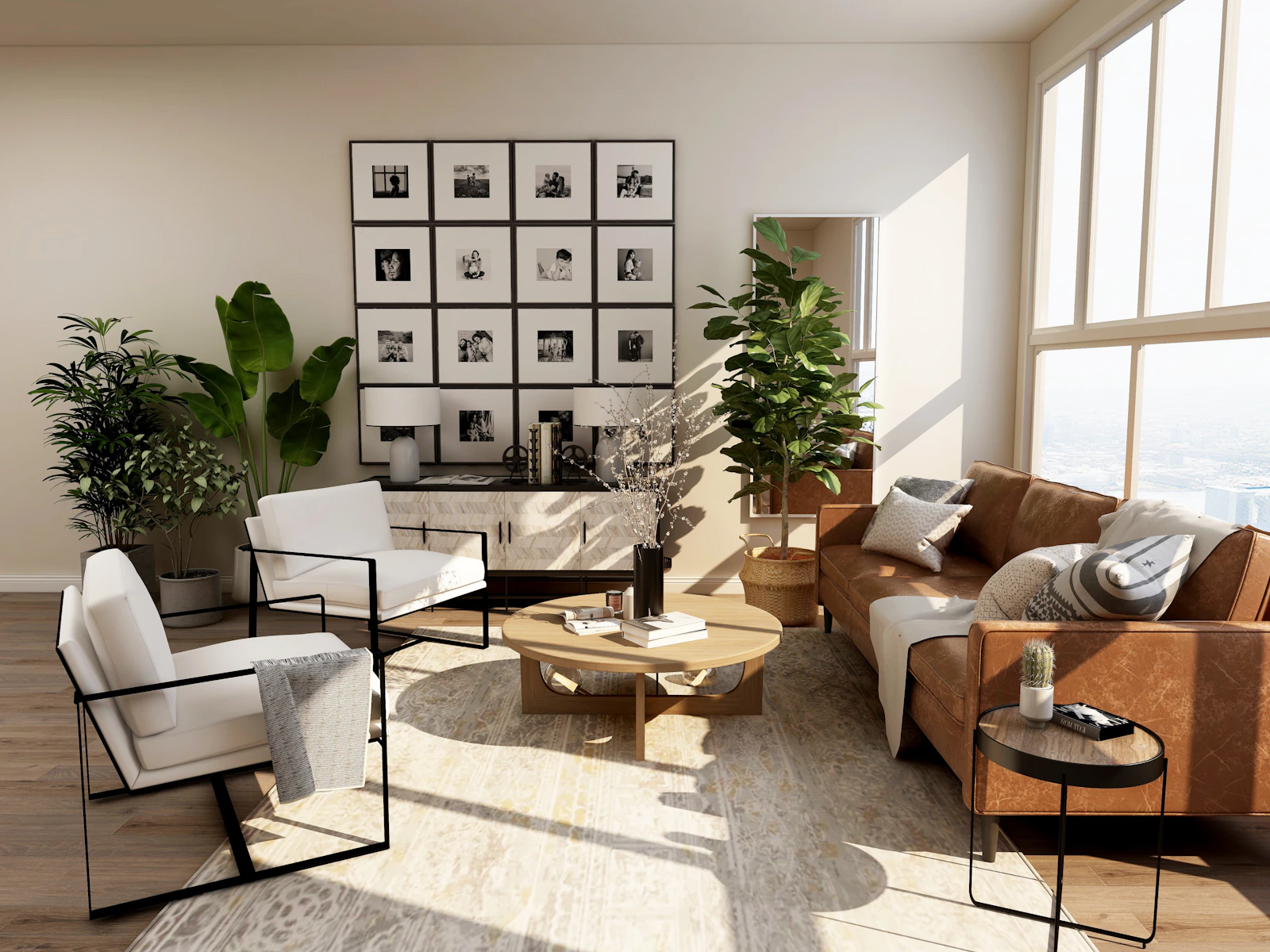
You do not need a minimalist home.
You need a home that is reasonably easy to use.
For some people, visual clutter is distracting. For others, a completely empty room feels cold or uncomfortable.
So instead of following a universal “calm home aesthetic,” pay attention to what creates friction for you.
Start with high-friction surfaces
Look at the places where unfinished tasks tend to accumulate:
- kitchen counters
- dining tables
- bedside tables
- entryway surfaces
- desks
- bathroom counters
- laundry areas
Choose one.
Clear it.
Then ask what repeatedly causes the mess.
If mail has nowhere to go, create a mail tray.
If keys disappear, create a key spot.
If clothes always land on a chair, put a laundry basket nearby.
The goal is not merely to make the room look better.
The goal is to make the next action easier.
Keep meaningful objects
Do not remove everything that makes your home personal.
Photographs, books, artwork, souvenirs, plants, and family objects can contribute to a sense of identity and comfort.
A calm home does not have to be an empty home.
It simply needs enough organization that your meaningful possessions do not become an endless visual to-do list.
For a deeper decluttering strategy, see How to Declutter Your Home.
A — Improve Air and Physical Comfort
Indoor air quality is one of the most practical parts of a healthy home environment.
The EPA recommends three broad strategies:
- Source control — reduce or remove pollution sources.
- Ventilation — bring in outdoor air when conditions allow.
- Filtration or air cleaning — use appropriate filtration when useful.
The EPA also recommends controlling indoor moisture and keeping relative humidity below 60%, ideally around 30–50%.
Simple indoor-air improvements
- Use kitchen and bathroom exhaust fans when appropriate.
- Ventilate when outdoor air quality and weather conditions permit.
- Keep damp areas dry.
- Address leaks promptly.
- Clean or replace HVAC filters according to manufacturer instructions.
- Avoid smoking indoors.
- Reduce unnecessary sources of indoor pollutants.
- Consider appropriate filtration if outdoor pollution or indoor particles are a concern.
Do not interpret this as “open your windows every day no matter what.” The EPA specifically notes that outdoor pollution, pollen, extreme temperatures, and humidity can affect whether ventilation is appropriate.
What about houseplants?
Plants can make a room more pleasant and visually connected to nature.
But they should not be presented as a substitute for ventilation or filtration.
If you enjoy plants, use them because they make your space feel better—not because you expect a few houseplants to clean your entire home’s air.
L — Use Light to Support Your Daily Rhythm
Lighting is both a practical and behavioral part of your environment.
During the day, natural light can make a home feel more open and help distinguish daytime from evening.
At night, excessive bright light and stimulating activities can make it harder to transition toward sleep.
Instead of obsessing over a specific bulb temperature, create a simple rhythm:
- Morning: open curtains or blinds and let daylight into the room when practical.
- Daytime: use brighter task lighting when you need to work or focus.
- Evening: gradually reduce unnecessary bright lighting.
- Before bed: make the bedroom darker and quieter when possible.
The objective is not to create a magical “calm lighting frequency.”
It is to make your home visually match what you are trying to do.
Bright, functional light makes sense when you are cooking or working.
Lower, more comfortable lighting may make more sense when you are reading or preparing for sleep.
M — Make Movement Easy
Anxiety can involve physical tension, restlessness, and difficulty settling.
Movement is one of the practical behaviors that can support overall mental health.
NIMH includes regular physical activity among healthy habits that can support mental health, while also emphasizing that lifestyle measures do not replace appropriate treatment for anxiety disorders.
You do not need a home gym.
Create a small area where movement is easy.
That could be:
- a yoga mat beside the sofa
- an empty section of floor
- space near a window for stretching
- a comfortable pair of walking shoes by the door
- a place where you can do a few simple mobility exercises
The best setup is the one you will actually use.
What to Do When Anxiety Is High Right Now
If you are already anxious, redesigning your living room is probably not the first thing you need.
Start with something smaller.
1. Change your physical position
If you have been sitting and worrying for thirty minutes, stand up.
Move to another room.
Step outside if it is safe and practical.
A change in activity can interrupt repetitive thinking.
2. Slow your breathing
Try breathing slowly and comfortably rather than forcing yourself to take extremely deep breaths.
You might inhale gently and make your exhale somewhat longer than your inhale.
Do not strain or hold your breath if that makes you uncomfortable.
NCCIH notes that breathing exercises and other relaxation techniques may help with stress and anxiety, although the evidence varies by technique and condition.
3. Try progressive muscle relaxation
Progressive muscle relaxation involves deliberately tensing and then relaxing different muscle groups.
It gives your attention something physical to focus on rather than requiring you to “stop thinking.”
This is particularly useful if anxiety feels strongly physical.
4. Reduce unnecessary stimulation
Turn off the television.
Put your phone on Do Not Disturb.
Lower the volume.
Move away from a crowded or uncomfortable space.
Give yourself ten minutes with fewer inputs.
5. Name what is actually worrying you
Sometimes anxiety becomes more manageable when a vague feeling becomes a specific problem.
Write:
“Right now, I am worried about…”
Then finish the sentence.
You may discover a practical problem that needs action.
Or you may realize that the worry is something you cannot solve tonight.
Both are useful pieces of information.
Create a “Calm Corner” Without Turning It Into a Treatment Device
A calm corner can be extremely simple.
You might choose:
- one comfortable chair
- a blanket
- a book
- soft lighting
- headphones
- a journal
- a cup of tea
- a plant
The important part is not the objects.
It is the function.
This is a place where you can read, breathe, listen to music, stretch, journal, or simply sit for a few minutes.
Do not make the corner another place where you analyze everything that is wrong with your life.
Use it for recovery-oriented activities.
Reduce Digital Anxiety at Home
For many people, the most stimulating object in the house is not the television.
It is the phone.
Your home can be physically quiet while your attention is being constantly interrupted.
Try creating boundaries such as:
- no work email during a defined evening period
- Do Not Disturb during sleep
- no social media during meals
- phone charging outside the bedroom if practical
- one screen-free period each evening
- turning off nonessential notifications
You do not have to quit social media.
You simply need periods in which your attention belongs to you again.
If overthinking is one of your main anxiety patterns, see How to Stop Overthinking: A Practical Guide to Quieting a Busy Mind.
Make the Evening Transition Easier
Many people do not actually transition from work to home.
They simply move from a work screen to a personal screen.
That can leave the mind in a state of continuous stimulation.
Create a small transition ritual.
For example:
- Finish the most important work task.
- Write tomorrow’s first task down.
- Close the laptop.
- Put work materials away.
- Change clothes.
- Take a short walk or shower.
- Prepare a simple meal.
- Reduce unnecessary notifications.
- Do something enjoyable without requiring productivity.
The purpose is not to “hack your nervous system.”
It is to create a clear behavioral boundary between work and recovery.
You can also explore a consistent evening wind-down routine if that pattern is relevant to you.
Make Your Bedroom More Anxiety-Friendly
Sleep and anxiety can influence each other.
When you are anxious, falling asleep can become harder.
When you repeatedly sleep poorly, anxiety and emotional strain can become harder to manage.
Make your bedroom as simple and comfortable as your circumstances allow.
Reduce work cues
If possible, keep laptops, paperwork, and work-related materials out of the immediate sleeping area.
Reduce unnecessary light
Use curtains, blinds, or an eye mask if needed.
Manage temperature
Choose bedding and room temperature that allow you to sleep comfortably.
Reduce disruptive noise
If outside noise is unavoidable, consider practical options such as earplugs, a fan, or steady background sound if you find it helpful.
Keep the room functional
You do not need a designer bedroom.
You need a bedroom that makes the next step—going to sleep—reasonably easy.
Use Sound Carefully
Some people relax better with silence.
Others prefer steady background sound.
There is no universal “best frequency” for anxiety.
You can experiment with:
- quiet
- gentle music
- nature sounds
- a fan
- white noise
- another consistent background sound
The test is simple:
Does this make it easier for you to rest, or does it become another thing demanding attention?
If a sound helps you relax, use it.
If it becomes irritating, turn it off.
What About Color?
Color is worth discussing, but it should be treated as a preference rather than a medical intervention.
You may personally find muted blues, greens, warm neutrals, or earth tones comfortable.
Someone else may find those colors dull or depressing.
Your associations with color matter.
Instead of asking:
“Which color scientifically cures anxiety?”
Ask:
“Which colors make this room feel comfortable to me?”
Test small changes before repainting an entire room.
A cushion, blanket, artwork, or small rug is enough to experiment.
What About Scents and Essential Oils?
Smell can strongly influence personal experience and memory, so a pleasant scent may become part of a relaxing routine.
But be careful with claims about essential oils.
A pleasant lavender scent is not the same thing as treating an anxiety disorder.
Some people also experience headaches, irritation, allergies, or sensitivity to fragrances.
If you use scented products:
- use them lightly
- stop if they cause irritation
- ventilate appropriately
- keep them away from children and pets when relevant
- never use them instead of appropriate treatment
The ritual may be useful because it creates a pleasant association—not because the scent has a guaranteed biological effect.
Build Social Connection Into Your Home
A calm home should not become an isolated home.
Supportive relationships are an important part of emotional well-being. The CDC notes that social connection can help people manage stress, anxiety, and depression and can support sleep and overall health.
Consider creating simple connection rituals:
- one screen-free meal each day
- a short conversation after work
- a weekly call with someone you trust
- a shared walk
- a family breakfast
- a regular date night
- checking in with a friend
Sometimes anxiety relief at home does not mean being alone in a quiet room.
Sometimes it means hearing a familiar voice.
When Your Home Is Actually the Source of Anxiety
There is an important distinction between:
“I feel anxious while I am at home.”
and:
“Something about my home is making me feel unsafe.”
If you live with ongoing hostility, intimidation, coercion, abuse, threats, or another serious safety problem, rearranging furniture or lighting will not solve the underlying issue.
In that situation, the priority is safety and appropriate support.
This distinction is especially important because people sometimes try to “self-regulate” in environments that genuinely need to change.
You do not have to decorate your way out of an unsafe situation.
What If You Get Anxious as Soon as You Arrive Home?
This can happen for several reasons.
Perhaps home is where you finally stop distracting yourself and notice your worries.
Perhaps you associate home with unfinished work.
Perhaps there is conflict in the household.
Perhaps evenings are when you are most tired, making worries feel more intense.
Perhaps your bedroom has become associated with hours of lying awake and worrying.
Or perhaps you are dealing with anxiety that would occur regardless of where you were.
Do not automatically assume that the building itself is the problem.
Track the pattern for a week.
Ask:
- What happens during the first ten minutes after I arrive?
- What thought appears first?
- What physical sensation do I notice?
- What room am I in?
- What do I usually do next?
- Does the anxiety decrease if I go for a walk?
- Does it decrease when I talk to someone?
- Does it increase when I check work messages?
You are looking for patterns, not proof.
How to Create Anxiety Relief at Home in a Small Apartment
You do not need a large house.
In a small space, focus on creating functional zones.
For example:
- one area for sleeping
- one area for working
- one place for eating
- one small area for relaxation
The zones do not need to be separate rooms.
A different chair, lamp, rug, or arrangement can create a visual distinction.
When the same room performs several functions, simply changing the lighting or clearing the workspace at the end of the day can help create a transition.
How to Create Anxiety Relief at Home as a Renter
You do not need to own the property.
Try changes that are easy to reverse:
- lamps
- removable artwork
- curtains
- rugs
- plants
- storage baskets
- furniture rearrangement
- portable air filtration when appropriate
- noise-reducing options
- screen and notification boundaries
Focus on what you can control rather than waiting until you own a home.
What Not to Do When Trying to Reduce Anxiety at Home
Do not try to redesign the entire house in one weekend
If the project itself becomes stressful, you have defeated the purpose.
Change one high-friction area at a time.
Do not believe every “nervous system” claim online
Terms such as “vagus nerve reset,” “nervous system healing,” and “safety signals” are increasingly used online in ways that can go far beyond the evidence.
Prefer practical advice supported by established health organizations.
Do not spend money before identifying the problem
If your anxiety comes from poor sleep, buying decorative objects will not fix it.
If the problem is noise, changing the wall color may not matter.
If the problem is relationship conflict, an essential-oil diffuser is not the solution.
Do not use alcohol as your primary wind-down strategy
Alcohol may initially feel relaxing, but it can interfere with sleep and is not a recommended treatment for anxiety.
Use healthier routines instead.
Do not turn self-care into another performance
You do not need the perfect morning routine, perfect meditation corner, perfect bedroom, or perfect home.
That is just another source of pressure.
A 7-Day Anxiety-Friendly Home Reset
| Day | Focus | One Action |
|---|---|---|
| Day 1 | Visual calm | Clear one surface that you see repeatedly. |
| Day 2 | Air | Check ventilation, moisture, and obvious indoor-air problems. |
| Day 3 | Light | Open curtains in the morning and reduce unnecessary bright light at night. |
| Day 4 | Digital boundaries | Turn off nonessential evening notifications. |
| Day 5 | Movement | Create a small space for stretching or take a short walk after work. |
| Day 6 | Connection | Have one meaningful conversation without phones. |
| Day 7 | Review | Write down what made your home feel easier to live in and what still creates friction. |
Do not measure success by whether your anxiety disappears.
Instead ask:
“Did I make it slightly easier to rest, sleep, move, connect, or focus?”
That is a more realistic goal.
When Home Strategies Are Not Enough
Home-based strategies are useful tools, but anxiety can be a mental-health condition rather than simply a response to your surroundings.
NIMH describes generalized anxiety disorder as involving excessive anxiety and worry that is difficult to control, along with symptoms such as restlessness, fatigue, difficulty concentrating, irritability, muscle tension, and sleep problems. Treatment commonly involves psychotherapy, medication, or both, depending on the individual.
Consider professional support if anxiety:
- persists and is difficult to control
- interferes with work or school
- interferes with relationships
- regularly disrupts sleep
- causes significant physical symptoms
- leads you to avoid important activities
- causes frequent panic attacks
- makes ordinary responsibilities difficult
- is becoming progressively worse
Getting help does not mean that your home strategies failed.
It means you are addressing the problem at the level it actually requires.
Frequently Asked Questions About Anxiety Relief at Home
Can changing my home really reduce anxiety?
It can help create conditions that support relaxation, sleep, healthy routines, and coping. However, environmental changes are not a standalone treatment for an anxiety disorder. Think of your home as part of your support system rather than the entire solution.
What can I do for anxiety at home right now?
Start with something simple: move to a quieter space, slow your breathing, reduce unnecessary stimulation, step outside if appropriate, stretch, write down what is worrying you, or contact someone you trust. Choose one action rather than trying everything at once.
Can clutter cause anxiety?
Clutter may contribute to stress or feelings of being overwhelmed for some people, particularly when it represents unfinished tasks. Research has found associations between perceptions of clutter and stress-related measures, but clutter should not be treated as a universal cause of anxiety.
What is the best color for anxiety relief?
There is no universally proven anxiety-relieving color. Personal preference and associations matter. Choose colors that make your home feel comfortable rather than following a rigid “calming colors” formula.
Do plants reduce anxiety?
Plants can make a space more pleasant and may support a sense of connection with nature, but they should not be presented as a treatment for anxiety or as a substitute for proper ventilation and filtration. Their practical value may be as much about the experience of the space as air purification.
Does opening a window help anxiety?
Fresh outdoor air can improve ventilation and indoor air quality when outdoor conditions are suitable. However, you should not open windows automatically when outdoor pollution, pollen, extreme temperatures, or other conditions make ventilation undesirable. The EPA recommends considering outdoor conditions when deciding when to ventilate.
Can breathing exercises help anxiety?
Breathing and relaxation exercises may help reduce stress and anxiety for some people. NCCIH describes slow breathing and other relaxation techniques as approaches that may support relaxation, while noting that evidence varies by technique and condition.
Should I use essential oils for anxiety?
A pleasant scent may become part of a relaxing routine, but essential oils should not be treated as a replacement for evidence-based anxiety treatment. Some people may also experience irritation or sensitivity to fragrances.
Can I calm anxiety without medication?
Some people can reduce mild or situational anxiety with behavioral strategies, exercise, relaxation practices, sleep improvements, social support, and other healthy habits. But if you have an anxiety disorder, do not assume that medication or therapy is unnecessary. NIMH notes that treatment may involve psychotherapy, medication, or both depending on the person’s needs.
Why do I feel anxious when I get home?
Home may be where worries become more noticeable because distractions decrease. It can also be associated with work, chores, loneliness, relationship conflict, or previous stressful experiences. Tracking what happens immediately after you arrive home can help identify the pattern.
How can I reduce anxiety in a small apartment?
Create clear functional zones, reduce high-friction clutter, manage noise and light, protect your sleeping area, and create one small space dedicated to rest. You do not need a large home to create a supportive environment.
What if my home itself does not feel safe?
If you are dealing with abuse, threats, intimidation, coercion, or another serious safety concern, environmental design is not enough. Prioritize physical and emotional safety and seek appropriate support.
When should I see a professional about anxiety?
Consider professional help when anxiety is persistent, difficult to control, interferes with daily functioning, disrupts sleep, affects relationships, causes significant distress, or leads to avoidance. Effective treatments are available, including psychotherapy and, when appropriate, medication.
Authoritative Sources & References
- National Institute of Mental Health — Generalized Anxiety Disorder
- National Institute of Mental Health — Anxiety Disorders
- National Institute of Mental Health — Caring for Your Mental Health
- NCCIH — Relaxation Techniques: What You Need to Know
- NCCIH — Stress
- CDC — Improve Your Emotional Well-Being
- CDC — Social Connection
- U.S. EPA — What Can I Do to Improve Indoor Air Quality in My Home?
- U.S. EPA — Care for Your Air: A Guide to Indoor Air Quality
- U.S. EPA — How Much Ventilation Do I Need in My Home?
Final Thoughts: Let Your Home Support You, Not Pressure You
Anxiety relief at home does not require a perfect house.
It does not require expensive furniture.
It does not require a collection of essential oils, a particular paint color, or an elaborate “nervous system reset” routine.
It starts with something much more practical.
Make your home easier to live in.
Reduce one source of unnecessary noise.
Clear one surface that constantly bothers you.
Improve ventilation where appropriate.
Create a clearer boundary between work and rest.
Make your bedroom more comfortable for sleep.
Put your phone away for part of the evening.
Create a place where you can sit without needing to accomplish anything.
Talk to someone you trust.
Move your body.
Give yourself a few minutes of genuine recovery.
These actions may sound ordinary.
That is exactly the point.
A supportive home is usually built through ordinary decisions repeated consistently—not through one dramatic transformation.
And if anxiety remains strong despite these changes, that does not mean you failed to create a calm enough home.
It may simply mean that your anxiety needs more support than environmental changes can provide.
Therapy, medication, medical evaluation, or other professional care can be appropriate depending on the situation.
Your home can be part of your support system.
It does not have to be your entire treatment plan.
The most realistic goal is not to make anxiety disappear every time you walk through the door.
It is to make home a place where you have a better chance to rest, reconnect, recover, and take the next small step.
Recommended Articles:
- Evening Routine for Better Sleep and Less Anxiety: 10 Simple Habits to Wind Down
- How to Stop Feeling Empty: A Gentle, Practical Path Back to Yourself
- How to Feel Happy Again: Gentle Steps to Reclaim Joy
- How to Stop Overthinking: A Practical Guide to Quiet Your Mind
- Anxiety Relief at Home: How to Create a Calmer Space That Supports You
- How to Calm Anxiety at Home Naturally (12 Proven Ways)
- Why Do I Feel Restless All the Time? Causes, What It Means & How to Feel Calmer
- Why Do I Feel Overwhelmed in My Relationship? 12 Hidden Sources of Emotional Pressure
- Why Do I Feel Sad at Night? 13 Hidden Reasons Your Heart Aches After Dark
- Why Do I Feel Empty After Social Media? 10 Hidden Causes Behind the Scroll
- Why Do I Feel Like Something Is Missing in My Life? 12 Hidden Reasons Behind the Emptiness
- Why Do I Feel Drained After Talking to People? 10 Hidden Causes of Social Fatigue
- When Home Doesn’t Feel Safe: Why Do I Feel Anxious in My Own House?
- When You Don’t Recognize Yourself in the Mirror: Why Do I Feel Disconnected from Myself?
- Why Do I Feel Stuck in Life? 11 Root Causes & How to Move Forward
- When Life Loses Its Spark: Why Do I Feel Bored With My Life?
- Why Do I Feel Like I Don’t Belong Anywhere? 9 Hidden Reasons and the Path to True Connection
- Why Do I Feel Like I’m Not Good Enough? Understanding Self-Doubt and Low Self-Worth
- Why Do I Feel Like I’m Not Good Enough? Understanding Low Self-Worth
- Why Do I Feel Emotionally Exhausted? Causes & Healing
- Why Do I Feel Overwhelmed by Simple Things? Understanding Emotional Overload and Stress Sensitivity
- Why Do I Feel Unmotivated and Tired? Understanding Low Energy, Burnout, and Lack of Drive
- Why Do I Feel Mentally Drained Every Day? Understanding Burnout, Fatigue, and Emotional Exhaustion
- Why Do I Feel Lost in Life Right Now? Find Your Purpose, Direction & Yourself
- Why Do I Feel Unhappy for No Reason? Real Causes, What It Means & Simple Ways to Feel Better
- Why Do I Feel Anxious at Home? 9 Real Causes and How to Feel More at Ease
- Why Do I Feel Emotionally Numb All the Time? Understanding Emotional Numbness and How to Feel Again
- How to Calm Anxiety at Home: Gentle, Science-Backed Ways to Create Anxiety Relief in Your Safe Space
- Letting Go of Stress: Calm Practices You Can Do at Home
- Everyday Rituals That Support Emotional Wellbeing

- How to Find Inner Balance in a Busy and Noisy World

- Self-Care at Home That Actually Helps

- Emotional Healing: Simple Practices to Restore Inner Calm