

This is my little online home where we celebrate life's real magic - the warm connections, simple self-care rituals, and those quiet moments that stay with you.
What I do here:
• Craft stories and tips to brighten your everyday
• Build a space where everyone feels welcome
• Make each visit worth your while - whether you need quick advice or food for thought
My superpowers? Turning ordinary moments into something special through words that actually mean something.
Off-screen, I'm probably:
☕ Curled up with a book that changes my perspective
🎨 Trying some new creative hobby
🌿 Noticing the small wonders we usually rush past
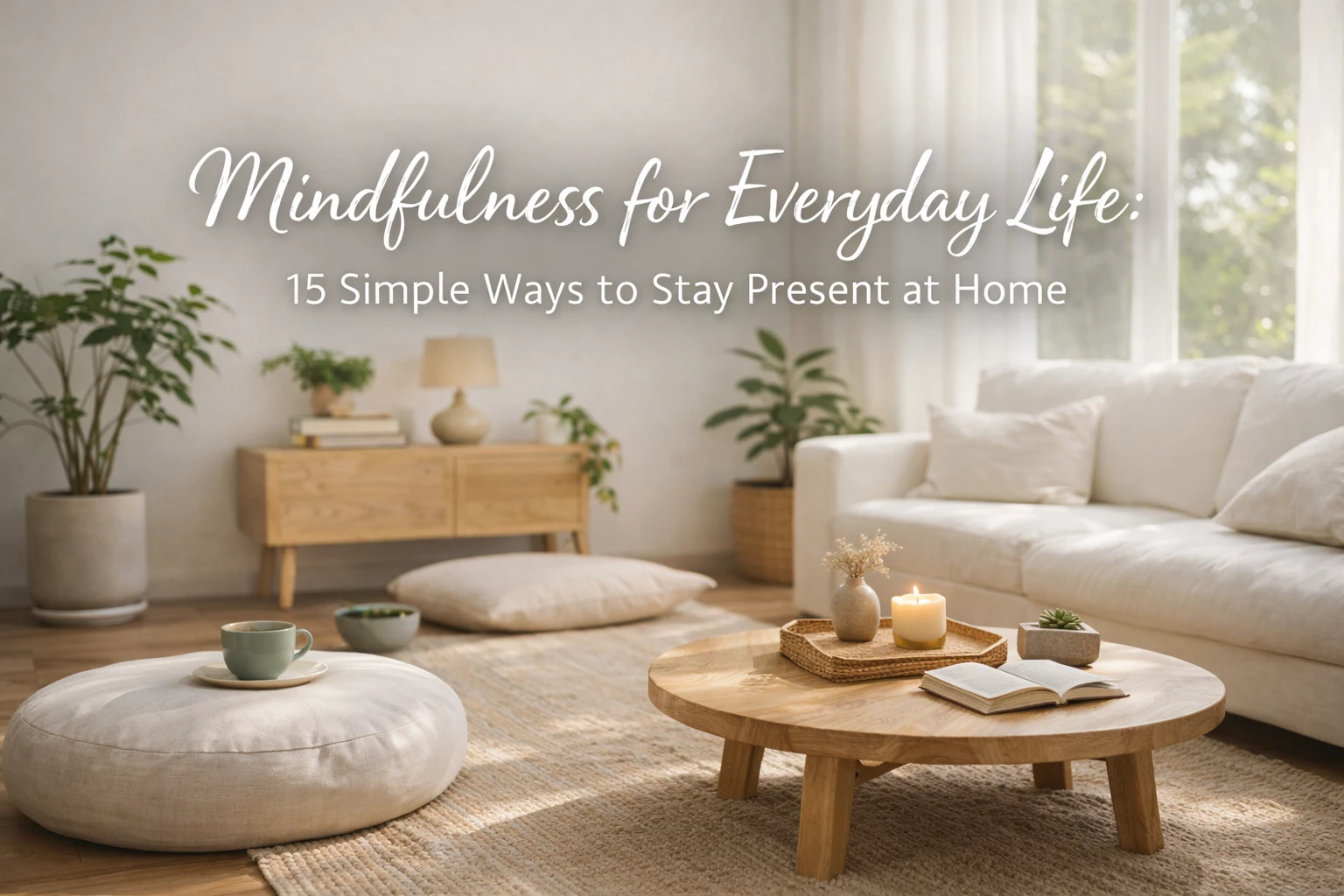
So glad you're here - let's make something meaningful together!
Table of Contents

Last Updated: September 21, 2026
Sometimes you are sitting at home, but your attention is somewhere else.
You may be eating while scrolling through your phone, listening to someone while thinking about your next task, washing dishes while replaying an argument, or lying in bed while mentally planning tomorrow.
Your body is in the room.
Your attention is not.
This is one reason mindfulness for everyday life can be so practical. You do not necessarily need another appointment, another productivity system, or another complicated morning routine. You can begin with moments that are already part of your day.
Mindfulness is the practice of intentionally noticing what is happening in the present moment with openness rather than immediately judging, avoiding, or reacting to it.
At home, that might mean actually tasting your morning coffee, listening carefully when someone speaks, noticing your thoughts while doing laundry, eating one meal without a screen, or taking a brief pause before responding when you feel irritated.
This guide explains what mindfulness really means, what current research suggests, and 15 realistic ways to practice it at home—even when your schedule is busy.
Quick Answer: What Is Mindfulness for Everyday Life?
Mindfulness for everyday life means bringing deliberate attention to what you are doing, thinking, feeling, and experiencing right now, without immediately judging or reacting to it.
You can practice mindfulness while drinking tea, washing dishes, walking through your home, talking with your partner, eating dinner, noticing difficult emotions, or preparing for bed.
You do not have to meditate for an hour or create a perfectly quiet home. The most useful starting point is usually much smaller: choose one ordinary activity and practice giving it your full attention for a few minutes.
What Is Mindfulness?
Mindfulness is commonly described as paying attention to present-moment experience with an attitude of openness and nonjudgment.
That experience can include:
- physical sensations
- sounds
- thoughts
- emotions
- breathing
- visual details
- the people around you
- the activity you are currently doing
The important part is not simply noticing.
It is noticing without immediately getting pulled into a reaction.
For example, suppose you are washing dishes and suddenly remember an unpleasant conversation.
A distracted response might be:
“Why did they say that? I should have said this. What if they do it again?”
A mindful response might begin with:
“I notice that I am replaying that conversation, and I feel tension in my body.”
You have not solved the problem.
You have simply noticed what is happening before automatically following the thought wherever it leads.
That small distinction is central to mindfulness.
Mindfulness Is Not the Same as Meditation
The two concepts overlap, but they are not identical.
Meditation is a broad category of formal practices. Some meditation practices involve focusing on breathing, bodily sensations, sounds, a phrase, or another object of attention.
Mindfulness can be practiced formally through meditation, but it can also be integrated into ordinary activities.
For example:
- Mindful meditation: sitting quietly and observing the breath.
- Mindful eating: noticing taste, texture, smell, and the experience of eating.
- Mindful listening: giving someone your attention instead of preparing your response.
- Mindful walking: noticing movement, contact with the ground, and your surroundings.
- Mindful emotional awareness: noticing an emotion without immediately judging yourself for having it.
NCCIH describes mindfulness as maintaining awareness of the present moment without judgment and notes that mindfulness may be practiced within different meditation approaches.
So if formal meditation does not appeal to you, you can still explore mindfulness through ordinary life.
Why Practice Mindfulness at Home?
Home is where many automatic behaviors happen.
You probably do not consciously decide how to brush your teeth, make coffee, put away dishes, check your phone, sit on the sofa, or prepare for bed.
Much of daily life runs on habit.
That makes home an unusually practical place to practice awareness.
Instead of adding another activity to your schedule, you can attach mindfulness to something you already do.
Mindfulness Can Create a Pause Between Experience and Reaction
When something frustrating happens, the first thought or emotion that appears does not always need to determine what you do next.
Mindfulness can help you notice:
- “I am becoming irritated.”
- “I am assuming what this person meant.”
- “I am worried about tomorrow.”
- “I keep checking my phone.”
- “I am rushing even though nothing requires me to rush.”
That pause is useful.
It does not guarantee a better decision, but it gives you an opportunity to choose your response more deliberately.
What Does the Research Say?
Mindfulness research is substantial, but it should be interpreted carefully.
NCCIH notes that studies have examined mindfulness and meditation in relation to stress, anxiety, depression, pain, sleep, and other outcomes, while also emphasizing that different practices and study designs make the evidence difficult to summarize as one universal effect.
A 2026 systematic review and meta-analysis of 17 randomized controlled trials involving 1,641 non-clinical adults found that mindfulness-based interventions were associated with significantly lower perceived stress after intervention. The authors also noted the need for further research, particularly around physiological stress markers.
That supports a reasonable conclusion:
Mindfulness can be a useful wellbeing practice, particularly for managing perceived stress, but it should not be presented as a cure-all or a replacement for appropriate medical or mental-health care.
15 Simple Ways to Practice Mindfulness at Home
You do not need to practice all 15.
Choose one or two that fit naturally into your current life. Once they become familiar, you can experiment with another.
1. Start Your Morning Before Checking Your Phone
For many people, the first moments of the day are immediately filled with notifications, headlines, messages, and other people’s requests.
Try creating a short buffer before opening your phone.
You might:
- sit on the edge of the bed for a moment
- notice how your body feels
- look at the light coming through the window
- take a few comfortable breaths
- notice your first thoughts without trying to change them
You do not need to wait an hour.
Even a few minutes can give you an opportunity to notice your own state before immediately responding to the outside world.
The goal is not “never use your phone in the morning.”
The goal is not letting your phone automatically become the first thing that receives your attention every day.
2. Turn Your Morning Coffee or Tea Into a Mindfulness Practice
You probably already have a morning drink.
Use it as an attention anchor.
Before drinking, notice:
- the smell
- the temperature of the cup
- the color
- the first taste
- the sensation as you swallow
If your attention wanders, gently bring it back.
You are not trying to make coffee profound.
You are practicing the ability to notice one experience instead of automatically dividing your attention between several things.
This same practice works with water, breakfast, fruit, or any other ordinary part of your morning.
3. Practice Mindful Breathing
Breathing is useful as a mindfulness anchor because it is already happening.
You do not have to force your breathing into a particular pattern.
Instead, try this simple exercise:
- Sit comfortably.
- Notice where you feel your breathing most clearly.
- Follow one inhalation from beginning to end.
- Follow one exhalation from beginning to end.
- When your attention wanders, notice that it wandered.
- Return your attention to the next breath.
Do this for one to three minutes.
The practice is not successfully keeping your mind blank.
The practice is noticing when your attention leaves and gently returning it.
If focusing on your breath feels uncomfortable, choose another neutral anchor such as sounds, your feet touching the floor, or the feeling of your hands resting in your lap.
4. Listen Fully During Conversations
One of the most meaningful forms of mindfulness happens between people.
When someone is talking to you, notice how often you:
- prepare your response
- think about what you need to do next
- check your phone
- interpret their intentions before they finish speaking
- wait for an opportunity to correct them
Try a different approach.
For one conversation, give the person your full attention.
Listen to the words.
Notice their tone.
Allow a brief pause before responding.
Ask a follow-up question when appropriate.
This does not guarantee that conflict will disappear or that every conversation will go well. But attentive listening can make it easier to understand what another person is actually saying.
For more practical relationship communication strategies, see How to Improve Communication in Relationships.
5. Choose One Household Task to Do Mindfully
Housework is often treated as something to finish as quickly as possible.
Try turning one ordinary task into a short mindfulness exercise.
Choose:
- washing dishes
- folding laundry
- cooking
- sweeping
- showering
- watering plants
- cleaning a table
For a few minutes, do only that task.
Notice your hands.
Notice sounds.
Notice movement.
Notice when your thoughts leave the activity.
You may discover that the task itself is not as unpleasant as the mental resistance surrounding it.
And if you still dislike washing dishes afterward, that is fine.
Mindfulness is not about convincing yourself that every chore is enjoyable.
6. Try the 5-4-3-2-1 Sensory Grounding Exercise
When you feel mentally scattered, you can deliberately reconnect with your immediate surroundings.
Try noticing:
- 5 things you can see
- 4 things you can physically feel
- 3 things you can hear
- 2 things you can smell
- 1 thing you can taste
Take your time.
The original version of this exercise is often described as a grounding technique. It is better to describe it as a way of directing attention toward present sensory information rather than promising that it will “instantly reduce anxiety.”
If you are experiencing severe or persistent anxiety, grounding exercises can be one coping strategy, but they should not replace appropriate professional care.
7. Practice Mindful Walking Around Your Home
You do not need a forest trail.
Walk from your bedroom to the kitchen.
Walk to the mailbox.
Walk around the garden.
As you walk, notice:
- your feet touching the ground
- the movement of your legs
- your posture
- the rhythm of your steps
- sounds around you
- changes in light and temperature
There is no need to walk unusually slowly.
Simply walk with more awareness than usual.
If you notice yourself thinking about something else, gently return to the physical experience of walking.
8. Eat One Meal Without Screens
Choose one meal—or even the first five minutes of one meal—and put your screens away.
Notice:
- the smell of the food
- the colors on your plate
- the first bite
- texture and temperature
- your hunger and fullness
- the people you are eating with
You do not have to eat every meal in silence.
In fact, conversation can be part of mindful eating.
The goal is simply to reduce automatic multitasking and become more aware of the experience you are already having.
For families, this can also become a small opportunity for connection.
9. Notice Thoughts Without Automatically Believing Them
Mindfulness does not require positive thinking.
It allows difficult thoughts to be noticed without immediately treating them as facts.
Suppose you think:
“Nobody appreciates what I do.”
Instead of arguing with yourself or accepting the statement as completely true, try:
“I am having the thought that nobody appreciates what I do.”
Or:
“I notice that I feel unappreciated right now.”
This small change creates some distance between you and the thought.
It does not mean the feeling is wrong.
It means you are observing your experience rather than automatically becoming the experience.
When This Practice Is Especially Useful
Try it when you notice:
- repetitive worry
- self-criticism
- anger
- embarrassment
- fear about the future
- replaying an old conversation
Start with observation before trying to solve the problem.
10. Create a Small Mindfulness Corner
You do not need a dedicated meditation room.
A chair near a window can be enough.
You might keep:
- a comfortable cushion
- a book
- a journal
- a plant
- a soft blanket
- natural light
The objects are optional.
The important part is creating a place that reminds you to pause.
It can become an environmental cue:
When I sit here, I give myself a few minutes of undivided attention.
This connects naturally with Slow Living at Home: How to Create a More Meaningful & Calm Daily Life.
11. Notice Three Things You Appreciate
At the end of the day, pause and identify three small things you appreciated.
They do not need to be major achievements.
Perhaps:
- someone made you laugh
- your shower felt relaxing
- you enjoyed a good meal
- the weather was pleasant
- you completed an annoying task
- you had a meaningful conversation
- you had ten quiet minutes alone
You can write them down or simply notice them mentally.
The purpose is not to force yourself to feel grateful when you are having a difficult day.
It is to practice noticing experiences that might otherwise pass unnoticed.
12. Create a Digital Boundary That You Can Actually Keep
The original version of this article recommended an “after 8 PM” rule.
That is too rigid for many people.
If you work evenings, care for family members, communicate across time zones, or simply prefer another schedule, choose a boundary that fits your life.
For example:
- no phone during breakfast
- no social media during meals
- phone outside the bedroom for the first 20 minutes after waking
- one screen-free hour before bed when practical
- notifications turned off during conversations
- email checked only at selected times
The goal is not to eliminate technology.
The goal is to stop technology from automatically claiming every empty moment.
13. Practice Mindful Connection Through Touch
Physical affection can become automatic too.
When you hug your partner, child, parent, or another loved one, try pausing for a moment.
Notice:
- the physical contact
- your breathing
- the warmth of the interaction
- your emotional response
- the fact that you are sharing this moment with another person
There is no need to turn every hug into a mindfulness exercise.
Simply allow yourself to be present during moments of connection instead of immediately moving on to the next task.
For more ideas about building emotional intimacy through ordinary moments, read Building Emotional Intimacy Through Small Daily Moments.
14. Use a One-Minute Reset
You do not always have time for a 20-minute meditation.
That should not prevent you from practicing awareness.
When you notice yourself rushing or becoming overwhelmed, pause for about one minute.
Try this:
- Stop what you are doing if it is safe to pause.
- Feel your feet or the chair beneath you.
- Take one comfortable breath.
- Notice what you are thinking.
- Notice what emotion is present.
- Ask what needs your attention right now.
- Continue with the next appropriate action.
You are not trying to make yourself perfectly calm.
You are checking in before continuing.
That distinction makes the practice more realistic.
15. End the Day With a Short Reflection
Before bed, take two or three minutes to reflect.
Ask yourself:
- Where was I genuinely present today?
- When was I most distracted?
- What emotion appeared repeatedly?
- What mattered to me today?
- Was there a moment I would like to remember?
- What can wait until tomorrow?
You do not need to write a long journal entry.
A few sentences are enough.
Reflection turns mindfulness into learning because you begin to notice patterns in how you spend your attention.
How to Make Mindfulness a Habit Without Turning It Into a Chore
One of the easiest ways to abandon mindfulness is to make it too complicated.
You do not need a perfect schedule.
Instead, connect a short practice with something you already do.
Try These Mindfulness Anchors
- After brushing your teeth: notice your breathing for three breaths.
- Before opening your laptop: decide what deserves your attention first.
- Before eating: take one moment to notice the food.
- When entering your home: pause before immediately checking your phone.
- When washing your hands: notice temperature and sensation.
- Before bed: identify one meaningful moment from the day.
These small cues make mindfulness easier to remember because you are attaching it to an existing behavior.
What to Do When Your Mind Will Not Stop Racing
This is one of the most common misunderstandings about mindfulness.
Many beginners think:
“I cannot meditate because my mind is too busy.”
But a busy mind does not mean you are failing.
The mind produces thoughts.
That is what minds do.
The practice is noticing where your attention has gone and gently returning it.
For example:
“I am thinking about tomorrow.”
Then return to your breath.
A few seconds later:
“Now I am thinking about yesterday.”
Return again.
That return is part of the practice.
You do not need to win a battle against your thoughts.
What If Mindfulness Makes Me More Aware of Difficult Feelings?
This is an important point that is often missing from lifestyle articles about mindfulness.
Mindfulness does not guarantee that you will always feel calmer.
Sometimes becoming more attentive can make you more aware of emotions that were previously easy to ignore.
You might notice:
- sadness
- anger
- loneliness
- worry
- physical tension
- grief
That does not automatically mean mindfulness is harming you.
It may simply mean you are noticing something that was already present.
However, mindfulness should not be treated as a substitute for professional care when someone is experiencing significant mental-health symptoms.
NCCIH notes that meditation and mindfulness practices are generally considered to have few risks, but research on adverse effects is limited and some studies have reported negative experiences. It also advises against using mindfulness or meditation to replace conventional care or delay medical attention.
If a practice consistently increases distress, stop or modify it and consider discussing the experience with an appropriately qualified professional.
Mindfulness at Home and Relationships
Mindfulness can also change the way you participate in relationships.
Consider what happens during a disagreement.
Someone says something that hurts you.
Your body reacts.
Your mind immediately produces an interpretation.
You prepare a response.
Before you know it, the conversation has escalated.
A mindful pause does not mean ignoring the problem.
It can mean noticing:
- “I am getting defensive.”
- “I want to interrupt.”
- “I am assuming what they mean.”
- “I need a moment before responding.”
That awareness can create an opportunity for a more deliberate response.
Mindfulness alone does not guarantee healthier relationships. Communication skills, mutual respect, boundaries, trust, and willingness to repair conflict also matter.
But attentive presence is one useful part of healthy communication.
Mindfulness for Different People at Home
For Busy Parents
Do not wait for the house to become quiet.
Practice during ordinary moments:
- listen when your child tells you a story
- notice the experience of preparing a meal together
- take three breaths before responding to a frustrating behavior
- put your phone away during one shared activity
Mindfulness with children is often noisy and imperfect.
That is okay.
For Couples
Try one device-free conversation each day.
Ask:
- How was your day?
- What felt difficult?
- What was one good moment?
- Is there anything you need from me tonight?
Then actually listen to the answer.
For People Living Alone
Mindfulness can help make solitary time more intentional.
Try:
- cooking a meal without scrolling
- reading without background notifications
- taking a mindful walk
- creating a quiet corner
- keeping a short reflection journal
- enjoying music without multitasking
Living alone does not mean living disconnected from your own experience.
For People With Very Busy Schedules
Use micro-practices.
Thirty seconds of deliberate attention is still an opportunity to practice awareness.
The objective is not to accumulate meditation minutes like productivity points.
The objective is to become more intentional about where your attention goes.
Mindfulness and Your Home Environment
Your environment cannot create mindfulness for you, but it can either support or compete with your attention.
A home filled with constant notifications, television noise, clutter, and unfinished tasks may make it harder to notice what you are doing.
That does not mean you need a minimalist home.
Instead, identify places where your environment repeatedly pulls your attention away.
You might:
- keep your phone charger outside the bedroom
- create one screen-free chair
- keep the dining table clear enough to use comfortably
- reduce unnecessary background noise
- create a small reading or reflection space
- keep frequently used items where they are easy to find
For broader ideas about designing a home that supports intentional living, read Slow Living at Home.
A Simple 7-Day Mindfulness-at-Home Challenge
If 15 practices feel overwhelming, start here.
Day 1 — One Mindful Drink
Drink coffee, tea, or water without looking at your phone for the first few minutes.
Day 2 — One Mindful Task
Wash dishes, shower, cook, or fold laundry with your attention on the task.
Day 3 — One Screen-Free Meal
Eat without television or scrolling.
Day 4 — Three-Minute Breathing Practice
Follow your breathing and return when your attention wanders.
Day 5 — One Fully Present Conversation
Put your phone away and listen carefully to someone you care about.
Day 6 — One Mindful Walk
Walk for five to ten minutes while noticing your surroundings and physical movement.
Day 7 — Evening Reflection
Write down:
- one moment when you were fully present
- one thing that distracted you
- one practice you would like to continue
Do not try to maintain all seven practices permanently.
Choose the one that felt natural enough to repeat.
How Long Should You Practice Mindfulness?
There is no single number of minutes that everyone needs.
Some people prefer formal meditation sessions of 10–20 minutes. Others find it more sustainable to use several short moments throughout the day.
For everyday mindfulness, consistency and practicality matter more than chasing a specific number.
You can start with:
- one minute of breathing
- three mindful breaths before meals
- five minutes of mindful walking
- one screen-free meal
- two minutes of evening reflection
If you enjoy longer meditation, you can gradually increase the time.
If you do not, everyday mindfulness can still be meaningful.
Common Mistakes When Starting Mindfulness
1. Trying to Empty Your Mind
Mindfulness does not require an empty mind.
Thoughts will appear.
Notice them and return your attention.
2. Expecting Immediate Calm
Sometimes you will feel calmer.
Sometimes you will simply notice how distracted, tired, or irritated you are.
Awareness is not always comfortable.
3. Turning Mindfulness Into Another Productivity Goal
You do not need to become the “perfect mindful person.”
That would simply create another source of pressure.
4. Using Mindfulness to Avoid Real Problems
Mindfulness is not a reason to tolerate unhealthy relationships, ignore serious problems, or avoid necessary decisions.
You can notice your feelings and still take action.
5. Assuming More Is Always Better
If a practice is making you uncomfortable, excessively self-focused, or distressed, adjust it rather than forcing yourself to continue.
What Are the Long-Term Benefits of Everyday Mindfulness?
It is tempting to promise a long list of benefits, but the evidence does not justify saying that mindfulness will produce the same outcome for everyone.
Research suggests mindfulness-based approaches can help with some measures of stress and may help some people with anxiety and depressive symptoms, but findings vary by intervention, population, comparison group, and outcome. NCCIH specifically notes that research quality and results are mixed across different applications.
For everyday life, a more grounded way to think about potential benefits is that mindfulness may help you practice:
- greater awareness of your internal experience
- more deliberate attention
- less automatic engagement with some thoughts
- better recognition of stress signals
- more intentional responses in everyday situations
- greater appreciation of ordinary experiences
These are skills, not guarantees.
And like most skills, they become more familiar through practice.
Frequently Asked Questions About Mindfulness for Everyday Life
What is the easiest way to start practicing mindfulness at home?
Choose one ordinary activity you already do every day, such as drinking coffee, showering, washing dishes, or eating breakfast. For a few minutes, give that activity your full attention and notice when your mind wanders.
How long should I practice mindfulness each day?
There is no universal minimum. You can begin with one to five minutes and gradually increase the time if you find it useful. You can also practice through short moments during ordinary activities rather than one formal session.
Is mindfulness the same as meditation?
No. Meditation is a broad category of formal practices, while mindfulness is a quality of present-moment awareness that can be practiced during meditation or ordinary activities such as eating, walking, listening, and household tasks.
Can mindfulness help with stress?
Research suggests that mindfulness-based interventions can reduce perceived stress for some people. A 2026 systematic review and meta-analysis of 17 randomized controlled trials involving 1,641 non-clinical adults found a significant reduction in perceived stress following mindfulness-based interventions. However, results vary by program and population, and mindfulness should not be treated as a universal solution.
Can mindfulness reduce anxiety?
Some research suggests mindfulness-based approaches can help reduce anxiety symptoms, but the evidence varies by condition and intervention. NCCIH notes that mindfulness approaches have shown benefits in some studies while also emphasizing limitations in study quality and long-term evidence. Mindfulness should not replace professional treatment for a diagnosed anxiety disorder.
How long does it take to see results from mindfulness?
There is no reliable timetable that applies to everyone. Some people notice changes in how they relate to stress relatively quickly, while others need longer practice. Research studies often use structured programs lasting several weeks, but study results should not be interpreted as a guarantee that a particular person will experience a specific change after a specific number of days.
What if I cannot stop my thoughts during meditation?
You do not need to stop your thoughts. Notice that you are thinking, then gently return your attention to your chosen anchor. The act of noticing and returning is part of the practice.
Can I practice mindfulness while doing housework?
Yes. Washing dishes, folding laundry, cooking, cleaning, and showering can all become opportunities to practice present-moment awareness. The goal is not to make chores enjoyable but to reduce automatic multitasking and notice what you are doing.
Can mindfulness improve relationships?
Mindful listening and greater awareness of your own reactions can support more attentive communication, but mindfulness alone does not guarantee a healthy relationship. Trust, respect, communication skills, boundaries, and willingness to repair problems also matter.
Is mindfulness always safe?
Mindfulness and meditation are generally considered to have few risks, but they are not completely risk-free for everyone. NCCIH notes that some studies have reported negative experiences, including anxiety or depression symptoms, and recommends not using mindfulness as a substitute for conventional medical care.
Authoritative Sources & References
National Center for Complementary and Integrative Health (NCCIH)
Meditation and Mindfulness: Effectiveness and Safety — an evidence-focused overview of what mindfulness and meditation are, potential benefits, research limitations, and safety considerations.
2026 Systematic Review and Meta-Analysis
Effects of mindfulness-based interventions on perceived stress among non-clinical adults: a systematic review and meta-analysis — 2026 review of randomized controlled trials examining mindfulness-based interventions and perceived stress.
JAMA Internal Medicine Evidence Review
Meditation Programs for Psychological Stress and Well-being: A Systematic Review and Meta-analysis — systematic review examining evidence for meditation programs and psychological stress and wellbeing outcomes.
2025 Review of Mechanisms and Stress-Related Health
How mindfulness-based training improves stress-related health: a selective review of randomized clinical trials comparing psychological mechanisms of action — review discussing evidence and limitations concerning how mindfulness-based training may influence stress-related outcomes.
Related LoveAHH Guides
- Slow Living at Home: How to Create a More Meaningful & Calm Daily Life
- Living with Intention: A Gentle Guide to Mindful Living
- Finding Joy in Simple Moments: A Mindful Life at Home
- Self-Care at Home for Emotional Wellbeing
- How to Find Inner Balance in a Busy World
- How to Improve Communication in Relationships
- Building Emotional Intimacy Through Small Daily Moments
- Create a Peaceful Home Environment
Final Thoughts: Presence Is a Practice, Not a Personality
You do not have to become a naturally calm person to practice mindfulness.
You do not need a perfectly quiet home.
You do not need an expensive meditation cushion.
You do not need to eliminate your thoughts.
You simply need to notice where your attention is—and occasionally choose to bring it back.
Back to the person speaking to you.
Back to the food in front of you.
Back to your feet touching the floor.
Back to the task in your hands.
Back to the feeling that is actually present instead of the story your mind is building around it.
That is the quiet power of mindfulness for everyday life.
You are not trying to escape ordinary life. You are practicing being there for it.
Start with one moment today.
Give it your attention.
Then let the next moment come.
Recommended Articles:
- AI Travel Matching Review: Can This AI Trip Planner Really Find Your Perfect Travel Style?
- WaysToMakeMoney.lovable.app Review: Can This AI Side Hustle Tool Really Help You Make Money Online?
- Why Do I Feel Stressed Even When Nothing Is Wrong? Understanding Hidden Anxiety and Chronic Stress
- Why Do I Feel Like I Have No Purpose? Find Meaning & Direction Again
- Why Do I Overthink Everything at Night? A Deep Guide to Quieting Racing Thoughts and Finding Peace
- Why Do I Feel Empty Even When Life Is Good? A Deep Guide to Emotional Emptiness, Purpose, and Healing
- Finding Joy in Simple Moments: A Mindful Life at Home

- Living with Intention: A Gentle Guide to Mindful Living for Inner Peace

- Mindfulness for Everyday Life: 15 Simple Ways to Stay Present at Home

- Slow Living at Home: How to Create a More Meaningful & Calm Daily Life