

This is my little online home where we celebrate life's real magic - the warm connections, simple self-care rituals, and those quiet moments that stay with you.
What I do here:
• Craft stories and tips to brighten your everyday
• Build a space where everyone feels welcome
• Make each visit worth your while - whether you need quick advice or food for thought
My superpowers? Turning ordinary moments into something special through words that actually mean something.
Off-screen, I'm probably:
☕ Curled up with a book that changes my perspective
🎨 Trying some new creative hobby
🌿 Noticing the small wonders we usually rush past
So glad you're here - let's make something meaningful together!
Table of Contents
Last Updated: October 4, 2026
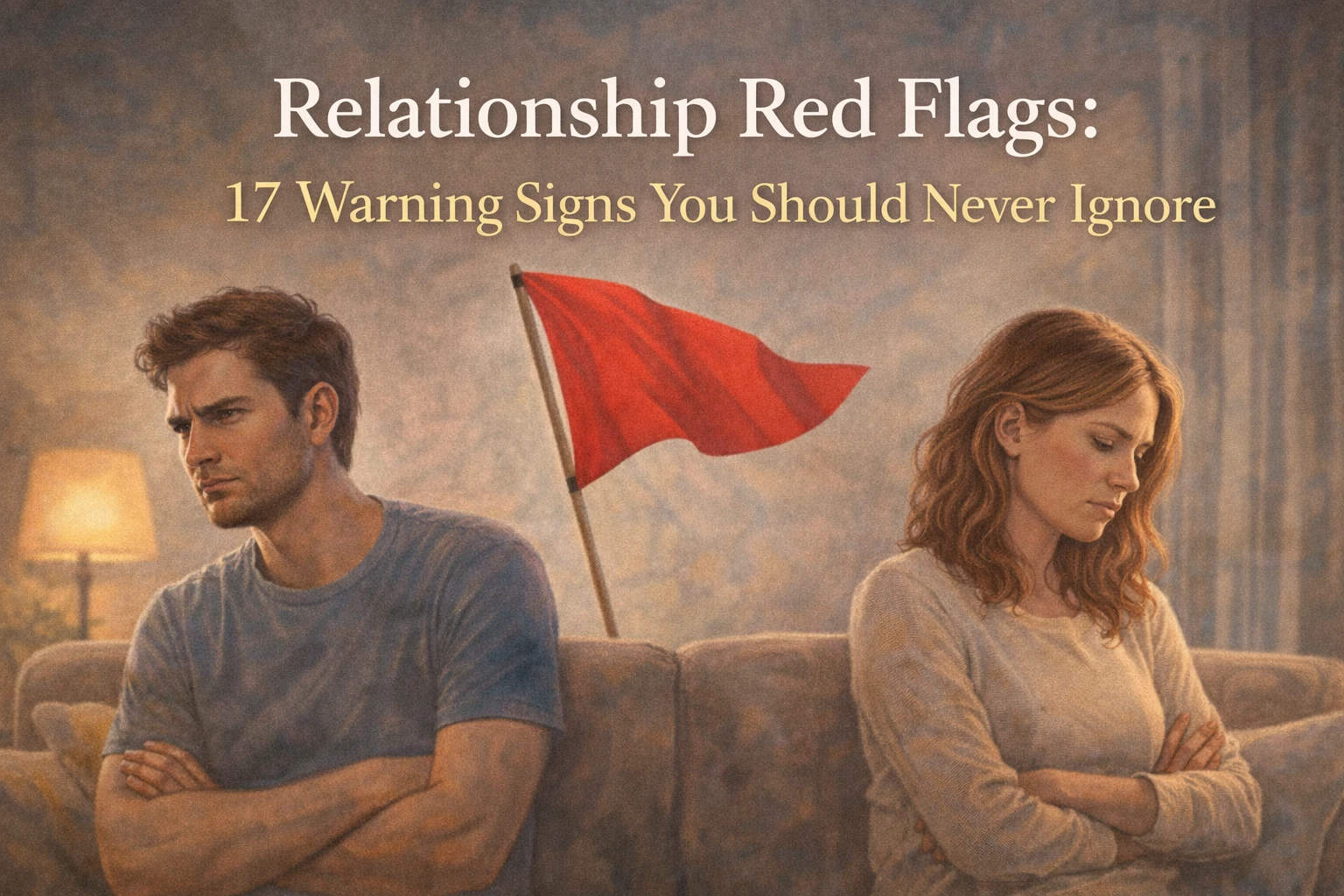
Quick Answer: Relationship red flags are repeated behaviors that can signal disrespect, manipulation, unhealthy control, emotional harm, or abuse. Common warning signs include controlling who you see, excessive jealousy, repeated lying, humiliation, boundary violations, isolation, financial control, sexual pressure, threats, intimidation, and making you question your own reality. One difficult moment does not automatically mean a relationship is unhealthy, but repeated patterns that make you feel afraid, controlled, diminished, or unable to be yourself deserve serious attention.

Relationships rarely become unhealthy all at once.
Sometimes the first sign is surprisingly small.
Your partner gets irritated when you spend time with a friend.
They want to know where you are all the time.
They make a joke about your appearance, then tell you that you are “too sensitive” when it hurts.
They become angry when you say no.
They repeatedly promise to change, but the same behavior keeps happening.
None of these situations should automatically lead to a conclusion about the entire relationship. Context matters. People make mistakes. Couples disagree. Everyone has moments when they communicate poorly.
But patterns matter.
The more a relationship moves toward control, fear, humiliation, isolation, coercion, or loss of personal freedom, the more seriously the behavior should be taken.
This guide explains 17 relationship red flags, how to distinguish an ordinary relationship problem from a more serious warning sign, and what you can do if several of these patterns feel familiar.
What Are Relationship Red Flags?
A relationship red flag is a behavior or pattern that suggests a relationship may have a serious problem that deserves attention.
Red flags can involve communication, trust, boundaries, emotional safety, money, sex, friendships, family, or physical safety.
Some are relatively subtle.
Others are unmistakably serious.
For example, repeatedly forgetting an important date is not the same as threatening someone. Being emotionally unavailable is not the same as preventing a partner from seeing friends. Having an argument is not the same as intimidating someone until they agree.
That distinction matters.
The goal of identifying red flags is not to label every imperfect relationship as “toxic.” It is to recognize patterns that may be damaging, controlling, or unsafe before they become normalized.
The National Domestic Violence Hotline describes relationship abuse as a pattern of behaviors used to establish or maintain power and control over a partner. Its warning signs include controlling behavior, isolation, humiliation, financial control, intimidation, threats, sexual pressure, and other forms of coercion.
Relationship Problems vs. Relationship Red Flags
Every relationship has problems.
Two people can disagree about money, household responsibilities, sex, family, parenting, social plans, or how much time they want together.
A disagreement alone is not necessarily a red flag.
The more useful question is:
What happens when the two of you disagree?
In a healthier relationship, you may be frustrated, disappointed, or even angry, but there is still room for respect, boundaries, honesty, and repair.
A more concerning pattern occurs when one person repeatedly uses fear, punishment, humiliation, manipulation, threats, or control to get their way.
The U.S. Office on Women’s Health distinguishes unhealthy relationships from abusive relationships while noting that unhealthy relationships can involve pressure, fear, loss of independence, inability to communicate honestly, and lack of support.
So do not ask only:
“Do we argue a lot?”
Also ask:
- Can I disagree without being punished?
- Can I say no?
- Can I maintain friendships and family relationships?
- Can I make reasonable decisions for myself?
- Do I feel safe expressing my needs?
- Does my partner respect my boundaries?
- Can we take responsibility when we hurt each other?
- Am I increasingly afraid of my partner’s reactions?
17 Relationship Red Flags You Should Never Ignore
These warning signs are not all equally serious. Some indicate an unhealthy relationship pattern, while others can indicate abuse or an immediate safety concern.
Look at the pattern, frequency, escalation, impact, and your ability to set boundaries.
1. Your Partner Tries to Control Who You See
A partner may express insecurity occasionally. That is different from trying to control your relationships.
Watch for behaviors such as:
- Demanding that you stop seeing certain friends
- Criticizing everyone close to you
- Creating arguments whenever you make plans without them
- Making you feel guilty for spending time with family
- Insisting that you choose between the relationship and other important people
Healthy love allows room for friendships, family connections, and individual interests.
When a partner deliberately isolates you, the concern becomes much more serious. Isolation is a recognized warning sign of relationship abuse.
2. Excessive Jealousy Becomes Control
Jealousy is a human emotion. Feeling jealous does not automatically make someone abusive.
The red flag appears when jealousy becomes a justification for controlling your behavior.
Examples include:
- Repeated accusations of cheating without evidence
- Demanding constant updates about where you are
- Checking your phone without permission
- Questioning every interaction with another person
- Becoming angry whenever you spend time away from them
Trust does not require constant surveillance.
3. They Constantly Put You Down
Healthy partners can give honest feedback without repeatedly attacking your worth.
A concerning pattern may involve:
- Calling you stupid, worthless, unattractive, or incapable
- Mocking your appearance
- Making fun of your weaknesses
- Embarrassing you in front of other people
- Using your insecurities against you during arguments
The National Domestic Violence Hotline identifies insults, humiliation, demeaning behavior, and repeated criticism as potential signs of emotional abuse.
4. You Are Afraid of Their Reaction
This is one of the most important questions to ask yourself.
Do you regularly change what you say, wear, do, or decide because you are afraid of how your partner will react?
Perhaps you rehearse conversations before bringing something up.
Maybe you hide purchases because you know they will become angry.
Maybe you avoid mentioning certain friends.
Maybe you constantly monitor their mood.
If fear is becoming part of your decision-making, do not dismiss it simply because your partner has not physically hurt you.
Emotional intimidation and threatening behavior can be serious forms of harm.
5. They Ignore or Repeatedly Violate Your Boundaries
A boundary is not a demand that another person become exactly who you want them to be.
It is a limit around what you are comfortable with and what you will participate in.
For example:
- “I don’t want to discuss this while we’re yelling.”
- “Please don’t read my private messages.”
- “I’m not comfortable with that sexual activity.”
- “I need some time alone tonight.”
A partner may disagree with a boundary, but repeatedly violating it is concerning.
The situation becomes particularly serious when saying no leads to threats, punishment, intimidation, or coercion.
6. They Make You Feel Guilty for Having Normal Needs
Everyone has needs in a relationship.
You may need affection, personal space, emotional support, rest, privacy, friendship, sex, or time alone.
A red flag appears when your partner consistently makes you feel selfish, needy, dramatic, or unreasonable simply for expressing normal needs.
For example:
“If you really loved me, you wouldn’t need time away from me.”
Love should not require you to eliminate your own needs.
7. They Constantly Blame You for Their Behavior
People are responsible for their own actions.
A partner can be angry without insulting you. They can be disappointed without threatening you. They can feel jealous without monitoring you.
Statements such as:
- “You made me yell.”
- “If you hadn’t done that, I wouldn’t have hit you.”
- “You forced me to check your phone.”
- “It’s your fault I treat you this way.”
shift responsibility away from the person choosing the behavior.
The Hotline specifically identifies blaming the other partner for abusive behavior as a warning sign.
8. They Gaslight You or Repeatedly Undermine Your Reality
Gaslighting is more than having different memories of an argument.
People can genuinely remember events differently.
The concern is a repeated pattern of denying, distorting, or dismissing your experiences in a way that makes you increasingly distrust your own perception.
You may hear:
- “That never happened.”
- “You’re imagining things.”
- “You’re always crazy.”
- “Everyone agrees you’re too sensitive.”
- “You can’t trust your own memory.”
When this happens repeatedly alongside manipulation or control, it deserves serious attention. Emotional abuse resources identify questioning a partner’s reality and dismissing their perceptions as potential abusive behavior.
9. They Use the Silent Treatment as Punishment
Taking a break from an argument can be healthy.
For example:
“I’m too upset to have this conversation productively. I need an hour, and then let’s come back to it.”
That is different from deliberately withholding communication or affection to punish, frighten, or control you.
Look at what happens afterward.
Does the pause create space for repair?
Or does it become a way to make you desperate enough to apologize for something you did not do?
10. They Control Money or Financial Independence
Couples can legitimately choose different ways to manage finances.
Shared accounts, separate accounts, budgets, and different spending arrangements can all work when both people agree.
Financial control is different.
Warning signs may include:
- Taking your money without consent
- Preventing you from accessing necessary funds
- Monitoring every purchase to control you
- Preventing you from working
- Using money to punish or threaten you
- Creating financial dependence so leaving becomes more difficult
Financial control is recognized as one form of relationship abuse.
11. They Pressure or Coerce You Sexually
Consent should be freely given.
You do not owe someone sex because you are married, dating, engaged, or because you agreed to intimacy previously.
Serious warning signs include:
- Pressuring you after you say no
- Using guilt to obtain sex
- Threatening to leave or cheat if you refuse
- Ignoring a clear refusal
- Forcing sexual activity
- Interfering with contraception or reproductive choices
The Office on Women’s Health identifies forced sex, sexual pressure, and reproductive control as forms of abuse.
12. They Threaten You, Themselves, Other People, or Pets
Threats should not be dismissed simply because the person later says they were “just angry.”
Threats may involve:
- Threatening to hurt you
- Threatening your children
- Threatening friends or family
- Threatening pets
- Threatening themselves to control your decisions
- Threatening to destroy important belongings
The Hotline lists threats to hurt a partner, loved ones, pets, or oneself as serious warning signs.
13. They Intimidate You or Destroy Things
Physical violence is not the only form of intimidation.
Someone may punch a wall, throw objects, destroy belongings, drive dangerously during arguments, block a doorway, or use threatening gestures.
Even when they do not directly hit you, these behaviors can create fear.
The Hotline identifies intimidation, destruction of property, and threatening behavior among abuse warning signs.
14. They Monitor Your Phone, Location, or Online Activity
Sharing locations or passwords can be a voluntary choice between partners.
It becomes concerning when monitoring is demanded, forced, or used as a condition of trust.
Examples include:
- Demanding your passwords
- Reading private messages without permission
- Tracking your location without meaningful consent
- Demanding immediate replies at all times
- Checking your social media interactions
- Questioning every person who contacts you
The Office on Women’s Health specifically lists monitoring activities, demanding passwords, and controlling communication as warning signs of abuse.
15. They Isolate You From Work, School, Family, or Friends
Isolation can develop gradually.
At first, it might sound romantic:
“I just want you all to myself.”
Over time, it can become:
“You don’t need those people. You only need me.”
If your partner repeatedly prevents or discourages you from maintaining important relationships, work, education, or outside activities, take the pattern seriously.
Isolation is one of the established warning signs of relationship abuse.
16. They Refuse Accountability and the Same Harmful Pattern Keeps Repeating
Apologies matter.
But an apology without meaningful change can become part of a cycle.
A healthier repair might sound like:
“I was wrong. I understand how that affected you. Here’s what I’m going to do differently.”
A concerning pattern may look like:
- Hurtful behavior
- Argument
- Apology
- Promises to change
- Temporary improvement
- The same behavior again
One failed attempt does not prove that someone will never change. Look at whether there is sustained accountability and behavior change over time.
17. You Feel Like You Are Slowly Losing Yourself
This can be one of the most difficult red flags to explain.
Maybe you used to see friends regularly but rarely do anymore.
Maybe you stopped expressing opinions because disagreements became exhausting.
Maybe you constantly worry about making your partner unhappy.
Maybe you no longer recognize yourself.
Perhaps you spend much of your energy managing their emotions instead of living your own life.
Ask yourself:
- Am I becoming smaller to keep this relationship stable?
- Do I feel free to make ordinary decisions?
- Can I be myself?
- Do I feel respected?
- Am I increasingly anxious about my partner’s reactions?
- Have I stopped doing things that used to matter to me because of this relationship?
Feeling less like yourself does not prove that your partner is abusive. But it is a strong reason to pause, reflect, and examine the relationship honestly.
Which Relationship Red Flags Are Most Serious?
Not every red flag carries the same level of risk.
Some problems may be addressed through honest communication, boundaries, individual reflection, or couples counseling when both partners are willing and the relationship is safe.
Other behaviors require a different response.
Threats, physical violence, sexual coercion, stalking, serious intimidation, forced isolation, financial control, reproductive coercion, and behavior that makes you fear for your safety should be treated as serious safety concerns.
The National Domestic Violence Hotline emphasizes that abusive relationships often involve multiple behaviors designed to establish or maintain power and control.
If you are experiencing serious abuse, the goal should not simply be to become better at communicating with the person harming you.
Your safety comes first.
Why Patterns Matter More Than One Incident
Everyone makes mistakes.
Someone can lose their temper, say something insensitive, become jealous, forget an important responsibility, or handle an argument badly.
That does not automatically make them an abusive partner.
What matters is what happens next.
Ask five questions:
- Does it happen repeatedly?
- Is the behavior becoming more intense?
- Does your partner take responsibility?
- Can you safely set a boundary?
- Are you becoming increasingly afraid, isolated, or controlled?
A single bad interaction deserves reflection.
A repeated pattern deserves action.
A pattern involving fear and control deserves particular attention.
What About Gaslighting?
The word “gaslighting” is often used too casually online.
Not every disagreement about what happened is gaslighting.
Two people can honestly remember the same conversation differently.
Gaslighting is more concerning when one person repeatedly manipulates another person’s perception of reality, denies events that occurred, dismisses legitimate concerns, or convinces the other person that they cannot trust their own judgment.
For example, imagine you clearly remember your partner insulting you during an argument.
You bring it up later.
They say:
“I did say that, but I shouldn’t have. I’m sorry.”
That is accountability.
Compare it with:
“That never happened. You are imagining things. You are becoming unstable.”
If this happens repeatedly and is part of a larger pattern of manipulation or control, it deserves serious attention.
Is Love Bombing a Relationship Red Flag?
Intense affection at the beginning of a relationship is not automatically unhealthy.
Some people naturally become enthusiastic when they fall in love.
The concern is when overwhelming attention, gifts, promises, or affection are used to create dependency or later justify control.
For example:
- Very intense affection immediately followed by possessiveness
- Pressure to commit before you are ready
- Excessive gifts followed by expectations that you “owe” them
- Extreme declarations followed by jealousy or control
- Using previous affection as leverage during arguments
The Hotline identifies love bombing as one behavior that can occur in emotionally abusive dynamics, particularly when excessive affection and gifts are later used manipulatively.
The key is not simply how much affection someone gives you.
It is whether the affection respects your autonomy.
How Your Partner Responds to Boundaries Tells You a Lot
One useful way to evaluate a relationship is to watch what happens when you say “no.”
Imagine you say:
“I need some time alone tonight.”
A healthier response might be:
“Okay. Let me know if you want to talk later.”
A concerning response might be:
“If you loved me, you wouldn’t need time alone.”
A more serious response could involve threats, intimidation, monitoring, punishment, or preventing you from leaving.
Boundaries do not guarantee that your partner will like your decision.
They help reveal whether the relationship allows you to have decisions.
Should You Talk to Your Partner About a Red Flag?
Sometimes, yes.
If the behavior is relatively mild, the relationship feels safe, and you believe your partner can hear feedback, a direct conversation may be useful.
Try being specific:
“When you check my phone without asking, I feel that my privacy is not being respected. I need us to agree that we don’t read each other’s private messages without permission.”
Then pay attention to the response.
A healthier response may involve:
- Listening
- Asking questions
- Taking responsibility
- Apologizing
- Discussing a solution
- Making a genuine effort to change
A concerning response may involve:
- Mocking you
- Threatening you
- Blaming you
- Escalating the behavior
- Demanding that you prove your loyalty
- Punishing you for raising the issue
And if you are afraid of what will happen when you raise a concern, you do not have to confront the person alone.
When a Relationship May Be Unsafe
If your partner has threatened you, physically harmed you, forced sexual activity, stalked you, threatened your children or pets, used weapons to intimidate you, or made you afraid that leaving could put you in danger, this is more than a communication problem.
The U.S. Office on Women’s Health notes that abuse can involve physical, emotional, verbal, and sexual behaviors, including controlling finances, monitoring communications, restricting contact with others, and threats.
If you are in immediate danger, contact your local emergency services.
If you are in the United States and want confidential support related to relationship abuse, the National Domestic Violence Hotline provides support and safety-planning resources.
National Domestic Violence Hotline
Important: If you believe your partner monitors your phone, browsing history, location, or accounts, consider your digital safety before searching for help or confronting them. The safest next step can depend on your situation.
What to Do If You Recognize These Signs
You do not need to diagnose your relationship immediately.
Start by getting clear about what is happening.
1. Write down specific behaviors
Instead of writing “my partner is toxic,” write:
“They checked my phone three times this week without permission.”
Specific examples make patterns easier to recognize.
2. Notice how you feel
Do you feel safe? Respected? Free to disagree? Able to say no?
Or do you increasingly feel afraid, controlled, isolated, confused, or diminished?
3. Talk to someone you trust
Isolation can make relationship problems harder to evaluate.
A trusted friend, family member, counselor, or qualified professional can sometimes provide perspective that is difficult to access from inside the relationship.
4. Set a reasonable boundary when it is safe to do so
For less serious relationship problems, a clear boundary can help you understand whether the other person is willing to work with you.
5. Watch actions rather than promises
Real change is visible over time.
An apology matters, but consistent behavior matters more.
6. Seek professional support when you feel stuck
A licensed therapist or qualified relationship professional may help with communication, recurring conflict, emotional distance, and other relationship difficulties.
However, when abuse or coercive control is present, specialized domestic violence support may be more appropriate than ordinary couples counseling.
If You Are Worried About Someone Else
You may recognize these signs in a friend’s relationship rather than your own.
Be careful not to shame or pressure them.
Statements such as:
“Why don’t you just leave?”
can sound simple from the outside, but leaving a controlling relationship can involve emotional, financial, housing, family, and safety concerns.
Instead, consider saying:
- “I’m worried about how they are treating you.”
- “You don’t deserve to be threatened or controlled.”
- “I’m here if you want to talk.”
- “You don’t have to handle this alone.”
The Hotline recommends avoiding victim-blaming and focusing on the abusive behavior itself when supporting someone experiencing abuse.
What a Healthier Relationship Looks Like
Recognizing red flags becomes easier when you also understand what healthy behavior looks like.
A healthier relationship generally makes room for:
- Respect: You can disagree without being degraded.
- Trust: You do not need constant surveillance to prove your loyalty.
- Boundaries: “No” is allowed to mean no.
- Independence: Both people can maintain appropriate friendships, interests, and identity.
- Communication: Difficult subjects can be discussed.
- Accountability: Both partners can acknowledge mistakes.
- Emotional safety: You do not constantly fear your partner’s reaction.
- Consent: Intimacy is mutual and freely chosen.
- Shared responsibility: Major decisions are not controlled by one person.
- Repair: Hurt does not have to become permanent distance.
A healthy relationship is not conflict-free.
It is a relationship where conflict does not require one person to surrender their dignity, autonomy, or safety.
Relationship Red Flags Checklist
If you want a quick self-check, ask yourself:
- Do I feel safe expressing disagreement?
- Can I say no without being punished?
- Can I maintain relationships with friends and family?
- Does my partner respect my privacy?
- Can I make ordinary decisions for myself?
- Do I feel respected during conflict?
- Does my partner take responsibility for harmful behavior?
- Do apologies lead to meaningful change?
- Do I feel increasingly anxious about my partner’s reactions?
- Have I become isolated?
- Does my partner monitor or control me?
- Do I feel pressured sexually?
- Does my partner control money or access to resources?
- Have there been threats or intimidation?
- Have I changed myself substantially just to avoid conflict?
No checklist can diagnose a relationship.
But if many of these questions make you uncomfortable, it is worth taking your concerns seriously.
Relationship Red Flags FAQ
What are the biggest relationship red flags?
Serious red flags include controlling behavior, isolation, intimidation, threats, physical violence, sexual coercion, stalking, financial control, repeated humiliation, and persistent boundary violations. These behaviors become particularly concerning when they form a pattern of power and control.
Is jealousy a relationship red flag?
Feeling jealous is not automatically a red flag. The concern is when jealousy becomes controlling behavior, such as monitoring your phone, restricting your friendships, demanding constant updates, or repeatedly accusing you of cheating.
Is arguing a red flag in a relationship?
Not necessarily. Disagreement is normal in close relationships. What matters is how disagreements are handled. Threats, intimidation, humiliation, physical violence, coercion, and repeated contempt are more serious concerns than ordinary disagreement.
Is gaslighting always a red flag?
A repeated pattern of denying or manipulating someone’s experience can be a serious warning sign. However, two people remembering an event differently is not automatically gaslighting. Look for a broader pattern of manipulation, control, and undermining of your ability to trust your own judgment.
Is love bombing a red flag?
Intense early affection is not automatically unhealthy. It becomes more concerning when excessive attention, gifts, or declarations are used to create pressure, dependency, or control.
Can a relationship have red flags and still be healthy?
Relationships are rarely perfect. A single mistake does not define an entire relationship. The more important questions are whether the behavior is repeated, whether the person takes responsibility, whether boundaries are respected, and whether meaningful change occurs.
Should I leave if I notice relationship red flags?
There is no universal answer for every relationship problem. For ordinary unhealthy patterns, you may choose to communicate, set boundaries, seek professional support, or reconsider the relationship. If there is violence, serious threats, sexual coercion, stalking, or coercive control, prioritize safety and consider specialized support rather than confronting the situation alone.
Can an abusive partner change?
Change requires genuine responsibility and sustained behavioral change. Promises, apologies, gifts, or short periods of improvement are not enough by themselves. If you are experiencing abuse, do not make your safety dependent on the hope that someone else will change.
What should I do if I am afraid of my partner?
If you are afraid that your partner may hurt you, threaten you, stalk you, or retaliate if you set boundaries or leave, consider speaking confidentially with a trusted person or specialized domestic violence service and creating a safety plan. If you are in immediate danger, contact local emergency services.
Final Thoughts: Pay Attention to the Pattern
Relationship red flags are not about finding a perfect partner.
Everyone has flaws.
Everyone makes mistakes.
Everyone has difficult days.
The deeper question is whether the relationship allows both people to remain safe, respected, autonomous, and able to grow.
One forgotten anniversary is not the same as controlling your friendships.
One argument is not the same as a pattern of intimidation.
Feeling jealous once is not the same as monitoring someone’s phone every day.
Making a mistake is not the same as refusing accountability over and over again.
Context matters.
But so does your experience.
If you repeatedly feel afraid, controlled, isolated, humiliated, pressured, or unable to be yourself, do not automatically dismiss those feelings because the relationship also contains love.
Someone can love you and still behave in ways that are harmful.
And love does not make abuse acceptable.
A healthy relationship does not require you to give up your dignity, boundaries, friendships, identity, or safety in order to keep the relationship.
You deserve a relationship where love and respect can exist together.
Authoritative Sources & References
- The National Domestic Violence Hotline — Know the Red Flags of Abuse
- The National Domestic Violence Hotline — Warning Signs of Abuse
- The National Domestic Violence Hotline — What Is Emotional Abuse?
- The National Domestic Violence Hotline — Types of Abuse
- The National Domestic Violence Hotline — Understand Relationship Abuse
- U.S. Office on Women’s Health — Am I Being Abused?
- U.S. Office on Women’s Health — Signs of Domestic Violence or Abuse
- U.S. Office on Women’s Health — Emotional and Verbal Abuse
- U.S. Office on Women’s Health — Dating Violence and Abuse
- Centers for Disease Control and Prevention — About Intimate Partner Violence
Editorial note: This article is educational information, not a diagnosis of a relationship or a substitute for professional or emergency support.
Recommended Articles:
- How to Build Emotional Connection: A Guide to Feeling Close
- Loneliness in the Elderly: How to Reconnect and Help
- How to Reconnect with Your Partner: Rebuilding Emotional Intimacy One Step at a Time
- How to Feel Emotionally Safe in a Relationship: 10 Keys to Trust
- Why Do I Feel Distant From My Partner? 11 Reasons and How to Reconnect
- Before I Do Scan Review: Is This AI Relationship Tool Worth It?
- Parallel Vows Review: Can This App Truly Heal Relationship Drift?
- Why Do I Feel Insecure in My Relationship? Understanding Trust Issues, Fear of Loss, and Attachment Anxiety
- Why Do I Feel Disconnected From My Partner? Real Causes and Practical Ways to Reconnect
- Why Do I Feel Lonely in a Relationship? Understanding Emotional Disconnect and Finding Real Connection
- Healthy Communication Habits That Bring Families Closer

- How to Create a Loving and Supportive Family Environment
- How to Improve Communication in Relationships: 12 Practical Strategies That Work

- Building Emotional Intimacy Through Small Daily Moments

- The Foundation of Healthy Relationships: Emotional Safety, Communication, and Trust
- 15 Signs of a Healthy Relationship: What to Look For
- Relationship Red Flags: 17 Warning Signs You Should Never Ignore
- Simple Ways to Strengthen Family Relationships at Home: 12 Practical Strategies
- How to Communicate with Love and Understanding in Everyday Relationships
- 100 Best Anniversary Gifts 2026: The Ultimate Guide for Every Couple, Budget & Love Story