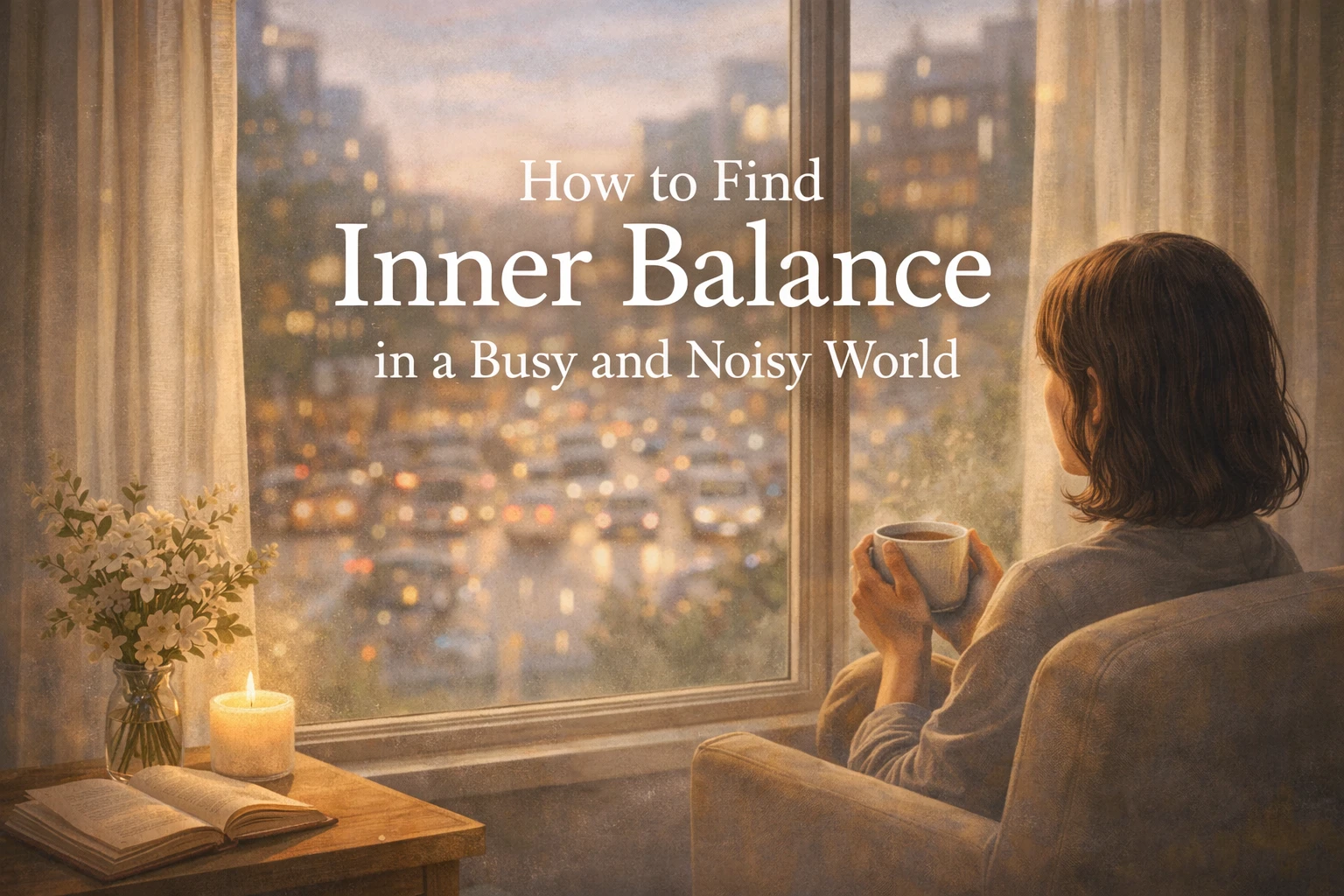
How to Find Inner Balance in a Busy and Noisy World

How to find inner balance in a busy and noisy world — peaceful indoor moment overlooking a city

Table of Contents

How to Find Inner Balance in a Busy World: Practical Tips for Calm & Focus

Peaceful person finding inner balance and calm while surrounded by a busy modern world

Last Updated: September 15, 2026

By David Yang

Quick Answer

Finding inner balance in a busy world does not mean eliminating stress or creating a perfectly calm life. It means learning how to manage your attention, energy, emotions, priorities, and daily routines so that constant demands do not completely control your day.

Practical ways to build more inner balance include protecting sleep, creating realistic priorities, taking intentional breaks, limiting unnecessary digital stimulation, moving your body, noticing emotions without immediately reacting to them, practicing simple relaxation techniques, staying connected with supportive people, and making time for activities that genuinely restore you.

Introduction: You Do Not Need a Quiet Life to Feel More Balanced

Modern life rarely becomes quiet on its own.

There are messages to answer.

Work to finish.

Family responsibilities to manage.

News to process.

Notifications competing for your attention.

And somewhere underneath all of it, there may be a quiet question:

“When do I actually get to slow down?”

You may have a full life and still feel mentally scattered.

You may love your family but feel overstimulated by constant demands.

You may be successful at work but struggle to switch off when the day ends.

You may even have time to rest but find that your mind continues working.

This is where the idea of inner balance becomes useful.

Inner balance is not about creating a life without pressure. It is about developing enough awareness and structure to recognize when you are becoming overloaded and make adjustments before everything feels like too much.

And importantly, balance is not another performance goal.

You do not need to become calm all the time.

You need to become better at returning to what matters.

What Does Inner Balance Actually Mean?

“Inner balance” is not a formal medical diagnosis or a precise psychological state.

It is a useful way of describing a sense of steadiness in how you manage competing demands, emotions, attention, and energy.

A balanced person can still:

  • feel stressed;
  • become frustrated;
  • have difficult days;
  • feel sad or disappointed;
  • change their mind;
  • need help;
  • experience periods of uncertainty.

The difference is that difficult emotions and external demands do not necessarily dictate every decision.

Inner balance may look like:

  • recognizing when you are becoming overwhelmed;
  • knowing what deserves your attention now;
  • letting some things wait;
  • recovering after stressful moments;
  • protecting sleep and basic physical needs;
  • staying connected to your values;
  • responding rather than automatically reacting;
  • making room for both responsibility and rest.

In other words:

Balance is not having everything under control. It is knowing what to do when life is not under control.

Inner Balance Is Not the Same as Happiness

This distinction is important.

Happiness is an emotion. It naturally changes.

Inner balance is more about how you navigate those changes.

You can feel sad and still be balanced.

You can feel nervous before an important event and still be balanced.

You can be angry about something unfair and still respond thoughtfully.

You can have a difficult week without deciding that your entire life is falling apart.

So the goal is not:

“I should feel peaceful all the time.”

A more realistic goal is:

“I want to have enough steadiness to handle whatever I am feeling without letting it control everything.”

Why Inner Balance Becomes Difficult in a Busy World

Overload does not always come from one dramatic problem.

It can come from accumulation.

A demanding job.

Interrupted sleep.

Too many open tasks.

Constant notifications.

Relationship tension.

Little time alone.

Too much information.

Not enough recovery.

Each individual demand may seem manageable.

Together, they can leave you feeling mentally crowded.

Common signs of overload may include:

  • difficulty concentrating;
  • feeling rushed even when nothing urgent is happening;
  • irritability over small things;
  • difficulty relaxing;
  • frequent checking of your phone;
  • sleep problems;
  • feeling emotionally drained;
  • forgetfulness;
  • difficulty deciding what to do first;
  • feeling disconnected from things you normally enjoy.

These experiences can have many causes, so they should not automatically be interpreted as a lack of emotional balance. Persistent or severe symptoms may require professional assessment.

12 Practical Ways to Find More Inner Balance

1. Start by Noticing What Is Actually Overloading You

Before changing your life, identify the pressure.

Ask yourself:

  • What is taking most of my mental energy right now?
  • What keeps interrupting my attention?
  • What am I worried about repeatedly?
  • What responsibilities are genuinely necessary?
  • What am I doing mainly because I feel guilty?

Sometimes the problem is not that you need better relaxation.

You may simply have too much on your plate.

If your schedule is overloaded, adding another meditation routine may not solve the underlying issue.

You may need to remove something.

2. Decide What Actually Matters Today

Inner balance becomes difficult when everything feels equally urgent.

Try dividing today’s responsibilities into three categories:

CategoryQuestion
Must doWhat genuinely needs attention today?
Should doWhat would be helpful but can wait?
Could doWhat would be nice but is not necessary?

This simple distinction can reduce the pressure to treat every task as an emergency.

NIMH recommends setting goals and priorities, deciding what needs attention now, and learning to say no when you begin taking on too much. NIMH: Caring for Your Mental Health

3. Protect Your Attention

Your attention is a limited resource.

If you constantly switch between email, social media, messages, work, news, and conversations, your day can feel busy even when you accomplish very little.

Try creating periods of single-tasking.

For example:

  • work on one task for 25–45 minutes;
  • keep unnecessary notifications muted;
  • check messages at designated times;
  • keep your phone away during important conversations;
  • avoid starting the morning with an endless stream of social media.

You do not need to eliminate technology.

You need to stop letting every notification decide where your attention goes.

4. Build Small Transitions Into Your Day

One reason people struggle to feel calm is that they move directly from one role to another.

Work ends.

Family responsibilities begin.

Dinner happens.

Messages arrive.

Then suddenly it is bedtime.

There is no transition.

Try creating small pauses between activities.

For example:

  • take a five-minute walk after work;
  • change clothes when you arrive home;
  • sit quietly before starting the evening routine;
  • take several slow breaths before entering a difficult conversation;
  • write tomorrow’s priorities before ending your workday.

These pauses do not guarantee calm, but they can make the day feel less like one continuous demand.

5. Create a Consistent Sleep Rhythm

Inner balance becomes much harder when you are chronically exhausted.

Protecting sleep is therefore one of the least glamorous but most important forms of self-care.

Consider:

  • keeping a reasonably consistent sleep schedule;
  • creating a short wind-down period;
  • reducing stimulating screen use before bed;
  • keeping the bedroom comfortable for sleep;
  • avoiding turning bedtime into an extension of your workday.

NIMH specifically recommends making sleep a priority and maintaining a sleep schedule as part of caring for mental health. NIMH mental health self-care guidance

If you have persistent sleep problems, do not assume you simply need more discipline. Ongoing sleep difficulties can have medical or psychological causes worth discussing with a healthcare professional.

6. Use Short Relaxation Practices Instead of Waiting for a Perfect Break

You do not need an hour of meditation to create a moment of calm.

Try one to three minutes.

Sit comfortably.

Relax your shoulders.

Breathe normally and comfortably.

Pay attention to the sensation of breathing.

When your mind wanders, gently return your attention.

That is enough.

NCCIH notes that relaxation techniques include practices such as deep breathing, progressive muscle relaxation, guided imagery, and other methods designed to encourage a relaxation response. Evidence varies depending on the technique and health outcome, so these practices should be viewed as supportive tools rather than universal treatments. NCCIH: Relaxation Techniques for Stress

7. Move Your Body Regularly

Movement can be one of the simplest ways to interrupt a day dominated by sitting, screens, and mental work.

You do not need an intense exercise program.

Try:

  • a short walk;
  • stretching;
  • cycling;
  • gardening;
  • dancing;
  • household activities;
  • another physical activity you genuinely enjoy.

NIMH notes that regular exercise can support mental health and that smaller amounts of activity can still add up when a longer workout is not realistic. NIMH: Caring for Your Mental Health

The most useful movement is often the movement you can keep doing.

8. Learn to Notice Emotions Before Acting on Them

Inner balance does not mean suppressing emotion.

It means creating enough space between feeling something and automatically acting on it.

Try this simple sequence:

Notice → Name → Pause → Choose.

For example:

Notice: “I am becoming angry.”

Name: “I feel disrespected and frustrated.”

Pause: “I don’t need to respond immediately.”

Choose: “I will explain what bothered me after I calm down.”

This is not about becoming emotionally detached.

It is about giving yourself a little more choice.

For deeper work around emotional recovery, see Emotional Healing: Simple Practices to Restore Inner Calm.

9. Create a Home Environment That Supports Recovery

Your environment cannot guarantee emotional wellbeing, but it can make certain habits easier.

Look for small improvements:

  • keep your bedroom comfortable and uncluttered enough to rest;
  • create one place where you can sit without a screen;
  • reduce unnecessary noise during your wind-down period;
  • keep frequently used items organized;
  • make healthy choices convenient;
  • let natural light into your living spaces when practical.

You do not need to redesign your entire house.

Choose one area that currently creates friction and make it easier to use.

For practical ideas, see Creating Comfort at Home.

10. Protect Some Time That Has No Productivity Goal

One subtle source of imbalance is the belief that every free minute should accomplish something.

You exercise to improve yourself.

You read to learn.

You meditate to become calmer.

You clean to become more organized.

You listen to podcasts while cooking so the time is not “wasted.”

There is nothing wrong with any of these activities.

But you also need moments that do not have to produce an outcome.

Drink tea.

Look outside.

Listen to music.

Talk with someone.

Take a slow walk.

Rest.

Rest does not have to justify its existence.

11. Stay Connected to People Who Help You Feel Like Yourself

Inner balance does not mean becoming completely self-sufficient.

Humans need connection.

A supportive conversation can sometimes accomplish something that another hour of solitary overthinking cannot.

Consider maintaining a small circle of people with whom you can:

  • be honest;
  • ask for help;
  • share ordinary experiences;
  • laugh;
  • talk about difficult things;
  • simply spend time without performing.

NIMH recommends staying connected with friends or family who can provide emotional support and practical help. NIMH: Caring for Your Mental Health

12. Reconnect With Your Values

Sometimes people feel “out of balance” because their calendar no longer reflects what matters to them.

Ask:

  • What kind of person do I want to be?
  • What relationships matter most to me?
  • What do I want my home to feel like?
  • What am I spending too much time on?
  • What important thing have I been repeatedly postponing?

You may discover that the solution is not simply “more relaxation.”

You may need to make your life more consistent with your priorities.

Inner Balance and Digital Overload

Technology can be useful, but constant connectivity can make it difficult to experience genuine mental downtime.

You do not need to delete every app.

Try creating boundaries around when technology gets your attention.

Morning

Delay nonessential notifications until after you have decided what matters that day.

During Work

Mute unnecessary alerts and create periods of focused work.

During Conversations

Put the phone away when another person deserves your attention.

Evening

Create a period when entertainment and communication become less stimulating.

Before Bed

Give your mind a transition instead of moving directly from scrolling into sleep.

The goal is not digital abstinence.

It is intentional use.

Inner Balance and the “Always Busy” Trap

Being busy can become an identity.

You may start measuring your worth by how much you accomplish.

Then rest feels uncomfortable.

You feel guilty when you are not productive.

You fill every empty space with another task.

Eventually, even relaxing can feel like work.

If that sounds familiar, try changing the question.

Instead of asking:

“What else can I get done?”

ask:

“What deserves my energy?”

Those are very different questions.

Inner Balance Does Not Mean Avoiding Difficult Emotions

A common mistake is to interpret calm as the absence of uncomfortable emotions.

But sadness, anger, fear, disappointment, and grief are part of ordinary human experience.

Trying to eliminate every uncomfortable feeling can actually create another layer of stress:

“Why am I still anxious?”

“Why can’t I just be positive?”

“Why am I not healed yet?”

A more useful approach is:

“This feeling is here. What does it need from me?”

Sometimes the answer is rest.

Sometimes it is a conversation.

Sometimes it is a boundary.

Sometimes it is action.

Sometimes it is simply time.

What Inner Balance Looks Like in Real Life

Inner balance is often much less dramatic than people imagine.

Without Much BalanceWith More Balance
Every task feels urgent.You distinguish priorities.
You react immediately when upset.You create a pause before responding.
You fill every free moment.You allow some unstructured time.
Your phone controls your attention.You choose when to check it.
You sacrifice sleep for productivity.You treat rest as part of functioning.
You keep stress inside.You talk with trusted people.
You try to fix everything.You accept that some things can wait.
You judge difficult emotions.You notice them without immediately fighting them.

How to Find Balance When You Are Extremely Busy

If your schedule is already full, do not create a complicated “balance routine.”

Use existing transitions.

While Making Coffee

Take three slow breaths and decide your most important task.

During Your Commute

Use part of the journey to transition rather than consuming more information.

Between Meetings

Stand up, stretch, drink water, and look away from the screen.

After Work

Create a short transition before moving into family or household responsibilities.

Before Bed

Write down tomorrow’s priorities so your brain does not have to keep rehearsing them.

Balance does not always require additional time.

Sometimes it requires using existing moments differently.

A 10-Minute Inner Balance Reset

When you feel scattered, try this short sequence.

Minutes 1–2: Stop

Put down whatever you are doing and sit or stand still.

Minutes 3–4: Breathe

Take comfortable, unforced breaths and notice the physical sensation of breathing.

Minutes 5–6: Name

Identify the strongest emotion or source of pressure you are experiencing.

Minutes 7–8: Prioritize

Choose the one thing that actually matters next.

Minutes 9–10: Act

Take one small step.

Send the message.

Drink the water.

Start the task.

Take the walk.

Ask for help.

Or go to bed.

The reset is not supposed to solve your entire life.

It is supposed to help you make the next decision with a little more clarity.

A 7-Day Inner Balance Reset

Day 1 — Notice

Write down the three biggest sources of mental pressure in your life right now.

Day 2 — Simplify

Remove one unnecessary task from today’s schedule.

Day 3 — Move

Take a short walk or do another form of physical activity you can sustain.

Day 4 — Disconnect

Create at least 30 minutes without unnecessary digital stimulation.

Day 5 — Connect

Talk with someone you trust without multitasking.

Day 6 — Restore

Protect an evening period for rest rather than productivity.

Day 7 — Reflect

Ask yourself:

  • What made me feel more grounded?
  • What consistently drained me?
  • What can I change next week?

Do not try to keep every practice.

Choose the one or two that genuinely fit your life.

How Do You Know Your Inner Balance Is Improving?

Progress may not feel like permanent peace.

Look for smaller changes.

  • You notice stress earlier.
  • You recover more quickly after difficult moments.
  • You can concentrate for longer periods.
  • You check your phone less automatically.
  • You sleep more consistently.
  • You are less reactive during conflict.
  • You can say no without excessive guilt.
  • You make decisions more deliberately.
  • You have more patience with people you care about.
  • You feel less pressure to make every moment productive.

One of the most useful signs may be this:

You begin to notice that you have a choice.

You can pause.

You can wait.

You can say no.

You can ask for help.

You can change direction.

Inner Balance and Relationships

Our internal state can affect how we communicate with other people.

When you are exhausted and overloaded, a small disagreement may feel much larger than it otherwise would.

That does not mean relationship problems are caused by your lack of inner balance.

Relationships have their own dynamics.

But taking care of your emotional and physical capacity can give you more room to communicate thoughtfully.

If relationship stress is part of what is disturbing your sense of balance, explore:

Inner Balance and Self-Care

Inner balance is closely connected with self-care, but the two concepts are not identical.

Self-care asks:

“What can I do to support my wellbeing today?”

Inner balance asks:

“How can I organize my attention, energy, emotions, and priorities so that I can live more steadily?”

That is why these two LoveAHH articles work well together:

Self-Care at Home for Emotional Wellbeing focuses on practical everyday care, while this article focuses more on maintaining steadiness within a busy life.

When Inner Balance Becomes a Mental Health Concern

Sometimes feeling overwhelmed is not simply a lifestyle problem.

If you are experiencing severe or distressing symptoms that persist, especially problems with sleep, appetite, concentration, interest in activities, daily functioning, or persistent irritability or restlessness, it may be time to seek professional help.

NIMH recommends seeking professional support when significant symptoms last for two weeks or more or interfere with daily life. NIMH: Caring for Your Mental Health

Self-care and professional care are not opposites.

You can use healthy routines while also working with a qualified professional.

And if you feel that you may harm yourself or someone else, seek urgent help through appropriate local emergency or crisis services.

Frequently Asked Questions About Inner Balance

What does inner balance mean?

Inner balance is a practical way of describing steadiness in how you manage emotions, attention, energy, priorities, and everyday demands. It does not mean being calm or happy all the time.

How do I find inner balance when life is busy?

Start by identifying what is consuming your attention and energy. Then simplify priorities, protect sleep, create small transitions, limit unnecessary digital stimulation, move regularly, make time for supportive relationships, and allow periods of genuine rest.

Can inner balance reduce stress?

Healthy routines and stress-management practices may help you cope with stress, although no single practice works for everyone. Sleep, exercise, relaxation techniques, realistic priorities, and social connection are among the approaches recommended by NIMH and other health organizations.

How long does it take to find inner balance?

There is no universal timeline. Some changes may feel helpful immediately, while building sustainable habits and changing an overloaded lifestyle can take much longer.

Is inner balance the same as emotional healing?

No. Emotional healing generally focuses more on recovering from emotional pain, difficult experiences, or prolonged distress. Inner balance is broader and includes managing everyday attention, energy, emotions, priorities, and stress.

Can meditation help with inner balance?

Mindfulness and meditation may help some people manage stress, anxiety, and sleep difficulties. Evidence varies, however, and these practices should be viewed as supportive tools rather than guaranteed treatments.

What if I am too busy to practice self-care?

Start with existing moments rather than creating a large routine. A short walk, a few minutes of quiet, a better bedtime, turning off unnecessary notifications, or saying no to one unnecessary task can be enough to begin.

When should I seek professional help?

Consider professional support when distress is severe, lasts for two weeks or more, worsens, or interferes with sleep, concentration, daily responsibilities, relationships, or activities you normally enjoy.

Final Thoughts: Balance Is a Practice, Not a Destination

You probably cannot create a life without noise.

There will always be deadlines.

People will sometimes disappoint you.

Your plans will change.

Some weeks will be exhausting.

Some seasons of life will demand more from you than others.

Inner balance does not require you to control all of that.

It asks something more realistic:

Can you notice when you are losing your footing and gently find your way back?

Maybe that means sleeping earlier.

Maybe it means putting your phone down.

Maybe it means saying no.

Maybe it means taking a walk.

Maybe it means having an honest conversation.

Maybe it means doing less.

And sometimes it means asking for professional help.

There is no perfect formula.

The goal is not to become someone who never feels overwhelmed.

The goal is to build a life in which you have reliable ways to return to yourself when things become overwhelming.

Calm is not the absence of a busy life. It is the ability to create moments of clarity, recovery, and choice within it.

Authoritative Sources & References


Recommended Articles:

Welcome – love a happy home

Self-Care at Home That Actually Helps

Self-CareAtHomeA1

Table of Contents

Self-Care at Home for Emotional Wellbeing: Simple Practices That Actually Help

Peaceful and comfortable home environment designed for self-care, rest, and emotional wellbeing

Last Updated: September 15, 2026

By David Yang

Quick Answer

Self-care at home means using simple, sustainable habits to support your physical, emotional, and mental wellbeing in the place where you spend much of your everyday life. It does not require expensive products, a perfect routine, or hours of free time.

Helpful self-care at home can include getting enough sleep, moving your body, eating regular meals, creating periods of quiet, practicing relaxation or breathing exercises, staying connected with people you trust, setting reasonable boundaries, and making your home easier to rest in. These habits may support wellbeing and stress management, but they are not a substitute for professional care when significant mental health symptoms persist.

Introduction: Self-Care Does Not Have to Be Complicated

Self-care is often presented as something you need to buy.

A new product. A perfect morning routine. A beautiful bedroom. A long meditation session. A complicated wellness schedule.

But real self-care is usually much less glamorous.

Sometimes it is going to bed instead of scrolling for another hour.

Sometimes it is eating a proper meal when you have been too busy to notice that you are hungry.

Sometimes it is taking a ten-minute walk.

Sometimes it is turning off the television and sitting quietly for five minutes.

And sometimes it is telling someone, “I can’t take care of everything today.”

Self-care at home is not about creating a perfect life.

It is about making small choices that support the life you actually have.

That distinction matters because self-care can easily become another source of pressure. If your “self-care routine” requires an hour every morning, expensive purchases, perfect nutrition, daily meditation, and an immaculate home, it may become another task to fail at.

A more useful approach is simpler:

Ask what your body, mind, and relationships need today—and choose one realistic action.

What Does Self-Care at Home Really Mean?

Self-care is not a formal treatment for mental illness. It is a broad term for behaviors that support physical and mental wellbeing.

The National Institute of Mental Health describes self-care as taking time for activities that help you live well and support both physical and mental health. Its recommendations include regular physical activity, healthy meals and hydration, adequate sleep, relaxing activities, realistic priorities, gratitude, and staying connected with supportive people.

At home, this can look like:

  • protecting your sleep;
  • creating a calmer evening routine;
  • keeping easy, nourishing food available;
  • moving your body regularly;
  • taking short breaks from constant stimulation;
  • checking in with your emotions;
  • speaking to yourself with less unnecessary criticism;
  • setting boundaries around time and energy;
  • staying connected with people who support you;
  • making your living space easier to rest in.

Notice what is missing from this list:

Perfection.

Why Home Can Be an Important Part of Self-Care

Your environment does not determine your mental health, but it can influence how easy or difficult certain habits are to maintain.

A home that makes sleep difficult, encourages constant screen use, contains distracting clutter everywhere, or provides no comfortable place to rest can make recovery from a demanding day harder.

On the other hand, small environmental changes can make healthy choices more convenient.

For example:

  • keeping walking shoes near the door makes a short walk easier to start;
  • placing your phone away from the bed can reduce bedtime temptation;
  • keeping water nearby makes hydration more convenient;
  • creating one comfortable chair can give you a reliable place to read or decompress;
  • reducing clutter in your bedroom can make the space feel more suitable for rest.

The goal is not to create a “perfect wellness home.”

The goal is to design your environment so that taking care of yourself requires slightly less effort.

12 Simple Self-Care Practices You Can Do at Home

1. Protect Your Sleep Before Adding More Wellness Habits

Sleep is one of the easiest parts of self-care to underestimate.

When you are busy, sleep is often the first thing sacrificed.

You stay up to finish work. You scroll because it is the only quiet time you have. You watch one more episode. You answer messages in bed.

Then you wonder why you feel emotionally depleted the next day.

Instead of creating a complicated nighttime routine, start with one consistent anchor.

  • Choose a reasonably consistent bedtime.
  • Create a short wind-down period.
  • Reduce stimulating activities close to bedtime.
  • Keep your bedroom comfortable for sleep.
  • Move your phone farther away if it repeatedly keeps you awake.

NIMH specifically recommends making sleep a priority and keeping a regular sleep schedule as part of mental health self-care.

2. Eat Regularly and Stay Hydrated

Self-care is not only emotional.

Your body also needs consistent support.

When life becomes stressful, it is easy to skip meals or rely almost entirely on caffeine and convenience foods.

You do not need a perfect diet to practice self-care.

Start with basics:

  • eat regular meals when possible;
  • keep simple nutritious foods available;
  • drink enough water;
  • notice how caffeine affects your sleep and anxiety;
  • avoid using food restriction as a response to emotional stress.

NIMH includes regular meals and hydration among its basic mental health self-care recommendations.

3. Take a Short Walk

You do not need a gym membership to move your body.

A short walk around your neighborhood, a few minutes of stretching, household chores, gardening, or another activity you enjoy can be a practical way to add movement to your day.

NIMH notes that even smaller amounts of physical activity can add up when you cannot complete a longer workout.

Think sustainable rather than impressive.

Ten minutes you actually do is more useful than a perfect workout plan you never start.

4. Create Five Minutes of Low-Stimulation Time

Modern life gives your attention very little time to rest.

Messages arrive.

Videos autoplay.

News updates appear.

Work notifications continue after work has technically ended.

Try creating five minutes when you intentionally reduce stimulation.

You could:

  • sit beside a window;
  • drink tea without your phone;
  • listen to quiet music;
  • look outside;
  • stretch;
  • simply sit and breathe.

The goal is not to force your mind to become empty.

It is simply to give your attention a short break.

5. Try a Simple Breathing Exercise

Slow breathing is one of the easiest relaxation practices to try at home.

For example:

  1. Sit comfortably.
  2. Relax your shoulders.
  3. Take a comfortable breath in.
  4. Let the exhale become slow and unforced.
  5. Repeat for one to three minutes.

NCCIH reports that slow, deep breathing may modestly reduce stress and has shown preliminary evidence for reducing stress in some studies.

But avoid turning breathing into another performance test.

You do not have to breathe in a particular pattern or force a longer exhale if that feels uncomfortable.

If a relaxation exercise makes you feel more anxious, stop and choose a different grounding activity. NCCIH notes that relaxation techniques can occasionally produce unpleasant experiences such as increased anxiety or intrusive thoughts in some people.

6. Check In With Your Emotions Without Trying to Fix Them

Emotional self-care does not always require solving a problem.

Sometimes you simply need to identify what is happening.

Ask yourself:

  • What am I feeling?
  • What happened today?
  • What is taking most of my mental energy?
  • What do I need right now?

You might discover that you are not “in a bad mood.”

You are tired.

Or disappointed.

Or lonely.

Or overwhelmed by too many unfinished tasks.

That information can change what you do next.

If emotional healing is a major concern for you, you can also read Emotional Healing: Simple Practices to Restore Inner Calm.

7. Practice More Supportive Self-Talk

Pay attention to how you speak to yourself when something goes wrong.

For example:

Instead of: “I’m so useless.”

Try: “I made a mistake, and I can figure out what to do next.”

Instead of: “Everyone else can handle this.”

Try: “This is difficult for me right now, and I can take it one step at a time.”

Self-compassion is not the same as making excuses.

It means responding to yourself with understanding while still taking responsibility for your choices.

Research supports an association between self-compassion and wellbeing, while newer research also suggests links between self-compassion, lower stress, and healthier behaviors. These findings are encouraging, but they do not mean self-compassion automatically solves mental health problems.

8. Set One Boundary at Home

Self-care sometimes means saying no.

That may be uncomfortable, especially if you are accustomed to taking care of everyone else first.

A boundary could be:

  • not answering work messages after a certain time;
  • asking for uninterrupted time;
  • declining an unnecessary commitment;
  • telling family members when you need quiet;
  • ending a conversation that has become disrespectful.

A boundary is not a demand that everyone behave exactly as you want.

It is a way of communicating what you can participate in and what you need to protect.

9. Create a Small Comfort Ritual

Rituals can make ordinary transitions feel more intentional.

Your ritual could be extremely simple:

  • tea after dinner;
  • reading for ten minutes before bed;
  • a short evening shower;
  • music while preparing dinner;
  • writing tomorrow’s priorities before going to sleep;
  • sitting quietly with your morning coffee.

The value is not in the object itself.

It is in creating a predictable moment that marks a transition from “doing” to “resting.”

10. Make One Part of Your Home Easier to Live In

Do not try to reorganize your entire house when you are already exhausted.

Choose one small area.

Maybe it is:

  • your bedside table;
  • your kitchen counter;
  • your desk;
  • your favorite chair;
  • the place where you keep your keys.

Remove what does not belong there.

Make the space functional.

Stop.

Self-care should not become a six-hour cleaning project.

11. Stay Connected Instead of Isolating Completely

Sometimes being alone is exactly what you need.

But isolation can also make difficult emotions heavier.

Try maintaining at least one small connection with someone you trust.

It could be:

  • a phone call;
  • a short text;
  • sharing a meal;
  • a walk together;
  • asking someone to listen without trying to solve the problem.

NIMH includes staying connected with friends and family who can provide emotional support and practical help among its mental health self-care recommendations.

12. Give Yourself Permission to Do Less

One of the most overlooked forms of self-care is reducing unnecessary demands.

Ask:

  • What genuinely needs to happen today?
  • What can wait?
  • What am I doing only because I feel guilty?
  • What could I simplify?

NIMH recommends setting goals and priorities, deciding what needs attention now, and learning to say no when responsibilities become excessive.

Sometimes the healthiest decision is not adding another habit.

It is removing one unnecessary burden.

How to Create a Self-Care-Friendly Home

Your home does not need to be expensive, minimalist, or Instagram-perfect.

Think about function instead.

Create One Place for Rest

Choose a chair, corner, bedroom area, balcony, or other small space where you can regularly slow down.

Make Healthy Choices Convenient

Keep water visible. Put comfortable walking shoes where you can see them. Keep simple foods available. Put books where you are likely to read them.

Reduce Unnecessary Stimulation

Consider turning off notifications, reducing background television, or creating parts of the evening when screens are not the center of attention.

Protect the Bedroom

Whenever possible, make the bedroom a place associated with sleep and rest rather than work, arguments, endless scrolling, or stressful tasks.

Do Not Turn Your Home Into Another Project

A self-care-friendly home is not a perfect home.

If maintaining your home consumes all your energy, simplify the standard.

Comfort matters more than perfection.

Self-Care for Different Emotional States

The best self-care strategy may depend on what you actually need.

If You Feel…You Might Try…
OverwhelmedReduce today’s priorities to one or two essentials.
Emotionally exhaustedRest, eat, hydrate, and reduce unnecessary demands.
LonelyContact someone safe rather than waiting until you feel better.
AnxiousTry slow breathing, gentle movement, grounding, or a supportive conversation.
AngryPause the conversation, move your body, and return when you are calmer.
SadAllow the feeling, seek connection, and maintain basic routines.
Mentally scatteredWrite down what needs attention and choose one next step.
Burned outLook beyond self-care and examine whether your workload or circumstances need to change.

Self-Care Is Not the Same as Escaping Stress

Some activities feel relaxing in the moment but do not actually support you over time.

For example, you might spend hours scrolling because you feel exhausted. You might avoid an important conversation because you do not want to deal with it. You might stay in bed all day because everything feels overwhelming.

There is nothing inherently wrong with rest or entertainment.

The question is:

“Does this leave me better supported, or does it simply help me avoid what I cannot face?”

Sometimes avoidance is understandable and temporary.

But if the same coping strategy repeatedly makes your sleep, relationships, responsibilities, or mood worse, it may be worth reconsidering.

Self-Care Is Not Selfish

Many people struggle with self-care because they associate caring for themselves with neglecting others.

But basic maintenance is not selfish.

You need food.

You need sleep.

You need breaks.

You need emotional support.

You need time when you are not performing a role for someone else.

Self-care also does not mean putting yourself first in every situation.

It means recognizing that your wellbeing is part of the equation.

Why Self-Care Sometimes Does Not Work

There is an important limit to self-care advice.

If the source of your distress is an unsafe relationship, overwhelming workload, serious financial pressure, untreated mental illness, chronic health problems, grief, trauma, or another major circumstance, lighting a candle and taking a bath may not solve the underlying problem.

That does not mean self-care is useless.

It means the intervention needs to match the problem.

Sometimes the next act of self-care is:

  • asking for help;
  • seeing a healthcare professional;
  • talking to a therapist;
  • changing an unhealthy boundary;
  • asking for practical support;
  • taking leave from an unsustainable situation;
  • addressing a relationship problem directly.

Self-care should support real life, not become a way to avoid changing what is hurting you.

Self-Care and Emotional Healing

Self-care and emotional healing overlap, but they are not exactly the same.

Self-care is often about supporting your wellbeing today.

Emotional healing can involve recovering from deeper or longer-lasting emotional pain.

For example:

Self-CareEmotional Healing
Getting enough sleepUnderstanding recurring emotional patterns
Taking a walkProcessing difficult experiences
Eating regularlyLearning healthier emotional responses
Taking a breakWorking through grief or relationship pain
Creating a calming homeBuilding greater emotional resilience over time

You can practice both.

For a deeper look at the emotional side, read Emotional Healing: Simple Practices to Restore Inner Calm.

A Simple 10-Minute Self-Care Routine at Home

If you are busy, try this:

Minute 1–2: Pause

Put your phone down and take a few comfortable breaths.

Minute 3–5: Check In

Ask yourself what you are feeling and what you need most today.

Minute 6–8: Move

Stretch, walk around the room, or step outside.

Minute 9–10: Choose One Next Step

Drink water. Make food. Send a message. Take a shower. Finish one important task. Go to bed earlier.

That’s enough.

You do not need to transform your entire life in ten minutes.

A Simple 7-Day Self-Care Reset

Day 1 — Sleep

Choose a realistic bedtime and protect it.

Day 2 — Movement

Take a short walk or do gentle movement at home.

Day 3 — Food and Water

Pay attention to whether you are eating and hydrating regularly.

Day 4 — Quiet

Create ten minutes without unnecessary digital stimulation.

Day 5 — Connection

Contact someone you trust.

Day 6 — Boundaries

Say no to one unnecessary demand.

Day 7 — Reflection

Ask:

  • What helped me most?
  • What felt unrealistic?
  • What would I like to continue next week?

Keep the habits that fit your real life.

How Do You Know Your Self-Care Is Actually Helping?

Self-care does not always produce dramatic changes.

Look for smaller signs.

  • You recover from stressful moments a little faster.
  • You notice your needs earlier.
  • You sleep more consistently.
  • You have slightly more energy.
  • You feel less guilty about resting.
  • You are better able to say no.
  • You are less harsh toward yourself.
  • You have more patience with people you care about.
  • Your home feels easier to rest in.
  • You feel more capable of handling ordinary difficult days.

Progress is not always “I feel amazing.”

Sometimes it is simply:

“I am coping a little better than I was last month.”

Frequently Asked Questions About Self-Care at Home

What is self-care at home?

Self-care at home means using practical habits and routines within your living environment to support physical, emotional, and mental wellbeing. It can include sleep, movement, regular meals, relaxation, emotional awareness, social connection, boundaries, and creating a comfortable environment.

What is the best self-care activity at home?

There is no single best activity for everyone. The most useful choice depends on what you currently need. If you are exhausted, rest may matter most. If you feel isolated, connection may help more. If you are overwhelmed, reducing demands may be more useful than adding another activity.

Does self-care actually reduce stress?

Some self-care practices can support stress management. NIMH recommends habits such as exercise, adequate sleep, relaxing activities, realistic priorities, and social connection. Relaxation techniques such as breathing exercises may also help some people manage stress.

Do I need a strict self-care routine?

No. A flexible routine is often more realistic. Self-care should fit your circumstances rather than become another source of pressure.

Is self-care selfish?

No. Basic self-care is part of maintaining your physical and mental wellbeing. Caring for yourself does not mean ignoring other people; it means recognizing that your own needs matter too.

What if I only have 10 minutes for self-care?

Ten minutes can still be useful. Try breathing, stretching, taking a short walk, drinking water, sitting quietly, writing down your priorities, or contacting someone you trust.

Can self-care replace therapy?

No. Self-care can support wellbeing and may complement professional treatment, but it should not be used as a replacement when significant or persistent mental health symptoms require professional care.

When should I seek professional help?

Consider professional support if symptoms are severe or distressing and last for two weeks or more, especially when they interfere with sleep, concentration, daily activities, appetite, enjoyment, or your ability to function. NIMH recommends talking with a healthcare provider when these problems persist or worsen.

When Self-Care Needs to Become Professional Care

There is no prize for handling everything alone.

Talk with a qualified healthcare or mental health professional if you are experiencing persistent or severe emotional difficulties, significant changes in sleep or appetite, loss of interest in things you normally enjoy, difficulty completing normal responsibilities, or symptoms that are getting worse.

If you feel you may hurt yourself or someone else, seek urgent help through your local emergency or crisis services.

Self-care is valuable.

But sometimes the most caring thing you can do for yourself is ask someone qualified to help.

Final Thoughts

Self-care at home does not have to look impressive.

It can be quiet.

It can be ordinary.

It can be ten minutes of rest, a glass of water, a walk around the block, a proper meal, an earlier bedtime, a difficult boundary, or a conversation with someone who makes you feel less alone.

The most sustainable self-care is usually not the routine that looks best on social media.

It is the routine you can realistically return to when life becomes difficult.

Your home does not need to become a perfect sanctuary.

Your life does not need to become perfectly balanced.

You simply need a few reliable ways to support yourself when the day becomes heavy.

Take care of yourself in ways that make tomorrow a little easier—not ways that make today another performance.

Authoritative Sources & References


Recommended Articles:

Welcome – love a happy home

Emotional Healing: Simple Practices to Restore Inner Calm
EmotionalHealingInnerCalmA1

Table of Contents

Peaceful person enjoying a quiet moment in nature while practicing emotional healing and self-care

Last Updated: September 15, 2026

By David Yang

Quick Answer

Emotional healing is the gradual process of understanding, accepting, and responding to difficult emotions in healthier ways. It does not mean eliminating sadness, anxiety, anger, or disappointment. Instead, it means developing enough emotional awareness, self-compassion, supportive routines, and connection that difficult feelings become easier to navigate.

Simple practices such as mindful breathing, emotional check-ins, regular sleep, movement, supportive relationships, journaling, calming routines, and realistic boundaries may help support emotional wellbeing. They are not a replacement for professional mental health care when symptoms are severe, persistent, or interfering with everyday life.

Introduction: You May Not Need to Fix Yourself

Sometimes emotional exhaustion does not arrive dramatically.

It can look like waking up already tired. Feeling irritated by small things. Losing interest in activities you normally enjoy. Thinking constantly but never feeling clear. Wanting to be alone while also wishing someone understood you.

You may even tell yourself:

“I should be able to handle this.”

But struggling emotionally does not automatically mean that something is wrong with you.

Life can be genuinely demanding. Relationship problems, grief, uncertainty, work pressure, caregiving, loneliness, financial stress, major transitions, and prolonged lack of rest can all place emotional demands on a person.

Emotional healing is therefore less about becoming perfectly calm and more about learning how to respond to yourself with greater awareness and care.

That may begin with something surprisingly small: noticing what you feel before immediately trying to escape it.

This guide explains practical, research-informed ways to support emotional healing without turning healing into another task you have to perform perfectly.

What Is Emotional Healing?

“Emotional healing” is not a formal medical diagnosis. It is a useful everyday term for the process of recovering emotionally after stress, disappointment, loss, conflict, difficult experiences, or periods of prolonged emotional strain.

In practical terms, emotional healing can involve learning to:

  • notice your emotions without immediately judging them;
  • understand what your emotions may be communicating;
  • regulate intense emotional reactions;
  • recover after stressful experiences;
  • treat yourself with more compassion;
  • maintain supportive relationships;
  • restore healthy daily routines;
  • recognize when additional professional support is needed.

Healing does not necessarily mean that painful memories disappear.

It may instead mean that those experiences no longer control every part of your present life.

What Emotional Healing Is Not

There are several common misconceptions about emotional healing.

Emotional healing is not forced positivity

You do not have to tell yourself that everything is wonderful when it is not.

Healthy emotional coping allows difficult feelings to exist while still helping you decide what to do next.

Emotional healing is not pretending that nothing happened

Ignoring an experience may sometimes provide temporary relief, but avoidance is not the same thing as processing or recovering from it.

Emotional healing is not constant happiness

A psychologically healthy life still includes disappointment, frustration, grief, uncertainty, anger, and sadness.

The goal is not permanent emotional comfort.

The goal is greater flexibility in how you respond.

Emotional healing is not always something you should do alone

Self-care can be useful, but some emotional difficulties require professional assessment or treatment. Reaching out for help is not a failure of self-care. It can be an important part of it.

Why Inner Calm Matters

When stress remains high for long periods, everyday tasks can become harder to manage.

You may notice:

  • difficulty relaxing;
  • trouble concentrating;
  • sleep disruption;
  • irritability;
  • emotional exhaustion;
  • constant worrying;
  • feeling overwhelmed by ordinary responsibilities;
  • less patience in relationships;
  • difficulty enjoying things that normally matter to you.

These experiences can have many possible causes, so they should not automatically be interpreted as evidence of “unhealed emotions.”

Still, supporting sleep, movement, relaxation, emotional awareness, social connection, and healthy routines can contribute to overall mental wellbeing. The National Institute of Mental Health recommends several of these basic self-care behaviors as part of caring for mental health. NIMH’s mental health guidance

10 Simple Practices That Can Support Emotional Healing

1. Start With a Gentle Emotional Check-In

Before trying to change how you feel, try identifying what you feel.

Once or twice a day, pause and ask:

  • What am I feeling right now?
  • Where do I notice it in my body?
  • What happened before I started feeling this way?
  • What do I need right now?

You do not need to find the perfect answer.

Even saying, “I feel overwhelmed today,” can create more clarity than simply thinking, “I feel bad.”

Emotional awareness does not automatically solve a problem, but it can give you better information about what is happening inside you.

2. Name the Emotion More Specifically

“Bad” is often too broad.

Try distinguishing between:

  • sadness;
  • disappointment;
  • loneliness;
  • frustration;
  • fear;
  • shame;
  • anger;
  • overwhelm;
  • grief;
  • uncertainty.

Specific language can make an emotional experience easier to examine.

Instead of:

“Everything is terrible.”

You might discover:

“I am disappointed because something I hoped would happen did not happen.”

That distinction matters because different emotions may require different responses.

3. Practice Slow, Comfortable Breathing

Breathing exercises can be a simple way to create a pause when stress is high.

You do not need a complicated technique.

Try this for one to three minutes:

  1. Relax your shoulders.
  2. Breathe in comfortably.
  3. Allow the exhale to be slow and unforced.
  4. Repeat without trying to make yourself feel calm immediately.

The purpose is not to “reset your nervous system” in a magical way.

It is simply to give your attention a slower, steadier rhythm.

Research summarized by the National Center for Complementary and Integrative Health suggests that mindfulness and relaxation-oriented practices may help with stress and related symptoms, although results vary between people and techniques. NCCIH: Stress

4. Create a Predictable Daily Rhythm

Emotional wellbeing is not only about what happens inside your mind.

Your daily structure matters too.

Try creating a few predictable anchors:

  • a reasonably consistent wake-up time;
  • regular meals;
  • a short morning walk;
  • a screen-free wind-down period;
  • a consistent bedtime routine;
  • one small activity you genuinely enjoy.

You do not need a perfect schedule.

The goal is to reduce unnecessary chaos and make basic self-care easier to repeat.

NIMH specifically recommends prioritizing sleep, physical activity, healthy routines, relaxing activities, realistic priorities, and social connection as parts of mental health self-care. NIMH: Caring for Your Mental Health

5. Move Your Body in a Way You Can Sustain

Emotional healing does not have to happen while sitting still.

Walking, stretching, cycling, swimming, gardening, dancing, or other forms of movement can provide a useful break from prolonged mental tension.

If you are emotionally exhausted, start small.

A ten-minute walk can be a better choice than creating an ambitious exercise plan you will abandon after three days.

The purpose is consistency, not punishment.

6. Use Journaling Carefully

Writing can be a useful tool for organizing thoughts and noticing patterns.

Try a simple three-column journal:

What happened?What did I feel?What do I need now?
My partner seemed distant today.I felt anxious and rejected.I need clarity rather than guessing.
I received difficult feedback at work.I felt embarrassed and discouraged.I need time to process before responding.

Evidence on expressive writing is mixed rather than universally positive. A 2023 meta-analysis found small effects on depression, anxiety, and stress symptoms that appeared more clearly at follow-up, while earlier reviews have reported inconsistent or limited effects. PubMed: Expressive Writing Meta-Analysis

So use journaling as an optional reflective tool, not as a guaranteed treatment.

7. Practice Self-Compassion Instead of Constant Self-Criticism

When you are struggling, notice the language you use toward yourself.

Compare:

“Why am I still like this?”

with:

“This is difficult right now. What would help me get through today?”

Self-compassion does not mean avoiding responsibility.

You can acknowledge mistakes while still treating yourself as a person worthy of care.

That difference can be especially important during periods of grief, failure, relationship stress, or uncertainty.

8. Protect Your Emotional Boundaries

Sometimes emotional exhaustion comes partly from repeatedly saying yes when you need to say no.

A healthy boundary might sound like:

  • “I can’t discuss this tonight. Can we talk tomorrow?”
  • “I need some quiet time before I respond.”
  • “I understand that you’re upset, but I won’t continue the conversation while we’re insulting each other.”
  • “I can’t take on another responsibility this week.”

Boundaries are not punishments.

They are ways of defining what you can reasonably participate in and what you cannot.

9. Stay Connected to Safe People

Emotional healing can become harder when every difficult thought stays inside your own head.

You do not need a large social circle.

One trustworthy person can be enough to begin.

You might say:

“I don’t need you to solve this. I just need someone to listen for a few minutes.”

Social connection is an important part of overall wellbeing, and maintaining supportive relationships is also included in NIMH’s self-care guidance. NIMH: Caring for Your Mental Health

10. Make Your Home Easier to Rest In

Your home does not need to look like a wellness retreat.

A few small changes may be enough:

  • clear one surface instead of the entire house;
  • reduce unnecessary background noise;
  • create one comfortable place to sit;
  • keep your bedroom reasonably dark and quiet;
  • put your phone farther away when you want to rest;
  • keep a few comforting objects nearby.

The goal is not aesthetic perfection.

It is creating an environment that makes healthy behaviors slightly easier.

For more practical ideas, see Self-Care at Home That Actually Helps.

Mindfulness and Emotional Healing: What the Evidence Actually Says

Mindfulness has become one of the most popular approaches to emotional wellbeing, but it is important not to oversell it.

Mindfulness generally involves intentionally paying attention to present-moment experience with greater openness and less automatic judgment.

Research suggests mindfulness-based approaches may help some people manage symptoms of stress, anxiety, and depression, and some evidence suggests possible benefits for sleep. However, studies vary in quality, interventions differ, and mindfulness should not be presented as a universal cure. NCCIH: Meditation and Mindfulness

A simple practice is enough to begin:

  1. Sit comfortably.
  2. Notice your breathing.
  3. Notice sounds around you.
  4. Notice physical sensations.
  5. When your mind wanders, gently return attention to the present.

There is nothing to “win.”

You are practicing noticing.

Emotional Healing and Sleep

It is difficult to feel emotionally steady when you are chronically exhausted.

Sleep should therefore not be treated as an optional luxury.

Consider creating a simple evening transition:

  • dim bright lights;
  • reduce stimulating content before bed;
  • keep your bedtime reasonably consistent;
  • avoid turning the bed into a place for prolonged worrying;
  • use a short calming activity such as reading or quiet music.

If persistent sleep problems are accompanied by significant mood changes, anxiety, loss of interest, or difficulty functioning, consider talking with a healthcare professional rather than assuming the problem is simply a lack of relaxation.

Emotional Healing After a Difficult Relationship Experience

Relationship stress can make emotional healing especially complicated.

You may simultaneously miss someone, feel angry with them, question yourself, and still hope the relationship can improve.

Try separating three questions:

  1. What am I feeling?
  2. What actually happened?
  3. What do I need going forward?

This prevents emotion from becoming the only source of information.

If you are struggling with emotional safety or relationship communication, you may also find these LoveAHH resources useful:

When Emotional Healing Feels Like Going Backward

One difficult day does not erase weeks of progress.

You may feel better for several days and then suddenly become overwhelmed again.

That can happen when:

  • a stressful event brings old feelings back;
  • you are physically exhausted;
  • a relationship conflict activates strong emotions;
  • you stop sleeping well;
  • an anniversary or memory brings up grief;
  • your environment becomes unusually demanding.

Instead of asking, “Why am I back at the beginning?” try asking:

“What changed, and what support do I need now?”

Healing is better understood as a process of adaptation and recovery than as a straight line toward permanent calm.

Signs You May Be Becoming More Emotionally Resilient

Progress may be subtle.

You might notice that:

  • you recover from upsetting moments more quickly;
  • you recognize emotions earlier;
  • you no longer react immediately to every uncomfortable feeling;
  • you can ask for help without feeling ashamed;
  • you are better able to set boundaries;
  • you sleep more consistently;
  • you can enjoy small moments again;
  • you are less dependent on constant reassurance;
  • you can experience sadness without believing your entire life is hopeless;
  • you treat yourself with slightly more patience.

None of these signs means that you are “fully healed.”

They simply suggest that your relationship with difficult emotions may be changing.

A Simple 7-Day Emotional Healing Reset

If you feel overwhelmed by the idea of changing everything at once, try this instead.

Day 1: Notice

Write down three emotions you experienced today without judging them.

Day 2: Breathe

Spend three quiet minutes practicing comfortable, slow breathing.

Day 3: Move

Take a short walk or do another form of gentle movement.

Day 4: Connect

Send a message to someone you trust or have a short conversation with them.

Day 5: Simplify

Remove one unnecessary source of stress from your environment or schedule.

Day 6: Reflect

Write three sentences:

  • What has been hardest lately?
  • What has helped even a little?
  • What do I need more of?

Day 7: Choose One Habit

Do not keep all seven practices.

Choose the one that genuinely helped you and make it easier to repeat next week.

When Self-Care Is Not Enough

Self-care is useful, but it has limits.

You should consider professional support when emotional distress is persistent, severe, worsening, or interfering with daily life.

NIMH recommends seeking professional help when significant symptoms such as sleep difficulties, appetite changes, difficulty concentrating, loss of interest, inability to complete usual tasks, or persistent irritability and restlessness last for two weeks or more. NIMH: Caring for Your Mental Health

Professional support may also be especially important after trauma, abuse, serious loss, or when you feel unable to stay safe.

You do not have to wait until things become unbearable.

When Emotional Pain Becomes a Safety Issue

If someone is threatening, controlling, physically hurting, sexually coercing, stalking, or deliberately intimidating you, the situation is not simply a matter of needing better self-care.

Those can be signs of abuse or intimate partner violence.

In those circumstances, prioritize safety and consider reaching out to a qualified professional, trusted person, local support service, or emergency service when appropriate.

Emotional healing should never be framed as something that requires you to tolerate ongoing harm.

Frequently Asked Questions About Emotional Healing

What is emotional healing in simple terms?

Emotional healing is the process of recovering from emotional strain and learning healthier ways to understand, regulate, and respond to difficult feelings. It does not require permanent happiness or the disappearance of painful memories.

How long does emotional healing take?

There is no universal timeline. It depends on the person, the circumstances, the duration and severity of the stress, available support, and whether professional treatment is needed.

Can emotional healing happen without therapy?

Some everyday emotional difficulties can improve with supportive routines, healthy relationships, self-care, and coping skills. However, persistent or severe symptoms may require professional assessment and treatment. Self-care and therapy are not mutually exclusive.

Does mindfulness really help emotional healing?

Mindfulness-based practices may help some people manage stress, anxiety, depression symptoms, and sleep problems. The evidence is promising but mixed, and mindfulness should not be treated as a guaranteed cure or replacement for appropriate medical care.

Does journaling heal emotional pain?

Journaling can help some people organize thoughts and reflect on emotions, but research on expressive writing has produced mixed results. It is better viewed as an optional coping tool rather than a guaranteed treatment.

Why do I sometimes feel worse when I slow down?

Quiet moments can make thoughts and emotions more noticeable. If slowing down consistently increases distress, try a gentler approach, such as walking, talking with someone you trust, or using a structured activity. If distress is intense or persistent, professional support may be appropriate.

What is the fastest way to calm down emotionally?

There is no single fastest method for everyone. A short pause, slow breathing, movement, grounding, changing your environment, or talking with a trusted person may help. The goal is not necessarily to eliminate the emotion but to reduce its intensity enough to choose your next step.

When should I seek professional help?

Consider professional support when emotional distress is severe, lasts for two weeks or more, interferes with sleep or daily functioning, causes significant loss of interest, or makes it difficult to care for yourself. Seek urgent help if you feel you may harm yourself or someone else.

Final Thoughts

Emotional healing is not a competition.

You do not have to become completely calm, perfectly positive, or endlessly resilient.

Sometimes progress looks much smaller.

You notice your feelings instead of immediately suppressing them.

You take a walk instead of staying trapped in your thoughts.

You tell someone you need help instead of pretending everything is fine.

You sleep instead of forcing yourself to keep working.

You set a boundary instead of abandoning yourself to keep someone else comfortable.

And sometimes healing simply means recognizing that today is difficult without deciding that your entire future will be.

Small, sustainable practices can support emotional wellbeing. But you do not have to carry serious emotional pain alone.

You are allowed to heal slowly. You are allowed to rest. And you are allowed to ask for help when you need it.

Authoritative Sources & References


Recommended Articles:

Welcome – love a happy home